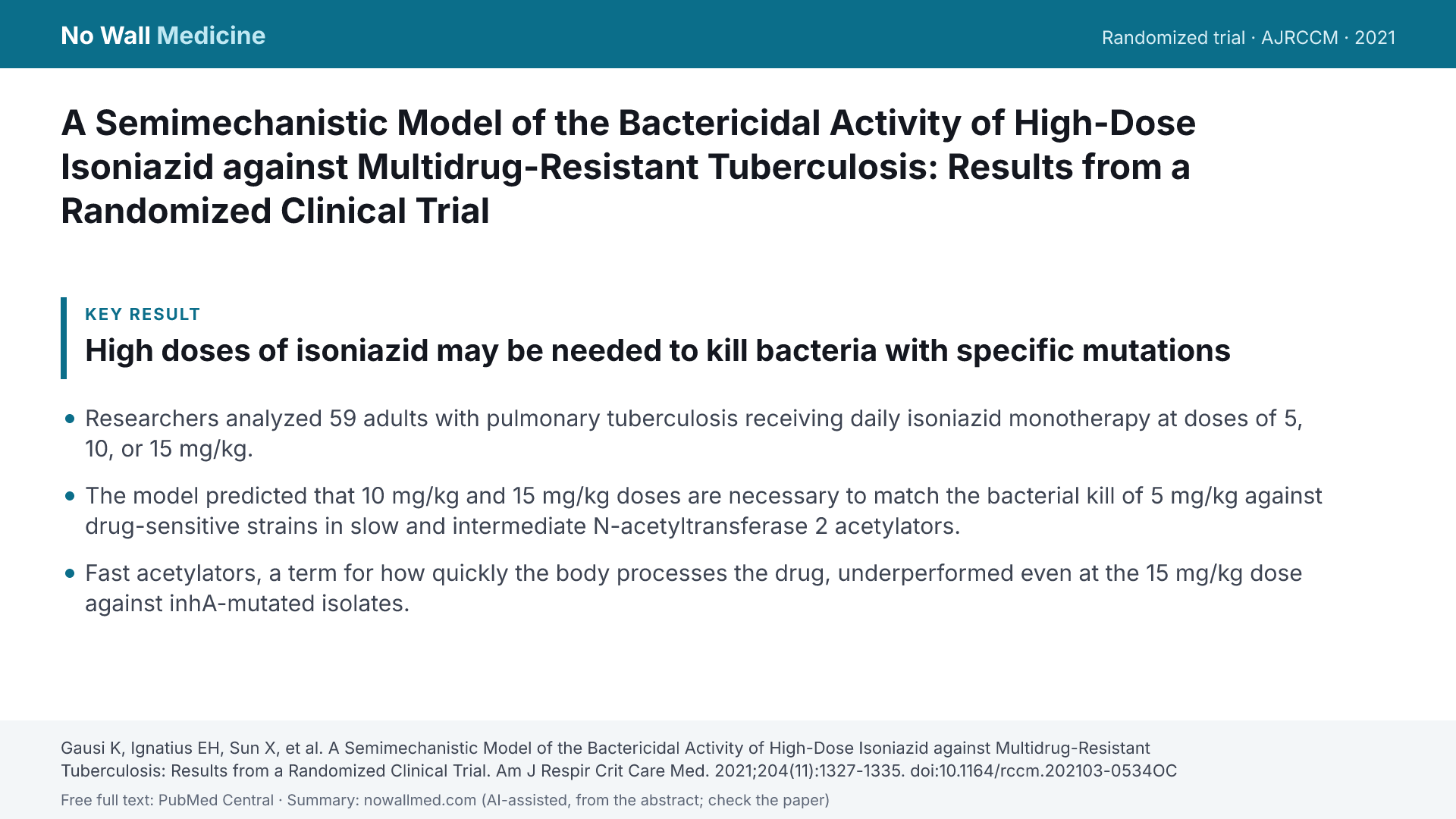
High doses of isoniazid may be needed to kill bacteria with specific mutations
A Semimechanistic Model of the Bactericidal Activity of High-Dose Isoniazid against Multidrug-Resistant Tuberculosis: Results from a Randomized Clinical Trial
Same trial (NCT01936831)
Papers we list that report this registered trial, oldest first. Read a secondary analysis alongside the main results.
- Main results
This paper AJRCCM 2021-08 - Related analysis No clear difference
High-dose isoniazid showed little early bacterial killing against tuberculosis with katG mutations AJRCCM 2024-04
Key points
- Researchers analyzed 59 adults with pulmonary tuberculosis receiving daily isoniazid monotherapy at doses of 5, 10, or 15 mg/kg.
- The model predicted that 10 mg/kg and 15 mg/kg doses are necessary to match the bacterial kill of 5 mg/kg against drug-sensitive strains in slow and intermediate N-acetyltransferase 2 acetylators.
- Fast acetylators, a term for how quickly the body processes the drug, underperformed even at the 15 mg/kg dose against inhA-mutated isolates.
Headline and key points written with AI from the paper’s abstract, with every number checked against it. Read the paper before relying on them.
Was this summary helpful?
Subject terms
Headline, design, result, key points, caveat and citation as plain text.
Cite this article
Gausi K, Ignatius EH, Sun X, et al. A Semimechanistic Model of the Bactericidal Activity of High-Dose Isoniazid against Multidrug-Resistant Tuberculosis: Results from a Randomized Clinical Trial. Am J Respir Crit Care Med. 2021;204(11):1327-1335. doi:10.1164/rccm.202103-0534OC
Spotted a mistake? Suggest a correction