Longer time between semen collection and intrauterine insemination was associated with higher pregnancy rates
A short versus a long time interval between semen collection and intrauterine insemination: a randomized controlled clinical trial
Non-blinded, single-center randomized controlled trialBenefit found
Does a short versus long interval between semen collection and intrauterine insemination increase cumulative ongoing pregnancy?
Who
297
Couples with unexplained or mild male subfertility undergoing intrauterine insemination · Academic hospital-based IVF center in the Netherlands
Compared
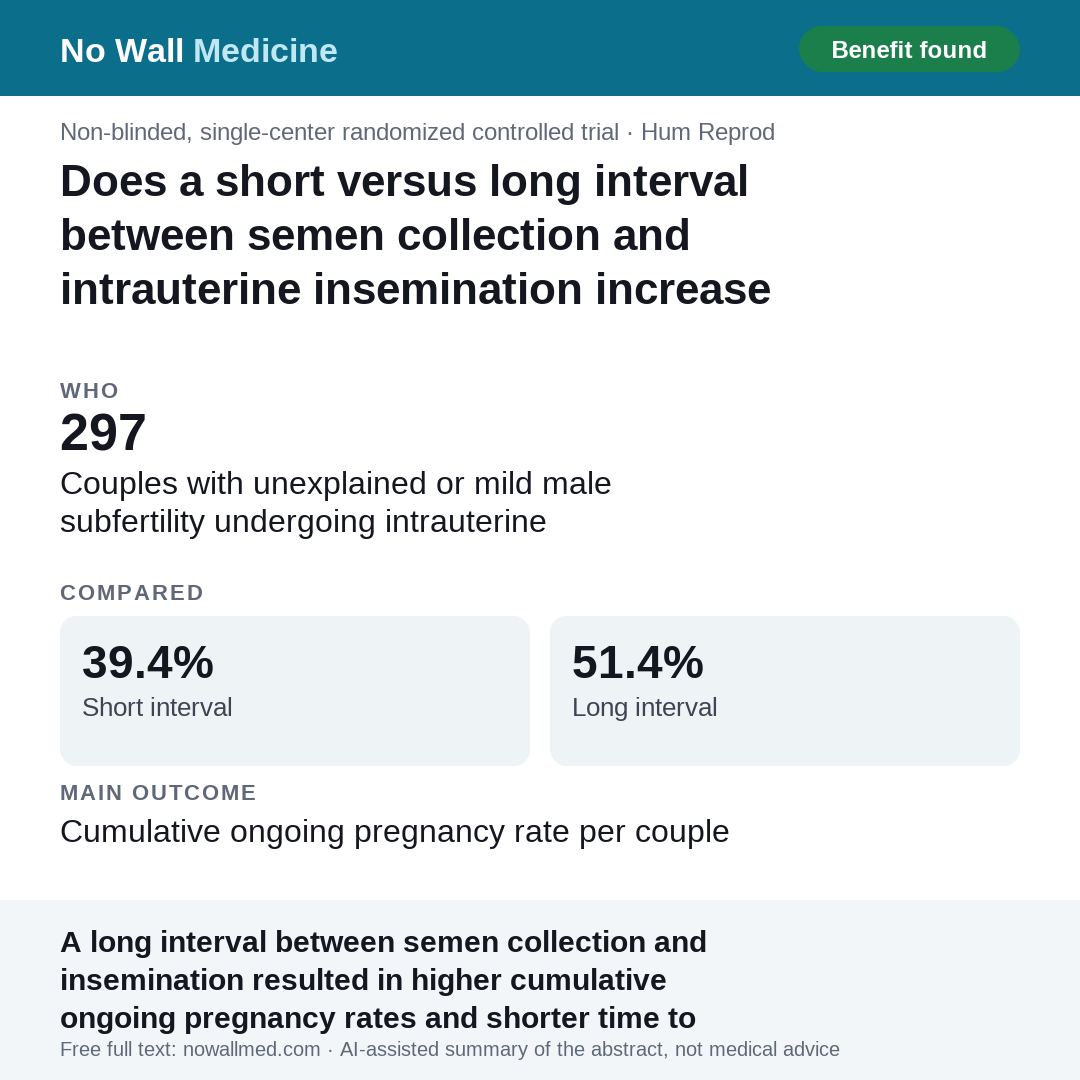
39.4%Short interval (56/142)
51.4%Long interval (71/138)
Main outcome
Cumulative ongoing pregnancy rate per couple
Result: relative risks 0.77 (95% CI 0.59-0.99)
Bottom line: A long interval between semen collection and insemination resulted in higher cumulative ongoing pregnancy rates and shorter time to pregnancy.
Limitation: Non-blinded design and a large number of protocol violations, predominantly in the short interval group.
Hum Reprod · 2023-03-10Download image
Clinical question: Does a short versus long interval between semen collection and intrauterine insemination increase cumulative ongoing pregnancy?
Why it matters: Retrospective studies have shown inconclusive results regarding whether a short or long interval between semen collection and intrauterine insemination affects pregnancy outcomes.
Key points
- Researchers studied 297 couples with unexplained or mild male subfertility undergoing up to six cycles of intrauterine insemination, which is a procedure where sperm is placed directly into the uterus.
- In the intention-to-treat analysis, the cumulative ongoing pregnancy rate was 51.4% for the long interval group compared to 39.4% for the short interval group.
- The long interval group, defined as 180 minutes or more after collection, also had a significantly shorter time to pregnancy.
Limitation the authors note: The authors noted the non-blinded design, a long inclusion and follow-up period, and a large number of protocol violations.
Headline and key points written with AI from the paper’s abstract, with every number checked against it. Read the paper before relying on them.
Topics
Cite this article
Statema-Lohmeijer CH, Schats R, Lissenberg-Witte BI, Kostelijk EH, Lambalk CB, Vergouw CG. A short versus a long time interval between semen collection and intrauterine insemination: a randomized controlled clinical trial. Hum Reprod. 2023. doi:10.1093/humrep/dead044
Spotted a mistake? Suggest a correction
Top studies every Monday
The week’s key trials and guidelines in your specialties, plus any topics you follow. By email, free.
Get the weekly digest