Pancreatic duct size and texture classification predicts risk of postoperative pancreatic fistula
A Simple Classification of Pancreatic Duct Size and Texture Predicts Postoperative Pancreatic Fistula: A classification of the International Study Group of Pancreatic Surgery
Meta-analysis and cohort studyBenefit found
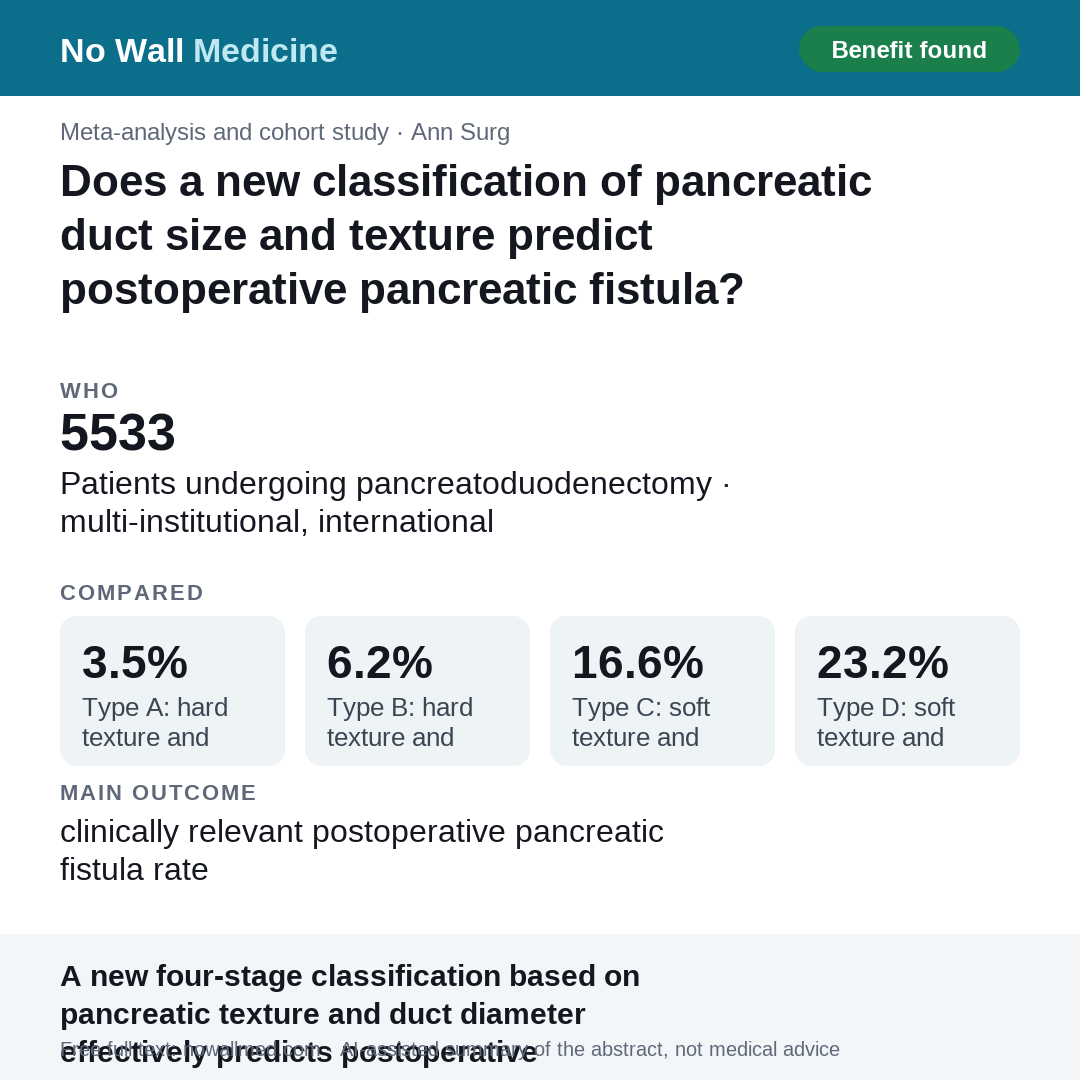
Does a new classification of pancreatic duct size and texture predict postoperative pancreatic fistula?
Who
5533
Patients undergoing pancreatoduodenectomy · multi-institutional, international
Compared
3.5%Type A: hard texture and duct >3 mm
6.2%Type B: hard texture and duct ≤3 mm
16.6%Type C: soft texture and duct >3 mm
23.2%Type D: soft texture and duct ≤3 mm
Main outcome
clinically relevant postoperative pancreatic fistula rate
Result: OR 4.24 (95% CI 3.67-4.89) for soft texture; OR 3.66 (95% CI 2.62-5.12) for duct ≤3 mm
Bottom line: A new four-stage classification based on pancreatic texture and duct diameter effectively predicts postoperative pancreatic fistula risk.
Ann Surg · 2021-03-12Download image
Clinical question: Does a new classification of pancreatic duct size and texture predict postoperative pancreatic fistula?
Why it matters: A standardized surgical reporting system for pancreas-associated risk factors after pancreatoduodenectomy is currently lacking.
Key points
- Researchers performed a meta-analysis of 108 studies to evaluate how pancreatic texture and main pancreatic duct diameter relate to clinically relevant postoperative pancreatic fistula.
- Soft pancreatic texture was associated with an odds ratio of 4.24 for clinically relevant postoperative pancreatic fistula, while a duct diameter of 3 mm or less had an odds ratio of 3.66.
- In an independent cohort of 5533 patients, the proposed classification showed clinically relevant postoperative pancreatic fistula rates of 3.5%, 6.2%, 16.6%, and 23.2% for types A, B, C, and D.
Headline and key points written with AI from the paper’s abstract, with every number checked against it. Read the paper before relying on them.
Was this summary helpful?
Subject terms
Cite this article
Schuh F, Mihaljevic AL, Probst P, Trudeau MT, Müller PC, Marchegiani G. A Simple Classification of Pancreatic Duct Size and Texture Predicts Postoperative Pancreatic Fistula: A classification of the International Study Group of Pancreatic Surgery. Ann Surg. 2021. doi:10.1097/SLA.0000000000004855
Spotted a mistake? Suggest a correction
Top studies every Monday
The week’s key trials and guidelines in your specialties, plus any topics you follow. By email, free.
Get the weekly digest