Electronic medical record alerts for medical assistants increased chlamydia screening in primary care practices
A Staff-Directed Electronic Medical Record Alert to Increase Chlamydia Screening: A Randomized Clinical Trial
Cluster randomized clinical trialBenefit found
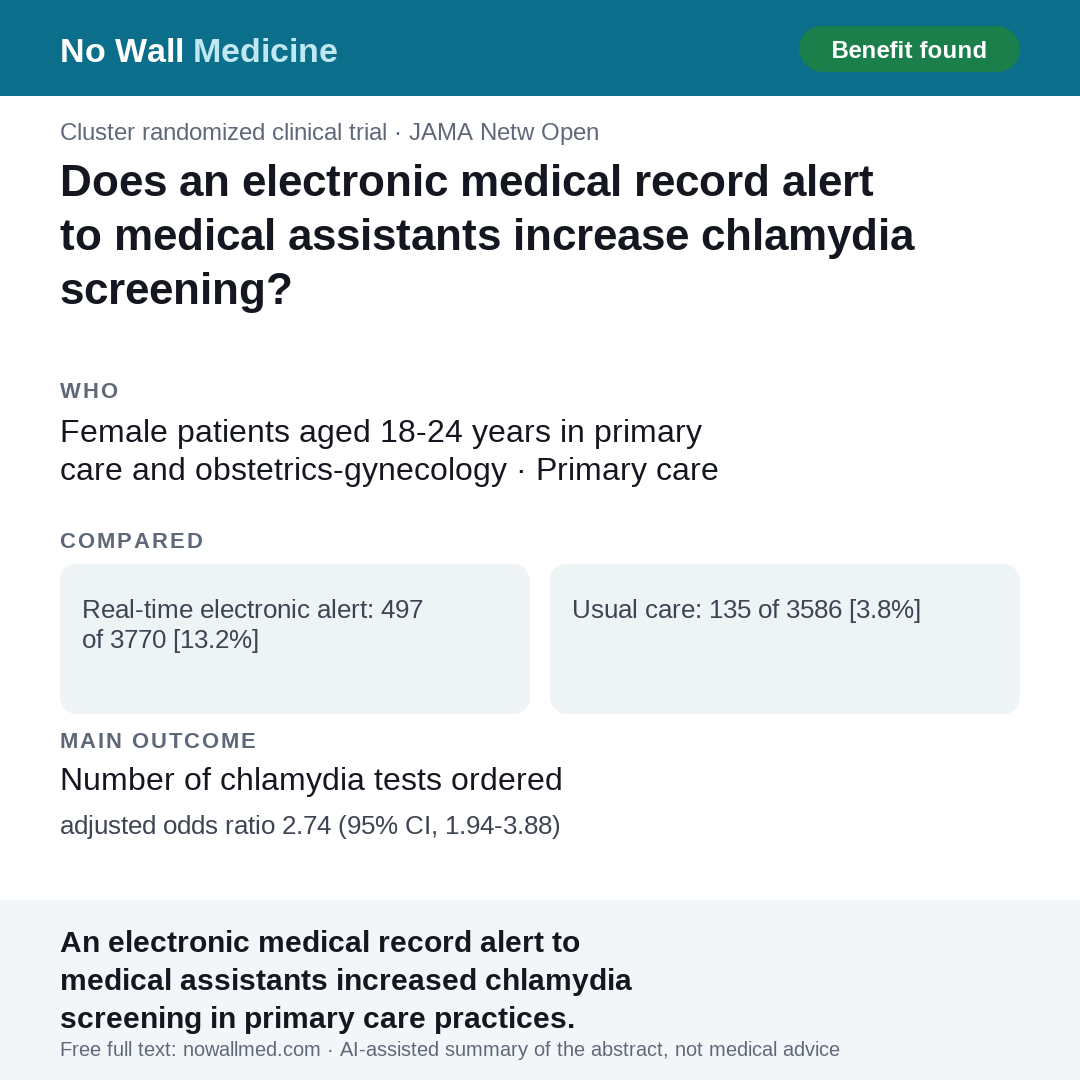
Does an electronic medical record alert to medical assistants increase chlamydia screening?
Who
Female patients aged 18-24 years in primary care and obstetrics-gynecology · Primary care and obstetrics-gynecology offices in western Pennsylvania
Compared
Real-time electronic alert: 497 of 3770 [13.2%]
Usual care: 135 of 3586 [3.8%]
Main outcome
Number of chlamydia tests ordered
Result: adjusted odds ratio 2.74 (95% CI, 1.94-3.88)
Bottom line: An electronic medical record alert to medical assistants increased chlamydia screening in primary care practices.
Limitation: The alert did not affect screening in obstetrics-gynecology practices.
JAMA Netw Open · 2026-05-01Download image
Clinical question: Does an electronic medical record alert to medical assistants increase chlamydia screening?
Why it matters: Screening for chlamydia in sexually active females aged 24 years or younger remains suboptimal despite recommendations to prevent pelvic inflammatory disease.
Key points
- Researchers studied 7,356 primary care encounters and 10,672 obstetrics-gynecology encounters for women aged 18 to 24 years.
- In primary care, chlamydia tests were ordered in 13.2% of alert group encounters compared to 3.8% in the control group.
- The electronic alert increased the odds of testing in primary care but did not affect screening in obstetrics-gynecology practices.
Headline and key points written with AI from the paper’s abstract, with every number checked against it. Read the paper before relying on them.
Topics
Cite this article
Wiesenfeld HC, Hong J, Xu T, Cuffe KM, Bernstein KT, Gift TL. A Staff-Directed Electronic Medical Record Alert to Increase Chlamydia Screening: A Randomized Clinical Trial. JAMA Netw Open. 2026. doi:10.1001/jamanetworkopen.2026.15360
Spotted a mistake? Suggest a correction