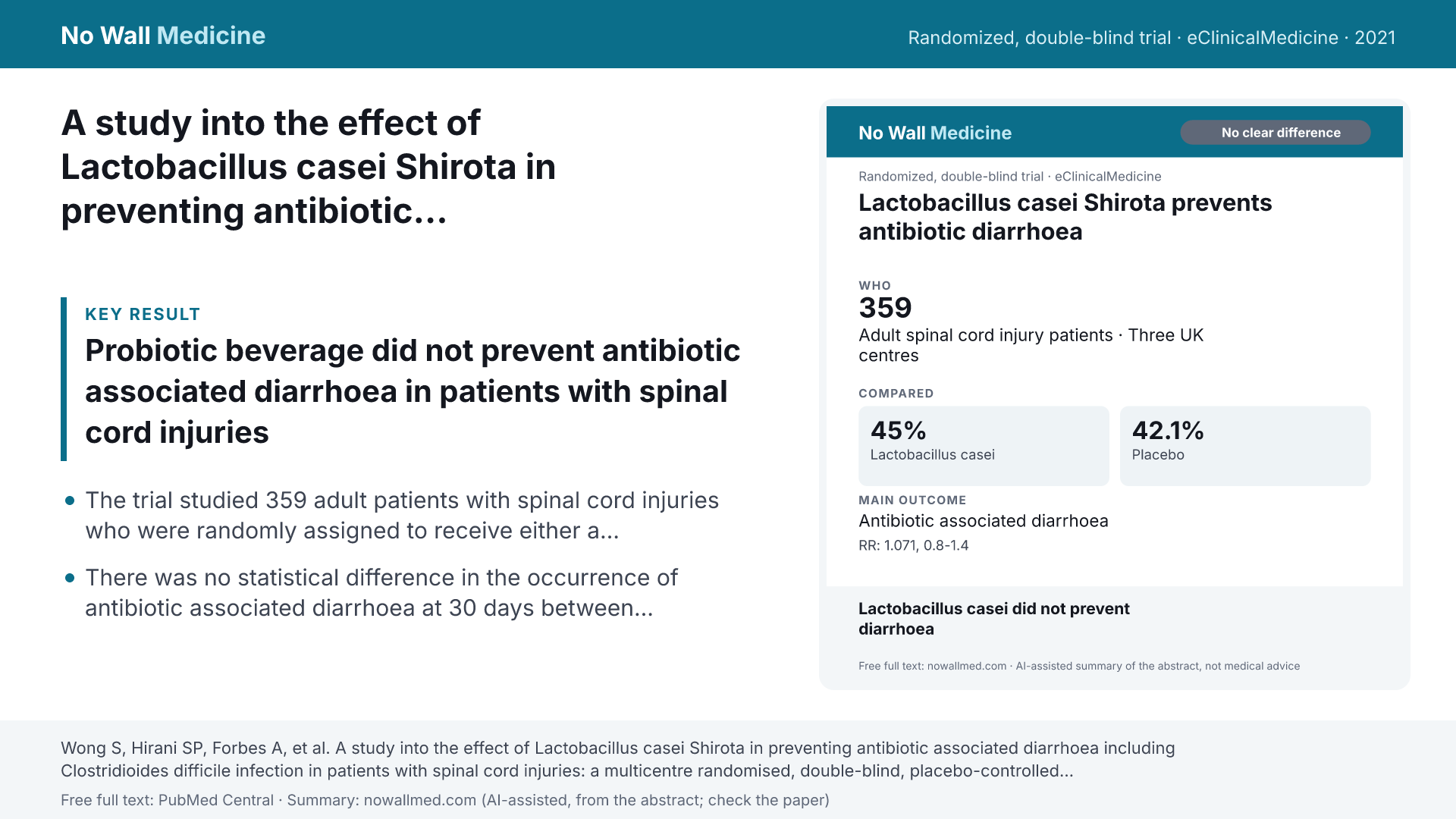
Probiotic beverage did not prevent antibiotic associated diarrhoea in patients with spinal cord injuries
A study into the effect of Lactobacillus casei Shirota in preventing antibiotic associated diarrhoea including Clostridioides difficile infection in patients with spinal cord injuries: a multicentre randomised, double-blind, placebo-controlled trial
Randomized, double-blind trialNo clear difference
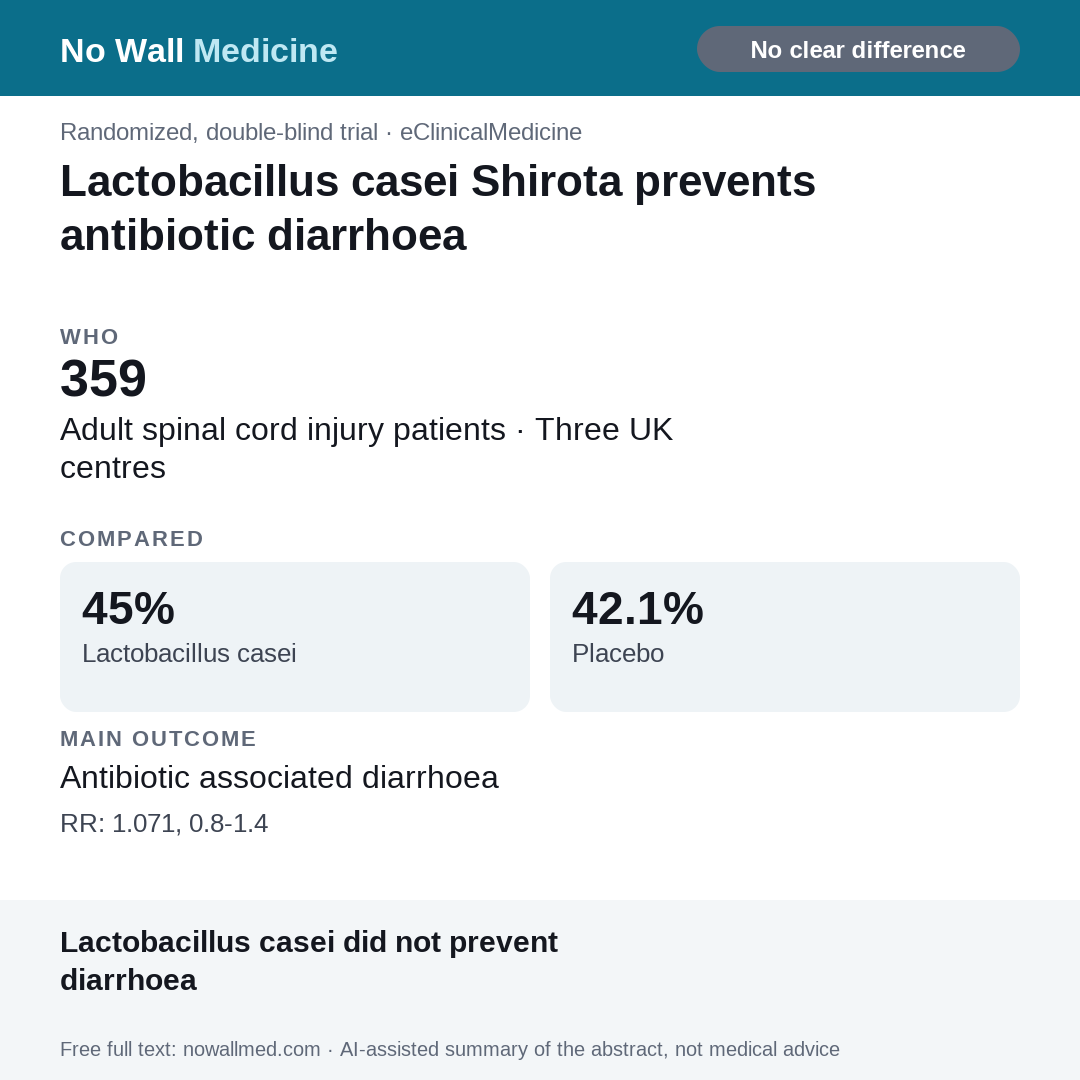
Lactobacillus casei Shirota prevents antibiotic diarrhoea
Who
359
Adult spinal cord injury patients · Three UK centres
Compared
45%Lactobacillus casei
42.1%Placebo
Main outcome
Antibiotic associated diarrhoea
Result: RR: 1.071, 0.8-1.4
Bottom line: Lactobacillus casei did not prevent diarrhoea
Funded by: Yakult Honsha Co.
eClinicalMedicine · 2021-09-11Download image
Key points
- The trial studied 359 adult patients with spinal cord injuries who were randomly assigned to receive either a probiotic beverage or a placebo during and after antibiotic treatment.
- There was no statistical difference in the occurrence of antibiotic associated diarrhoea at 30 days between the probiotic group (42.1%) and the placebo group (45%).
- In patients taking regular proton pump inhibitors, the probiotic was associated with a lower risk of antibiotic associated diarrhoea at 7 days (19% vs 35.7%) and 30 days (28% vs 52.2%).
Headline and key points written with AI from the paper’s abstract, with every number checked against it. Read the paper before relying on them.
Was this summary helpful?
Headline, design, result, key points, caveat and citation as plain text.
Cite this article
Wong S, Hirani SP, Forbes A, et al. A study into the effect of Lactobacillus casei Shirota in preventing antibiotic associated diarrhoea including Clostridioides difficile infection in patients with spinal cord injuries: a multicentre randomised, double-blind, placebo-controlled trial. eClinicalMedicine. 2021. doi:10.1016/j.eclinm.2021.101098
Spotted a mistake? Suggest a correction