Trial protocol describes study of smartphone-activated first responders using ultraportable defibrillators for cardiac arrest
A study protocol for a cluster-randomised controlled trial of smartphone-activated first responders with ultraportable defibrillators in out-of-hospital cardiac arrest: The First Responder Shock Trial (FIRST)
Cluster-randomised controlled trialUnclear result
Does equipping smartphone-activated first responders with ultraportable defibrillators increase 30-day survival?
Who
714
Smartphone-activated first responders and out-of-hospital cardiac arrest patients · Australia and New Zealand
Compared
9%Standard alert procedures
16%Ultraportable AED intervention
Main outcome
30-day survival
Bottom line: This ongoing trial aims to determine if ultraportable defibrillators improve 30-day survival in cardiac arrest.
Resusc Plus · 2023-09-06Download image
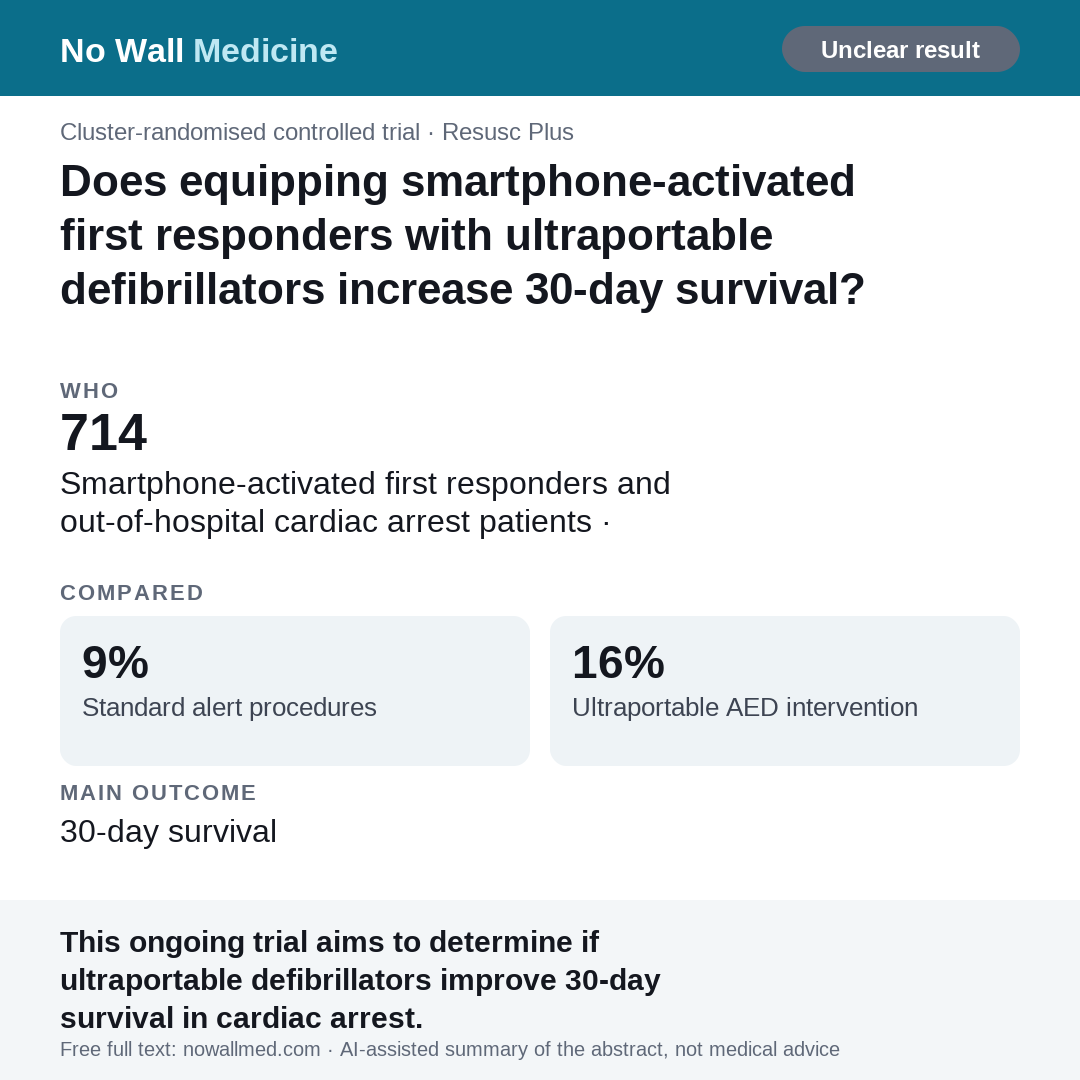
Clinical question: Does equipping smartphone-activated first responders with ultraportable defibrillators increase 30-day survival?
Why it matters: It is unknown whether equipping frequently responding, smartphone-activated first responders with an ultraportable automated external defibrillator increases 30-day survival rates after out-of-hospital cardiac arrest.
Key points
- The FIRST trial is a cluster-randomized controlled trial in Australia and New Zealand comparing standard alert procedures to providing high-frequency smartphone-activated responders with an ultraportable, single-use automated external defibrillator (AED).
- Researchers aim to detect if the intervention increases 30-day survival from 9% in the control group to 16% in the intervention group.
- The study requires a sample size of 714 patients, with 357 per arm, to detect this difference with 80% power.
Headline and key points written with AI from the paper’s abstract, with every number checked against it. Read the paper before relying on them.
Was this summary helpful?
Cite this article
Todd V, Dicker B, Okyere D, Smith K, Smith T, Howie G. A study protocol for a cluster-randomised controlled trial of smartphone-activated first responders with ultraportable defibrillators in out-of-hospital cardiac arrest: The First Responder Shock Trial (FIRST). Resusc Plus. 2023. doi:10.1016/j.resplu.2023.100466
Spotted a mistake? Suggest a correction
Top studies every Monday
The week’s key trials and guidelines in your specialties, plus any topics you follow. By email, free.
Get the weekly digest