Using additional treatments alongside minimally invasive urethral stricture procedures was associated with lower recurrence rates
A Systematic Review and Meta-analysis of Adjuncts to Minimally Invasive Treatment of Urethral Stricture in Men
Systematic review and meta-analysisBenefit found
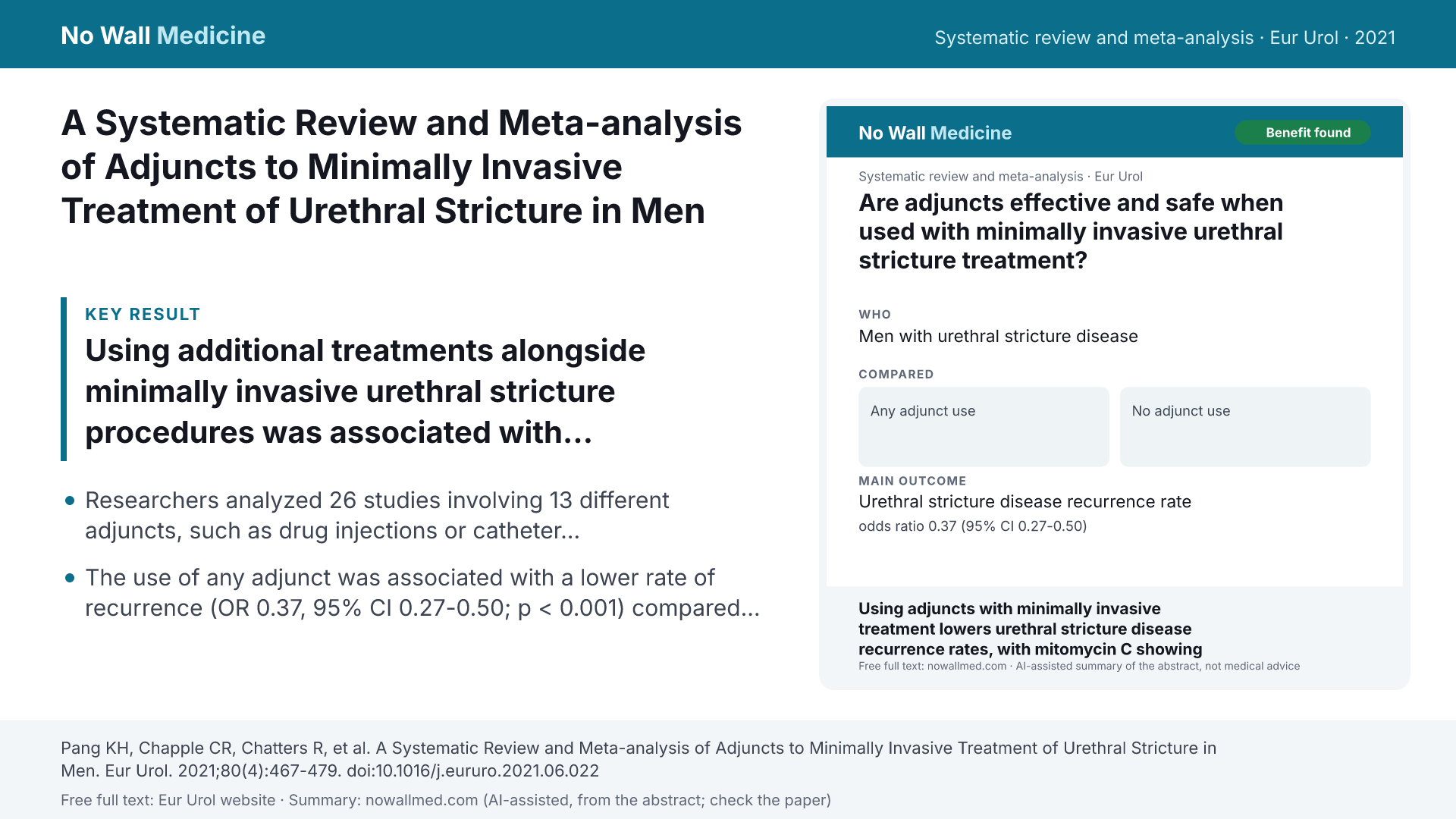
Are adjuncts effective and safe when used with minimally invasive urethral stricture treatment?
Who
Men with urethral stricture disease
Compared
Any adjunct use
No adjunct use
Main outcome
Urethral stricture disease recurrence rate
Result: odds ratio 0.37 (95% CI 0.27-0.50)
Bottom line: Using adjuncts with minimally invasive treatment lowers urethral stricture disease recurrence rates, with mitomycin C showing high efficacy.
Limitation: The included studies were at high risk of bias and were small and of low quality.
Eur Urol · 2021-07-16 · Save PNG

Clinical question: Are adjuncts effective and safe when used with minimally invasive urethral stricture treatment?
Why it matters: Minimally invasive techniques for treating the narrowing of the urethra are associated with high recurrence rates, and it is unclear which additional treatments are effective.
Key points
- Researchers analyzed 26 studies involving 13 different adjuncts, such as drug injections or catheter applications, used during minimally invasive treatment for urethral stricture disease in men.
- The use of any adjunct was associated with a lower rate of recurrence (OR 0.37, 95% CI 0.27-0.50; p < 0.001) compared to using no adjunct.
- Mitomycin C was associated with the lowest recurrence rates when used as an intralesional injection (OR 0.23, 95% CI 0.11-0.48; p < 0.001) or intraluminal instillation (OR 0.11, 95% CI 0.02-0.61; p = 0.01).
Limitation the authors note: The studies included in this review were at high risk of bias.
Headline and key points written with AI from the paper’s abstract, with every number checked against it. Read the paper before relying on them.
Was this summary helpful?
Subject terms
Headline, design, result, key points, caveat and citation as plain text.
Cite this article
Pang KH, Chapple CR, Chatters R, et al. A Systematic Review and Meta-analysis of Adjuncts to Minimally Invasive Treatment of Urethral Stricture in Men. Eur Urol. 2021;80(4):467-479. doi:10.1016/j.eururo.2021.06.022
Spotted a mistake? Suggest a correction