A systematic review and meta-analysis of microsurgery and radiosurgery outcomes in low-grade cerebral arteriovenous malformations: Obliteration rates, morbidity, and mortality
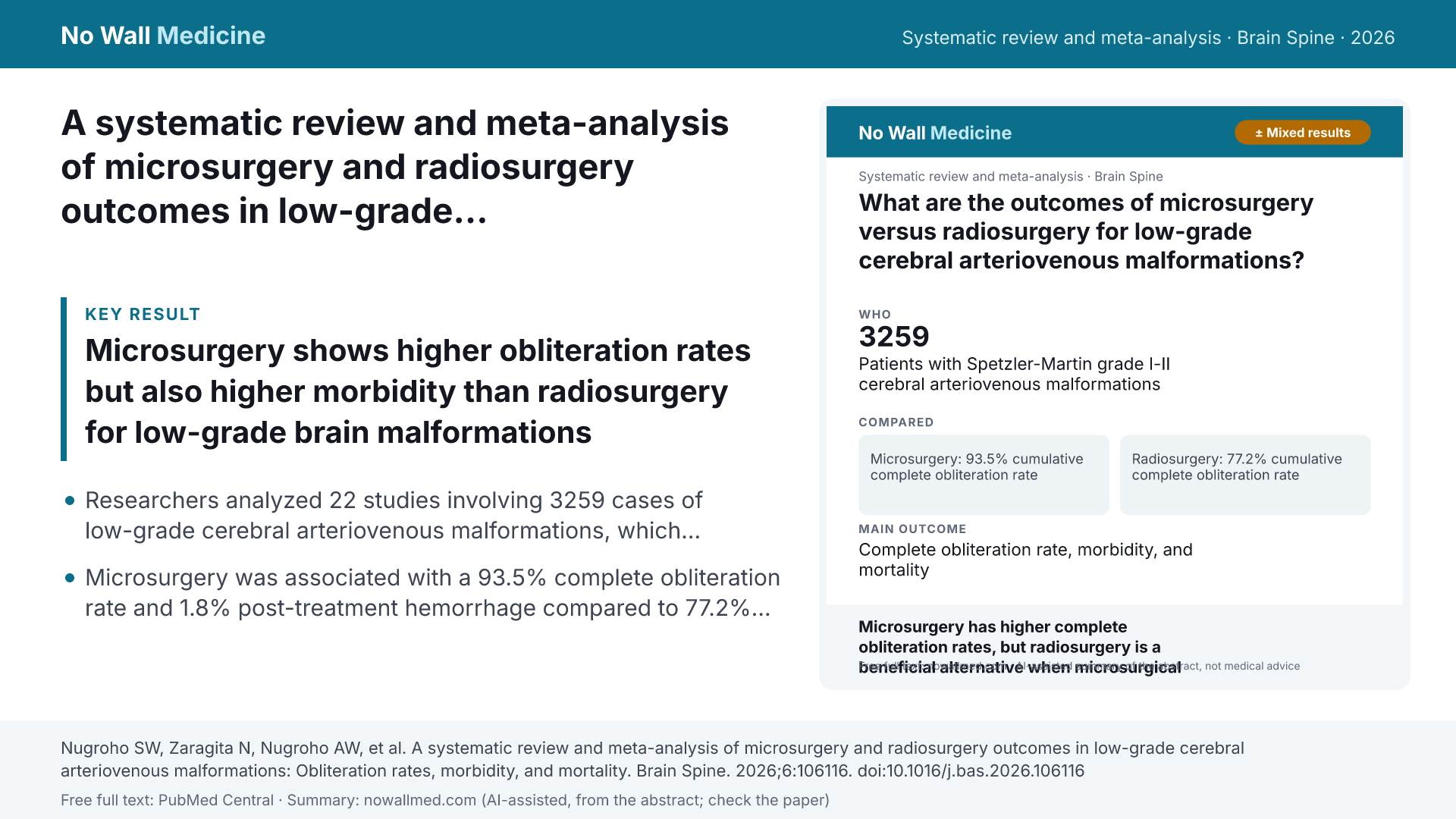
Key result: Microsurgery shows higher obliteration rates but also higher morbidity than radiosurgery for low-grade brain malformations

Key points
- Researchers analyzed 22 studies involving 3259 cases of low-grade cerebral arteriovenous malformations, which are abnormal tangles of blood vessels in the brain.
- Microsurgery was associated with a 93.5% complete obliteration rate and 1.8% post-treatment hemorrhage compared to 77.2% and 6.6% for radiosurgery.
- A meta-analysis of five studies showed microsurgery had a higher risk ratio for complete obliteration of 1.62 and a higher risk ratio for morbidity of 10.26.
Why it matters: Existing comparative evidence for treating low-grade cerebral arteriovenous malformations is mostly from non-randomized studies, limiting direct comparisons between microsurgery and radiosurgery.
Limitation the authors note: The findings are based on retrospective, non-randomized evidence and may be affected by treatment-selection bias.
Discussion prompts
- Would these patients look like yours? Who was left out?
- Is the main outcome one that matters to patients?
- Is the difference large enough to change what you do?
Cite: Nugroho SW, Zaragita N, Nugroho AW, et al. A systematic review and meta-analysis of microsurgery and radiosurgery outcomes in low-grade cerebral arteriovenous malformations: Obliteration rates, morbidity, and mortality. Brain Spine. 2026;6:106116. doi:10.1016/j.bas.2026.106116
Free full text: PubMed Central · Summary and visual abstract: nowallmed.com/a/a-systematic-review-and-meta-analysis-of-microsurgery-and-1xotp4s/ (AI-assisted from the abstract; check the paper before relying on it).