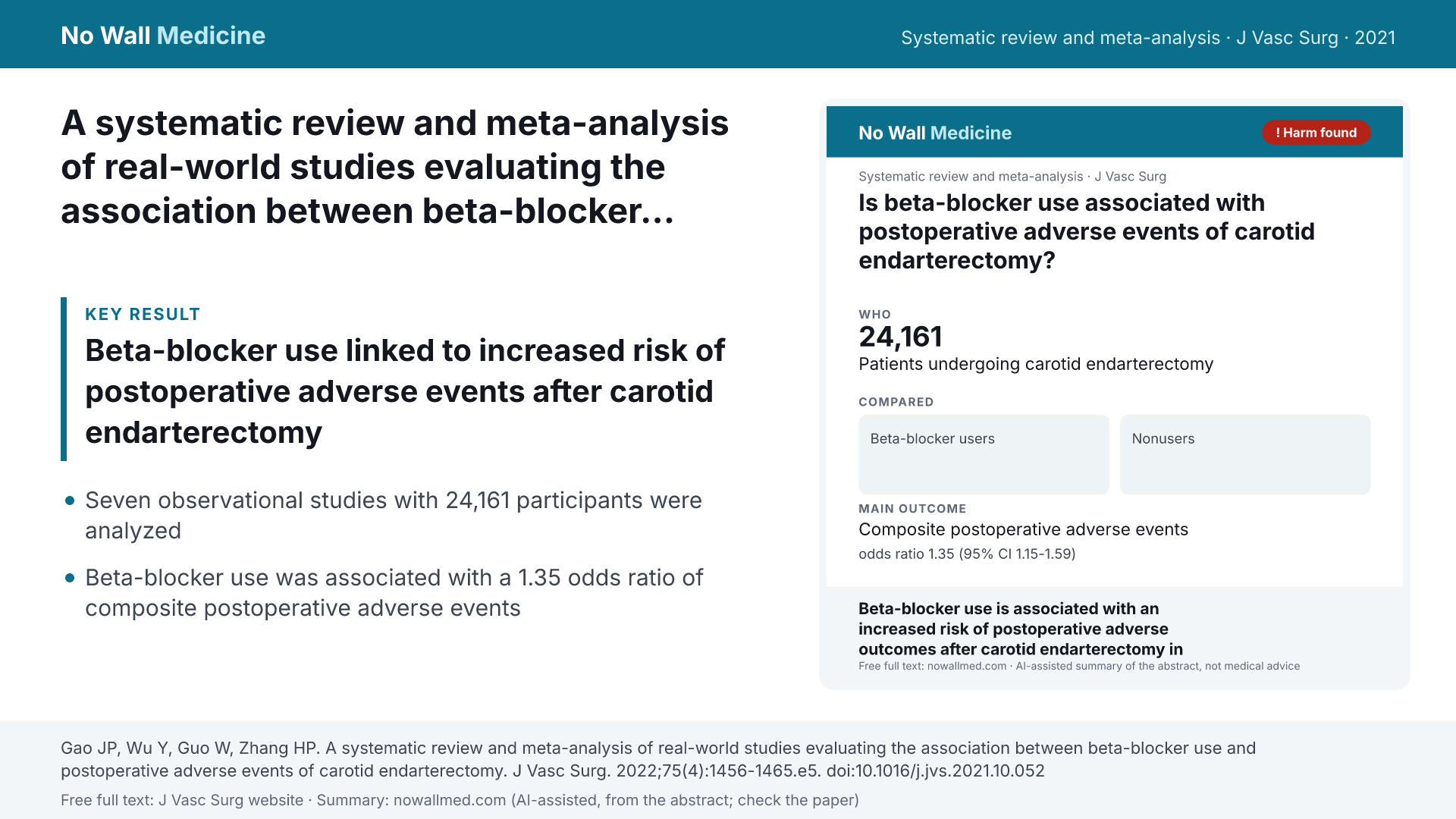
A systematic review and meta-analysis of real-world studies evaluating the association between beta-blocker use and postoperative adverse events of carotid endarterectomy
Key result: Beta-blocker use linked to increased risk of postoperative adverse events after carotid endarterectomy
Systematic review and meta-analysisHarm found
Is beta-blocker use associated with postoperative adverse events of carotid endarterectomy?
Who
24,161
Patients undergoing carotid endarterectomy
Compared
Beta-blocker users
Nonusers
Main outcome
Composite postoperative adverse events
Result: odds ratio 1.35 (95% CI 1.15-1.59)
Bottom line: Beta-blocker use is associated with an increased risk of postoperative adverse outcomes after carotid endarterectomy in real-world data.
Limitation: Included studies were observational, including case-control and cohort studies.
J Vasc Surg · 2021-11-14
Key points
- Seven observational studies with 24,161 participants were analyzed.
- Beta-blocker use was associated with a 1.35 odds ratio of composite postoperative adverse events.
- Beta-blocker use was also linked to increased risk of intraoperative cerebral ischemia and postoperative myocardial infarction.
Limitation the authors note: The study was based on observational data, not randomized controlled trials
Discussion prompts
- Would these patients look like yours? Who was left out?
- Is the main outcome one that matters to patients?
- Is the difference large enough to change what you do?
Cite: Gao JP, Wu Y, Guo W, Zhang HP. A systematic review and meta-analysis of real-world studies evaluating the association between beta-blocker use and postoperative adverse events of carotid endarterectomy. J Vasc Surg. 2022;75(4):1456-1465.e5. doi:10.1016/j.jvs.2021.10.052
Free full text: J Vasc Surg website · Summary and visual abstract: nowallmed.com/a/a-systematic-review-and-meta-analysis-of-real-world-studies-27bo93/ (AI-assisted from the abstract; check the paper before relying on it).