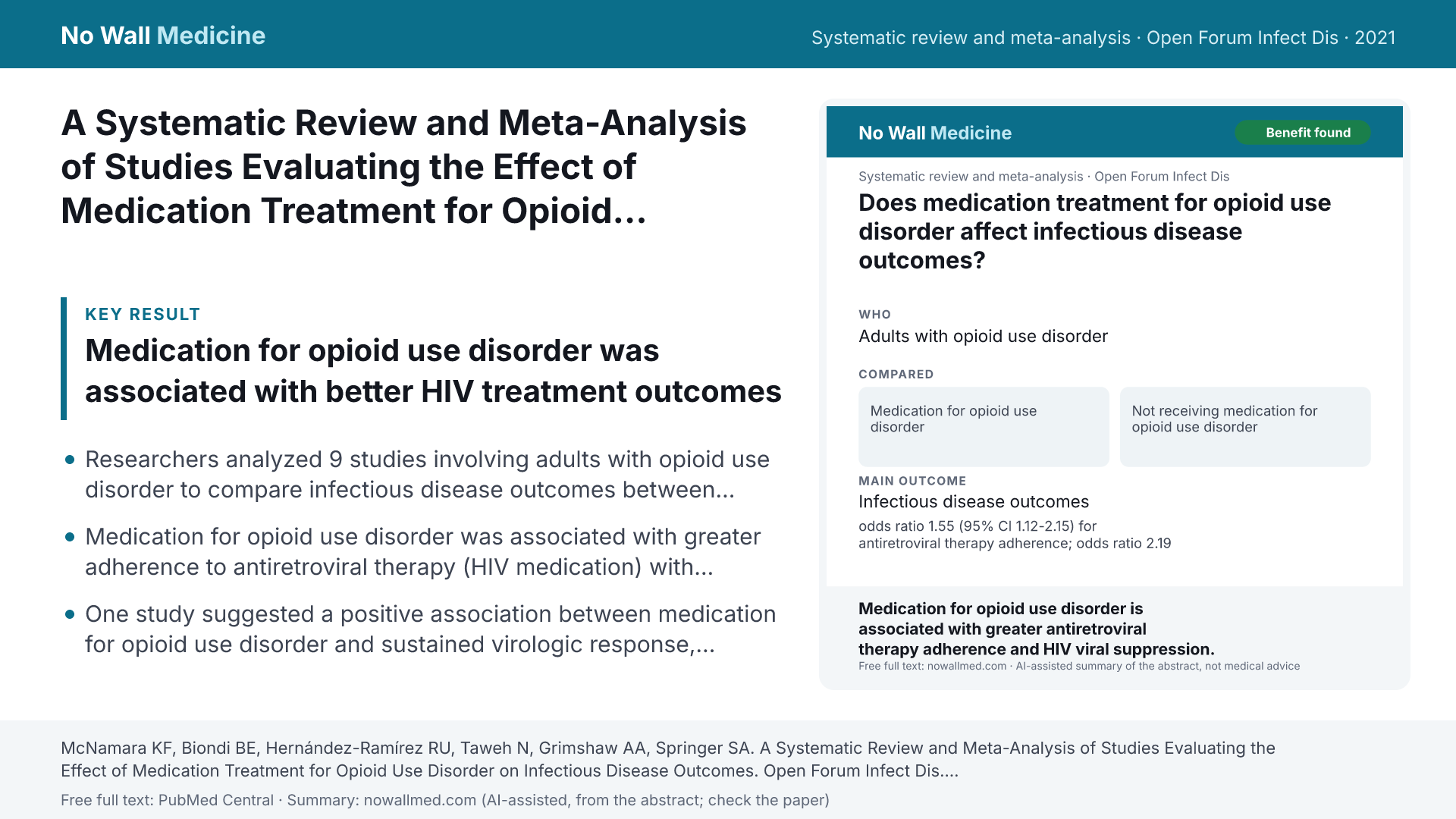
Medication for opioid use disorder was associated with better HIV treatment outcomes
A Systematic Review and Meta-Analysis of Studies Evaluating the Effect of Medication Treatment for Opioid Use Disorder on Infectious Disease Outcomes
Systematic review and meta-analysisBenefit found
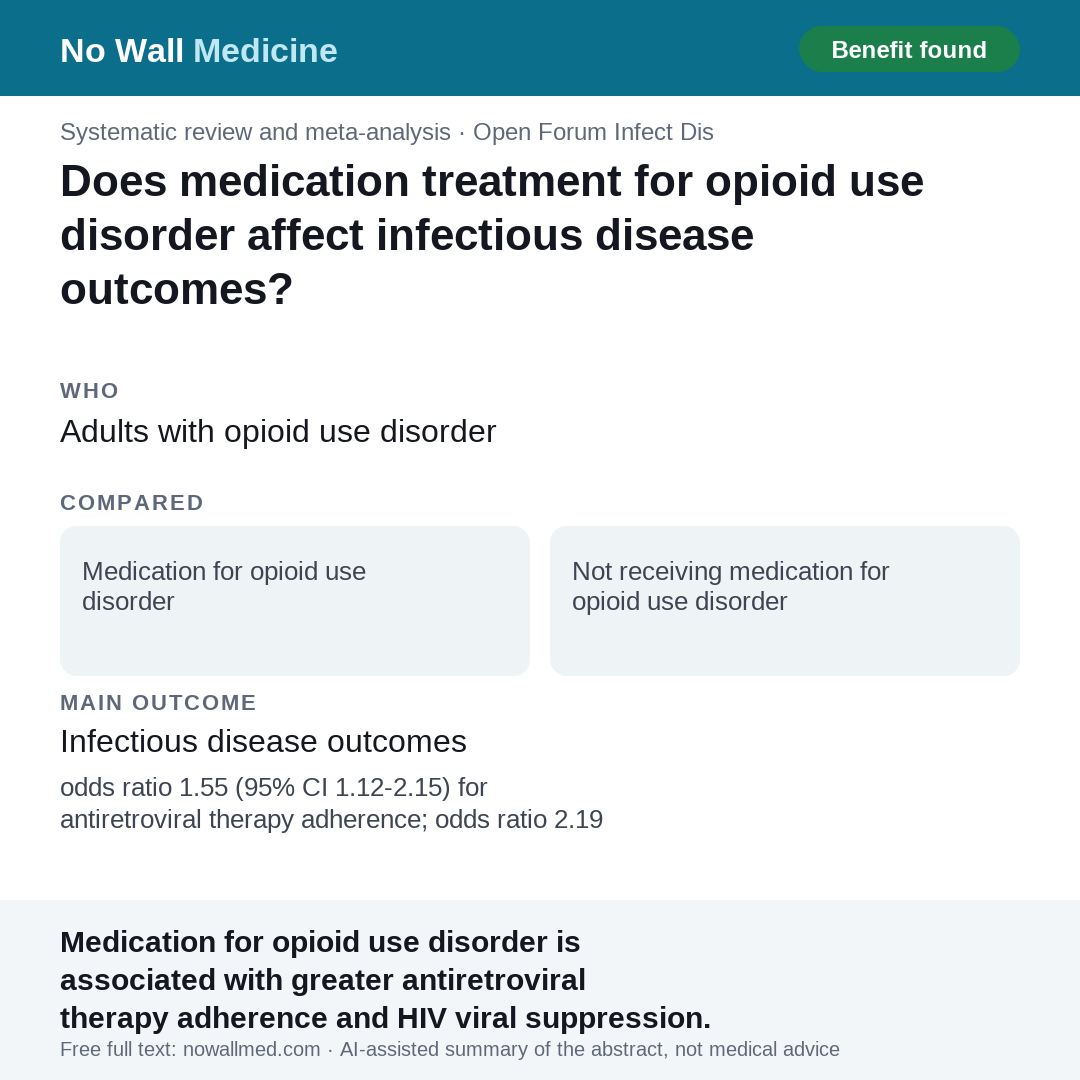
Does medication treatment for opioid use disorder affect infectious disease outcomes?
Who
Adults with opioid use disorder
Compared
Medication for opioid use disorder
Not receiving medication for opioid use disorder
Main outcome
Infectious disease outcomes
Result: odds ratio 1.55 (95% CI 1.12-2.15) for antiretroviral therapy adherence; odds ratio 2.19 (95% CI 1.88-2.56) for HIV viral suppression
Bottom line: Medication for opioid use disorder is associated with greater antiretroviral therapy adherence and HIV viral suppression.
Open Forum Infect Dis · 2021-06-02Download image
Clinical question: Does medication treatment for opioid use disorder affect infectious disease outcomes?
Why it matters: It was unknown how medications for opioid use disorder impact specific infectious disease outcomes like HIV viral suppression and hepatitis C virus treatment success.
Key points
- Researchers analyzed 9 studies involving adults with opioid use disorder to compare infectious disease outcomes between those receiving medication and those not receiving medication.
- Medication for opioid use disorder was associated with greater adherence to antiretroviral therapy (HIV medication) with an odds ratio of 1.55 and higher HIV viral suppression with an odds ratio of 2.19.
- One study suggested a positive association between medication for opioid use disorder and sustained virologic response, which is the absence of hepatitis C virus in the blood.
Headline and key points written with AI from the paper’s abstract, with every number checked against it. Read the paper before relying on them.
Was this summary helpful?
Cite this article
McNamara KF, Biondi BE, Hernández-Ramírez RU, Taweh N, Grimshaw AA, Springer SA. A Systematic Review and Meta-Analysis of Studies Evaluating the Effect of Medication Treatment for Opioid Use Disorder on Infectious Disease Outcomes. Open Forum Infect Dis. 2021. doi:10.1093/ofid/ofab289
Spotted a mistake? Suggest a correction
Top studies every Monday
The week’s key trials and guidelines in your specialties, plus any topics you follow. By email, free.
Get the weekly digest