Sub-microscopic malaria infections in India showed a pooled prevalence of 3.63% in meta-analysis
A systematic review and meta-analysis on sub-microscopic Plasmodium infections in India: Different perspectives and global challenges
Systematic review and meta-analysisUnclear result
What is the pooled burden of sub-microscopic Plasmodium infections in India?
Who
17,449
Samples from 39 districts in India · India
Compared
Clinic-based studies
Community-based studies
Main outcome
Pooled prevalence of sub-microscopic Plasmodium infections
Result: 3.63%
Bottom line: The pooled prevalence of sub-microscopic Plasmodium infections in India was 3.63% across 39 districts.
Lancet Reg Health Southeast Asia · 2022-05-28Download image
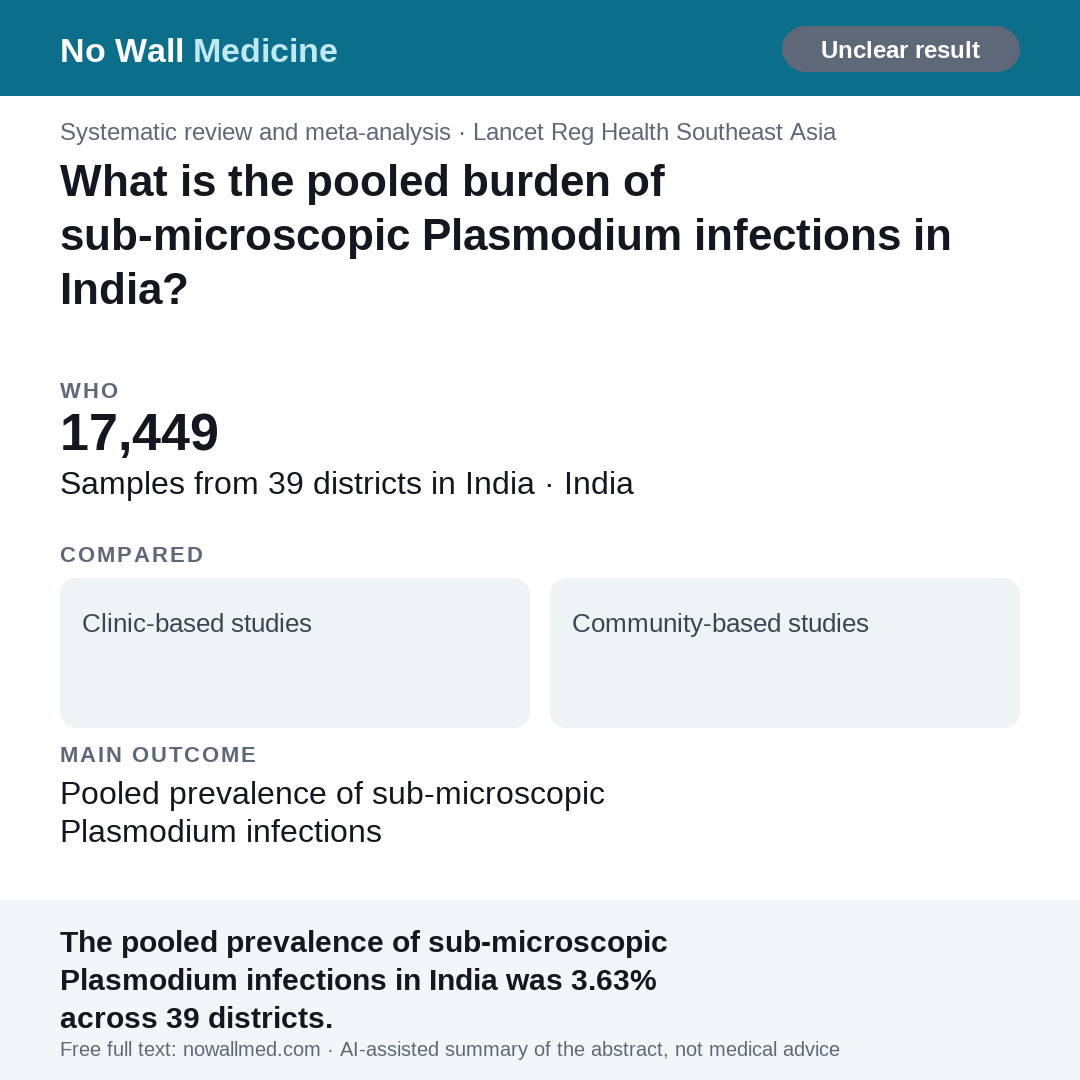
Clinical question: What is the pooled burden of sub-microscopic Plasmodium infections in India?
Why it matters: Parasite levels below the detection limit of microscopy may hinder malaria elimination efforts.
Key points
- Researchers analyzed 17,449 samples from 39 districts in India to compare malaria detection via microscopy and polymerase chain reaction (PCR), a molecular test.
- The pooled prevalence of sub-microscopic infections was 3.63%, with individual study rates ranging from 0.4% to 38.4%.
- Microscopy sensitivity was 91% for single Plasmodium vivax infections and 82% for single Plasmodium falciparum infections, but only 45% for mixed infections.
Headline and key points written with AI from the paper’s abstract, with every number checked against it. Read the paper before relying on them.
Was this summary helpful?
Cite this article
Deora N, Yadav CP, Pande V, Sinha A. A systematic review and meta-analysis on sub-microscopic Plasmodium infections in India: Different perspectives and global challenges. Lancet Reg Health Southeast Asia. 2022. doi:10.1016/j.lansea.2022.05.001
Spotted a mistake? Suggest a correction
Top studies every Monday
The week’s key trials and guidelines in your specialties, plus any topics you follow. By email, free.
Get the weekly digest