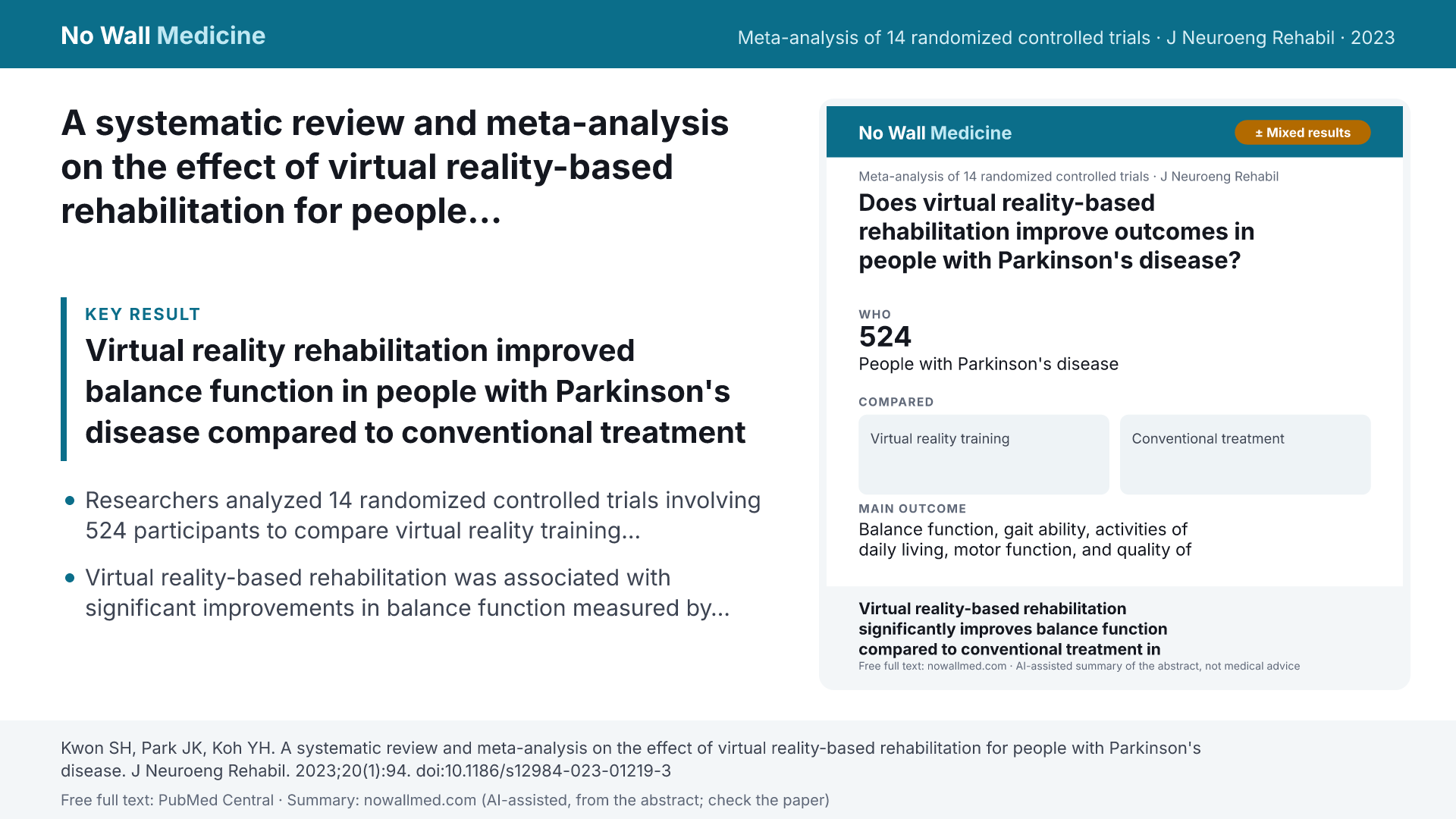
Virtual reality rehabilitation improved balance function in people with Parkinson's disease compared to conventional treatment
A systematic review and meta-analysis on the effect of virtual reality-based rehabilitation for people with Parkinson's disease
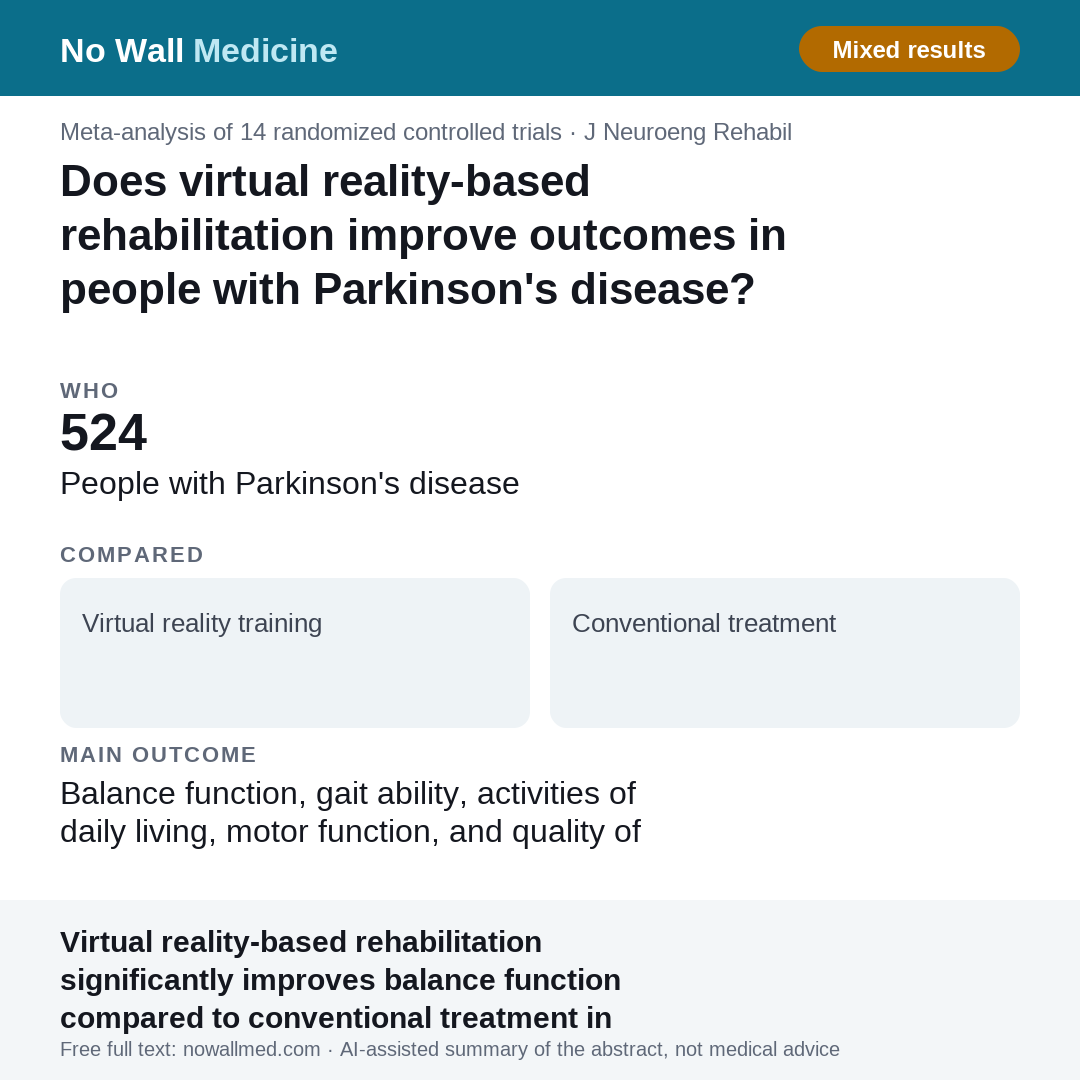
Meta-analysis of 14 randomized controlled trialsMixed results
Does virtual reality-based rehabilitation improve outcomes in people with Parkinson's disease?
Who
524
People with Parkinson's disease
Compared
Virtual reality training
Conventional treatment
Main outcome
Balance function, gait ability, activities of daily living, motor function, and quality of life
Bottom line: Virtual reality-based rehabilitation significantly improves balance function compared to conventional treatment in Parkinson's disease patients.
Limitation: Future research should focus on long-term follow-up studies and developing standardized protocols.
J Neuroeng Rehabil · 2023-07-20Download image
Clinical question: Does virtual reality-based rehabilitation improve outcomes in people with Parkinson's disease?
Key points
- Researchers analyzed 14 randomized controlled trials involving 524 participants to compare virtual reality training with conventional treatment for Parkinson's disease.
- Virtual reality-based rehabilitation was associated with significant improvements in balance function measured by the Berg balance scale and activities-specific balance confidence.
- No statistically significant differences were observed between groups regarding gait ability, motor function, quality of life, or activities of daily living.
Limitation the authors note: The authors noted a need for long-term follow-up studies and the development of standardized protocols.
Headline and key points written with AI from the paper’s abstract, with every number checked against it. Read the paper before relying on them.
Was this summary helpful?
Subject terms
Headline, design, result, key points, caveat and citation as plain text.
Cite this article
Kwon SH, Park JK, Koh YH. A systematic review and meta-analysis on the effect of virtual reality-based rehabilitation for people with Parkinson's disease. J Neuroeng Rehabil. 2023. doi:10.1186/s12984-023-01219-3
Spotted a mistake? Suggest a correction