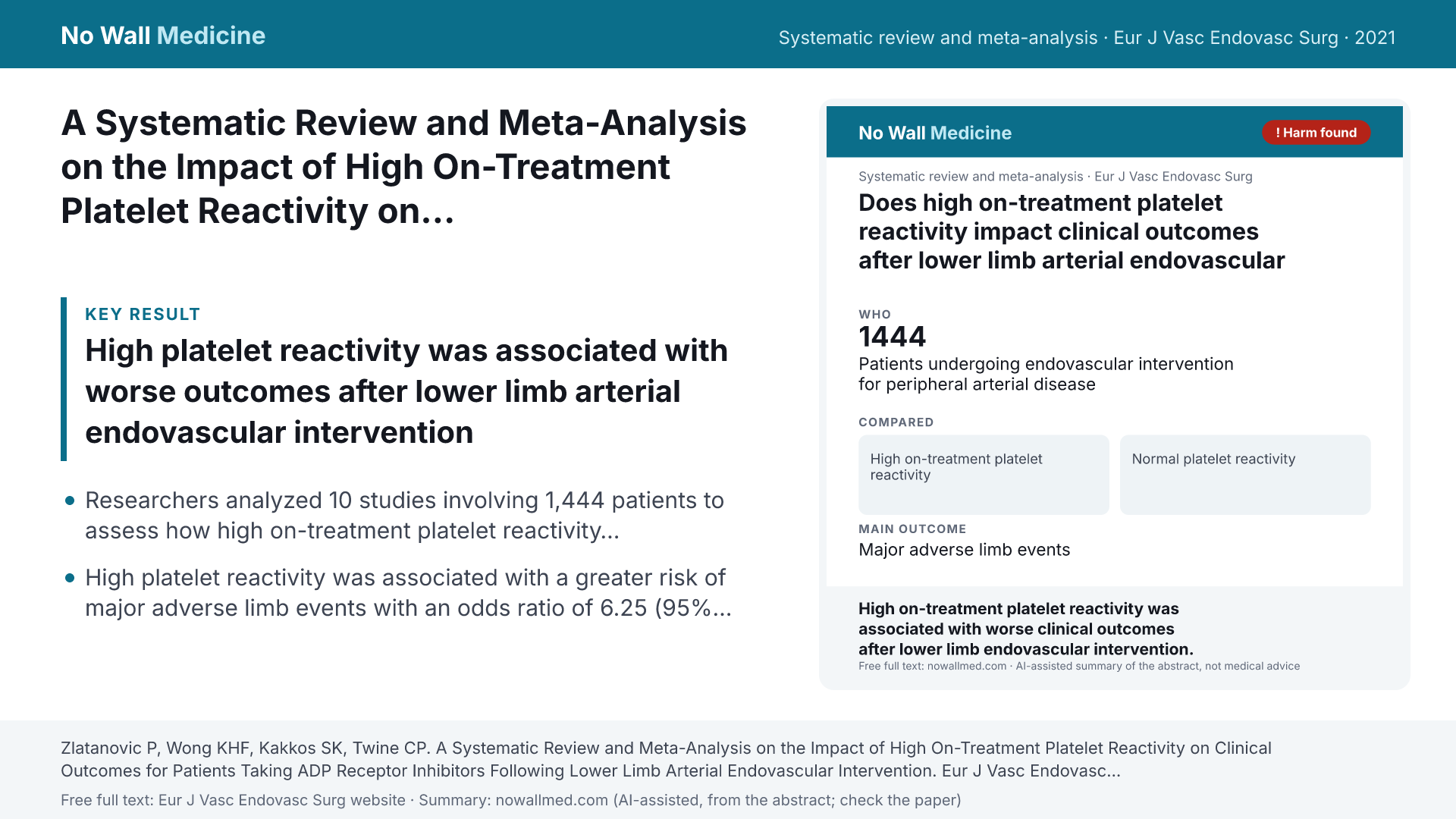
High platelet reactivity was associated with worse outcomes after lower limb arterial endovascular intervention
A Systematic Review and Meta-Analysis on the Impact of High On-Treatment Platelet Reactivity on Clinical Outcomes for Patients Taking ADP Receptor Inhibitors Following Lower Limb Arterial Endovascular Intervention
Systematic review and meta-analysisHarm found
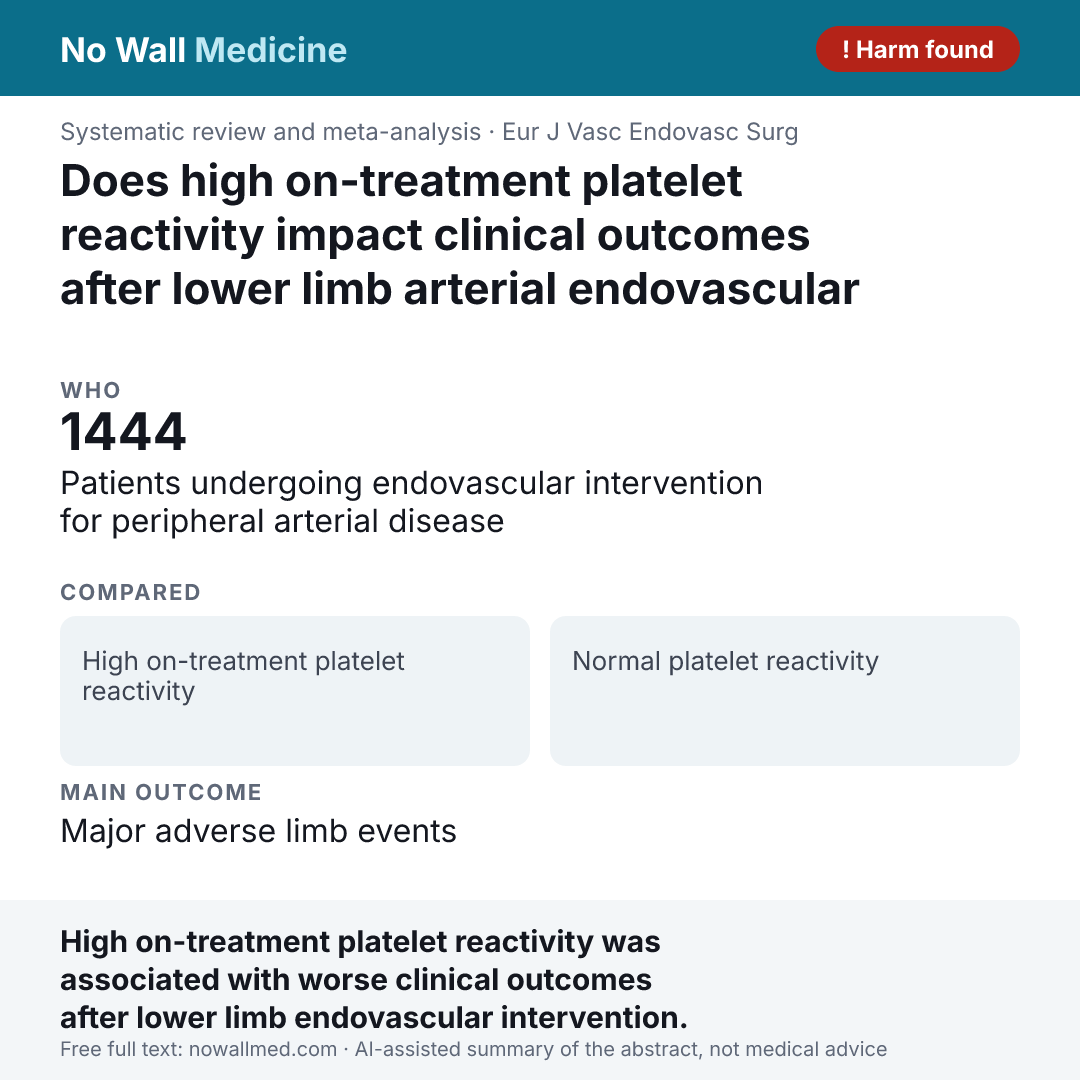
Does high on-treatment platelet reactivity impact clinical outcomes after lower limb arterial endovascular intervention?
Who
1444
Patients undergoing endovascular intervention for peripheral arterial disease
Compared
High on-treatment platelet reactivity
Normal platelet reactivity
Main outcome
Major adverse limb events
Result: odds ratio 6.25 (95% CI 2.09 to 18.68)
Bottom line: High on-treatment platelet reactivity was associated with worse clinical outcomes after lower limb endovascular intervention.
Limitation: Overall strength of evidence was very low for all outcomes.
Eur J Vasc Endovasc Surg · 2021-11-26 · Save PNG
Clinical question: Does high on-treatment platelet reactivity impact clinical outcomes after lower limb arterial endovascular intervention?
Why it matters: The clinical effect of high on-treatment platelet reactivity is unclear for patients undergoing endovascular intervention for peripheral arterial disease.
Key points
- Researchers analyzed 10 studies involving 1,444 patients to assess how high on-treatment platelet reactivity affects outcomes after procedures to open blocked leg arteries.
- High platelet reactivity was associated with a greater risk of major adverse limb events with an odds ratio of 6.25 (95% CI 2.09 - 18.68).
- The meta-analysis also showed a trend towards higher all-cause mortality (OR 1.71, 95% CI 0.99 - 2.94) and more major adverse cardiovascular events (OR 4.23, 95% CI 0.46 - 38.92).
Headline and key points written with AI from the paper’s abstract, with every number checked against it. Read the paper before relying on them.
Was this summary helpful?
Subject terms
Headline, design, result, key points, caveat and citation as plain text.
Cite this article
Zlatanovic P, Wong KHF, Kakkos SK, Twine CP. A Systematic Review and Meta-Analysis on the Impact of High On-Treatment Platelet Reactivity on Clinical Outcomes for Patients Taking ADP Receptor Inhibitors Following Lower Limb Arterial Endovascular Intervention. Eur J Vasc Endovasc Surg. 2022;63(1):91-101. doi:10.1016/j.ejvs.2021.09.026
Spotted a mistake? Suggest a correction