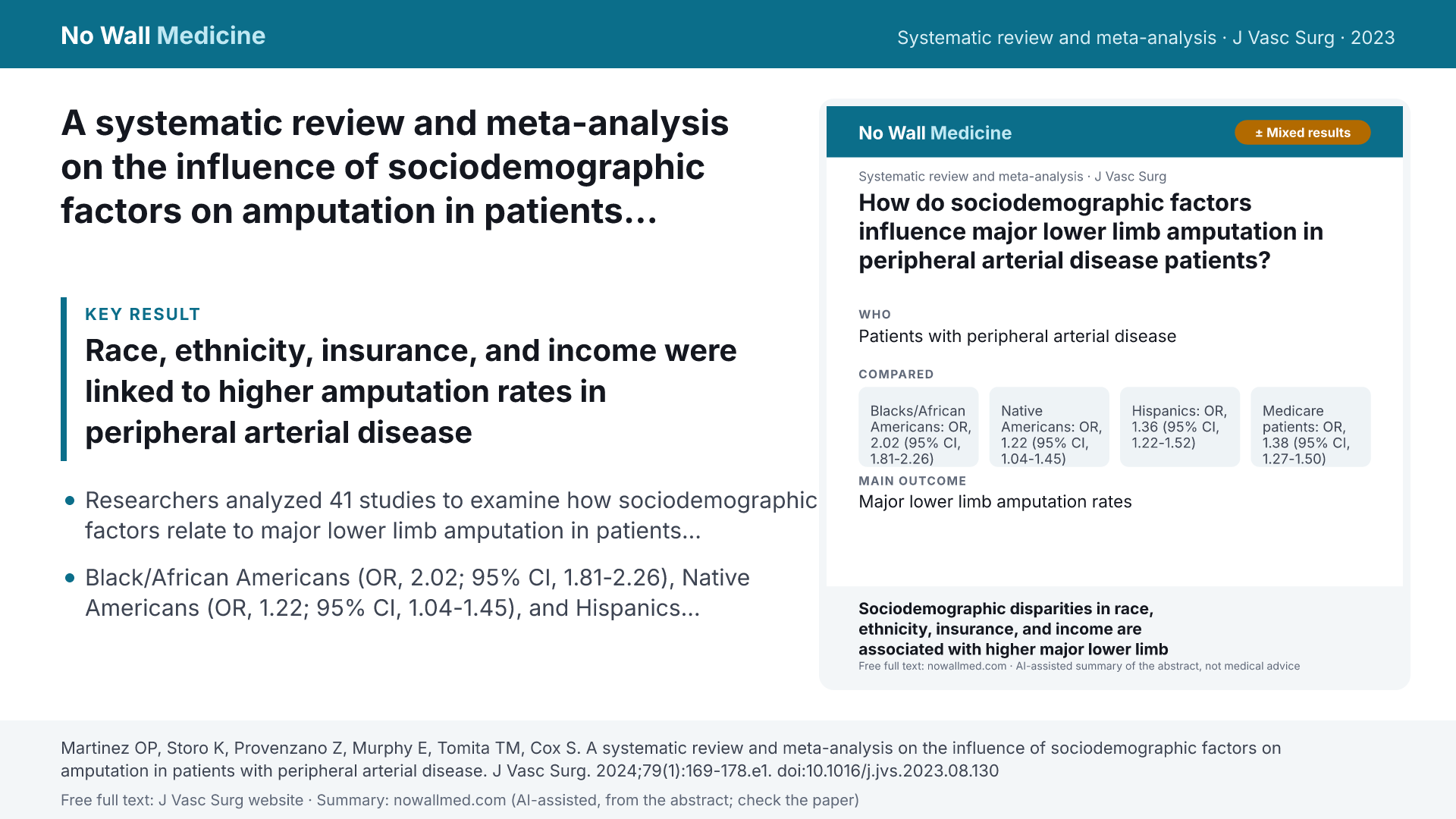
Race, ethnicity, insurance, and income were linked to higher amputation rates in peripheral arterial disease
A systematic review and meta-analysis on the influence of sociodemographic factors on amputation in patients with peripheral arterial disease
Systematic review and meta-analysisMixed results
How do sociodemographic factors influence major lower limb amputation in peripheral arterial disease patients?
Who
Patients with peripheral arterial disease
Compared
Blacks/African Americans: OR, 2.02 (95% CI, 1.81-2.26)
Native Americans: OR, 1.22 (95% CI, 1.04-1.45)
Hispanics: OR, 1.36 (95% CI, 1.22-1.52)
Medicare patients: OR, 1.38 (95% CI, 1.27-1.50)
Main outcome
Major lower limb amputation rates
Bottom line: Sociodemographic disparities in race, ethnicity, insurance, and income are associated with higher major lower limb amputation rates.
J Vasc Surg · 2023-09-16Download image

Clinical question: How do sociodemographic factors influence major lower limb amputation in peripheral arterial disease patients?
Why it matters: It was unknown how specific sociodemographic disparities influence the rates of major lower limb amputation in patients with peripheral arterial disease.
Key points
- Researchers analyzed 41 studies to examine how sociodemographic factors relate to major lower limb amputation in patients with peripheral arterial disease.
- Black/African Americans (OR, 2.02; 95% CI, 1.81-2.26), Native Americans (OR, 1.22; 95% CI, 1.04-1.45), and Hispanics (OR, 1.36; 95% CI, 1.22-1.52) were associated with higher amputation rates.
- Higher amputation rates were also associated with Medicaid (OR, 1.59; 95% CI, 1.44-1.76), noninsured status (OR, 1.41; 95% CI, 1.02-1.95), and the bottom income quartile (OR, 1.36; 95% CI, 1.24-1.49).
Headline and key points written with AI from the paper’s abstract, with every number checked against it. Read the paper before relying on them.
Was this summary helpful?
Subject terms
Cite this article
Martinez OP, Storo K, Provenzano Z, Murphy E, Tomita TM, Cox S. A systematic review and meta-analysis on the influence of sociodemographic factors on amputation in patients with peripheral arterial disease. J Vasc Surg. 2023. doi:10.1016/j.jvs.2023.08.130
Spotted a mistake? Suggest a correction