Artificial intelligence shows potential for cosmetic surgery despite limited validation and inconsistent outcome metrics
A Systematic Review of Applications, Challenges, and Future Trajectories of Artificial Intelligence in Cosmetic Surgery
Systematic reviewMixed results
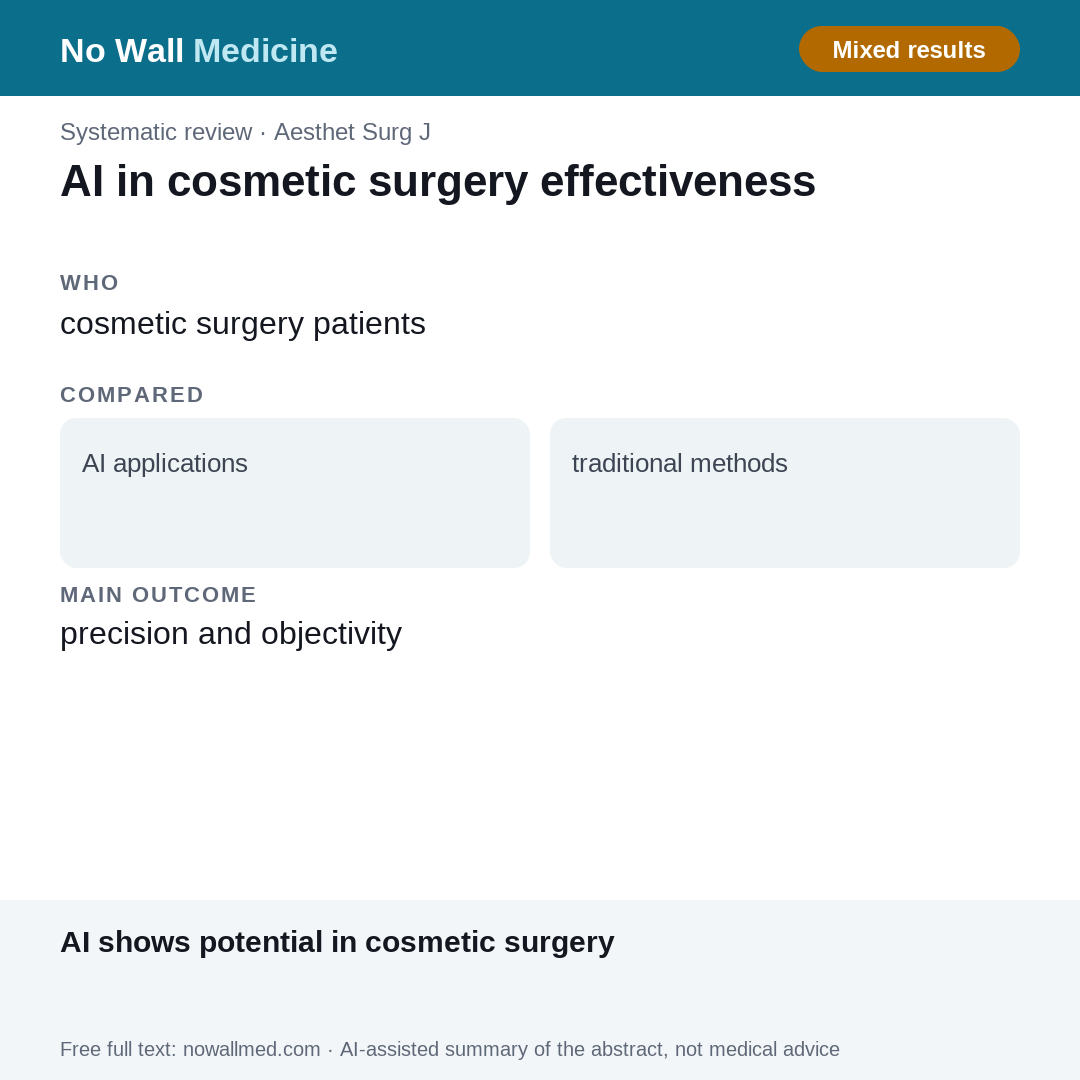
AI in cosmetic surgery effectiveness
Who
cosmetic surgery patients
Compared
AI applications
traditional methods
Main outcome
precision and objectivity
Bottom line: AI shows potential in cosmetic surgery
Limitation: limited external validation
Aesthet Surg J · 2025-11-14Download image
Why it matters: Cosmetic surgery lacks standardized metrics and relies on subjective outcomes, creating a need for objective tools through artificial intelligence.
Key points
- Researchers systematically reviewed 38 studies from 2020 to 2025 regarding artificial intelligence applications in aesthetic procedures.
- Artificial intelligence was linked to preoperative planning, intraoperative guidance, and postoperative monitoring such as smartphone-based complication detection.
- Most studies were early-phase and showed moderate to serious risk of bias with limited external validation.
Limitation the authors note: Most studies were early-phase with limited external validation, heterogeneous datasets, and inconsistent outcome metrics.
Headline and key points written with AI from the paper’s abstract, with every number checked against it. Read the paper before relying on them.
Topics
Cite this article
Shoham G, Naveh S, Confino I, Zoabi T, Govrin O, Fliss E. A Systematic Review of Applications, Challenges, and Future Trajectories of Artificial Intelligence in Cosmetic Surgery. Aesthet Surg J. 2025. doi:10.1093/asj/sjaf238
Spotted a mistake? Suggest a correction