A systematic review of clinical and laboratory studies comparing vascularised versus non-vascularised nerve grafts in peripheral nerve reconstruction
Systematic reviewBenefit found
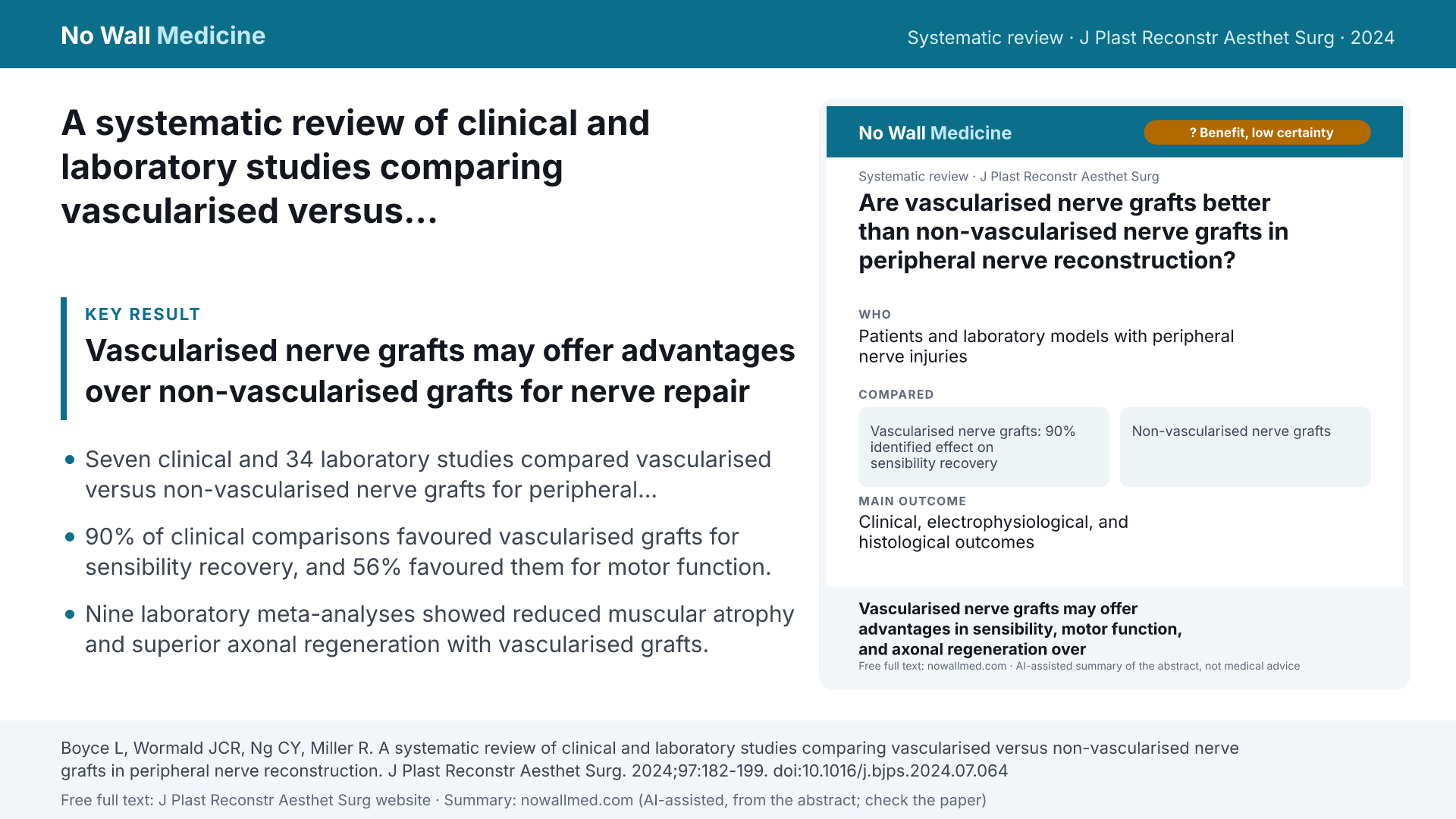
Are vascularised nerve grafts better than non-vascularised nerve grafts in peripheral nerve reconstruction?
Who
Patients and laboratory models with peripheral nerve injuries
Compared
Vascularised nerve grafts: 90% identified effect on sensibility recovery
Non-vascularised nerve grafts
Main outcome
Clinical, electrophysiological, and histological outcomes
Bottom line: Vascularised nerve grafts may offer advantages in sensibility, motor function, and axonal regeneration over non-vascularised grafts.
Limitation: Low quality of evidence, significant statistical heterogeneity, and clinical diversity of included studies.
J Plast Reconstr Aesthet Surg · 2024-07-30Download image

Clinical question: Are vascularised nerve grafts better than non-vascularised nerve grafts in peripheral nerve reconstruction?
Abstract
Background
Peripheral nerve injuries (PNIs) are common, with complex defects posing a significant reconstructive challenge. Although vascularised (VNGs) and non-vascularised nerve grafts (NVNGs) are established treatment options, there is no comprehensive summary of the evidence supporting their clinical, electrophysiological, and histological outcomes. This review aims to systematically evaluate the clinical and laboratory literature comparing VNGs and NVNGs to inform future clinical practice and research. Methods
This review was prospectively registered and reported according to PRISMA guidelines. PubMed, EMBASE, SCOPUS, and the Cochrane Register were systematically searched. Studies comparing VNGs and NVNGs in PNIs were included. Meta-analyses were performed for outcomes reported in ≥3 laboratory studies. Functional outcomes were synthesised by vote-counting based on direction of effect for clinical studies. Risk-of-bias was assessed using RoB2, ROBINS-I, and SYRCLE, and the certainty of evidence was evaluated using GRADE. Results
Seven clinical and 34 laboratory studies were included. Of the clinical comparisons, 90% and 56% identified an effect on recovery of sensibility (p = 0.01) and motor function (p = 0.05), respectively, that favoured VNGs. Nine (of 13) separate meta-analyses of laboratory studies demonstrated reduced muscular atrophy, superior axonal regeneration, and remyelination in VNGs. VNGs eliminated the 3-day interval of ischaemia otherwise sustained by NVNGs. Overall, the quality of evidence was low. Conclusion
This systematic review indicates that VNGs may offer some advantages over NVNGs in PNI reconstruction. However, due to the low quality of evidence, significant statistical heterogeneity, and clinical diversity of the included studies, these conclusions should be interpreted with caution. Further high-quality clinical trials are necessary to validate these findings.
Subject terms
Cite this article
Boyce L, Wormald JCR, Ng CY, Miller R. A systematic review of clinical and laboratory studies comparing vascularised versus non-vascularised nerve grafts in peripheral nerve reconstruction. J Plast Reconstr Aesthet Surg. 2024. doi:10.1016/j.bjps.2024.07.064
Spotted a mistake? Suggest a correction