Fall prediction models using routine data perform similarly to those from research cohorts
A systematic review of fall prediction models for community-dwelling older adults: comparison between models based on research cohorts and models based on routinely collected data
Systematic reviewNo clear difference
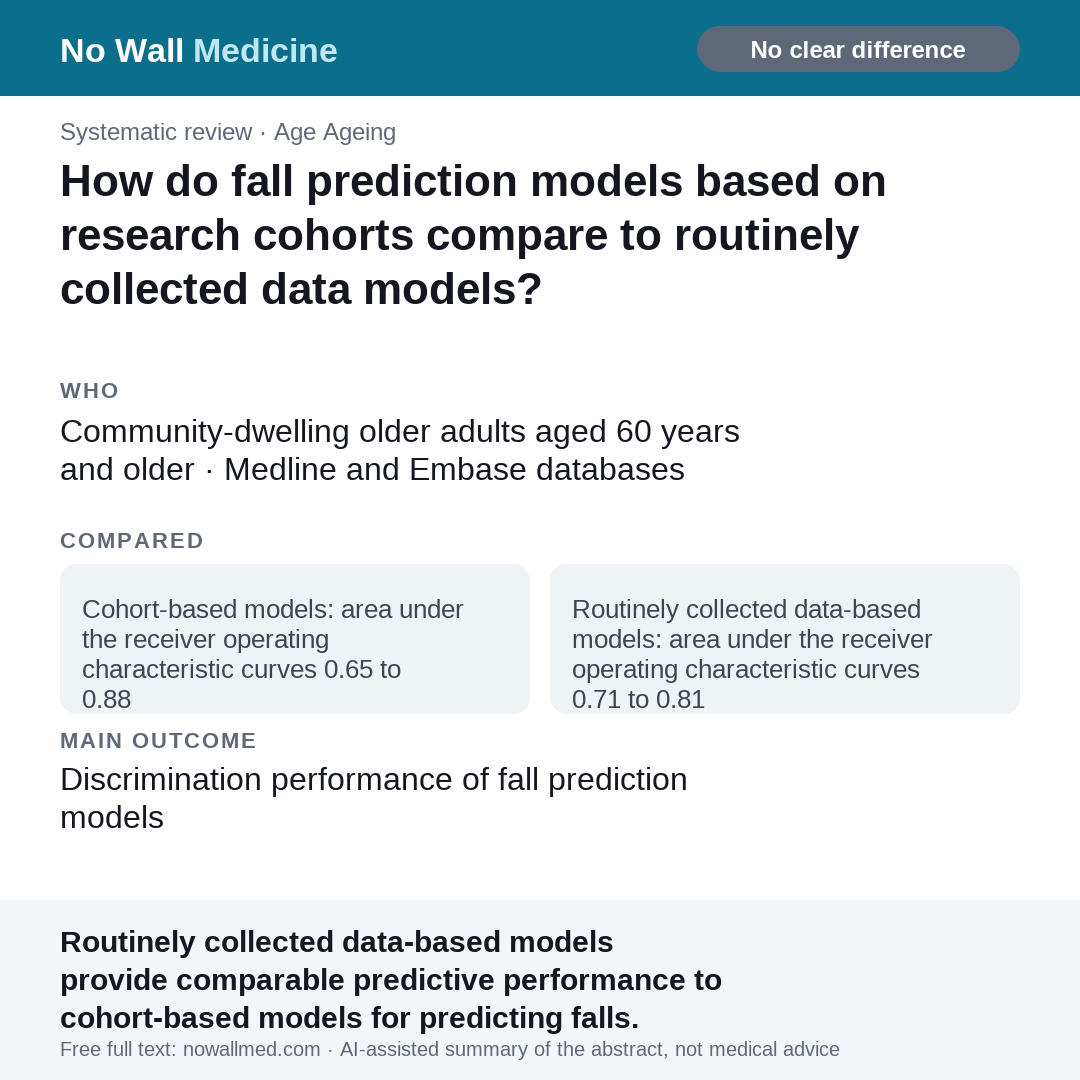
How do fall prediction models based on research cohorts compare to routinely collected data models?
Who
Community-dwelling older adults aged 60 years and older · Medline and Embase databases
Compared
Cohort-based models: area under the receiver operating characteristic curves 0.65 to 0.88
Routinely collected data-based models: area under the receiver operating characteristic curves 0.71 to 0.81
Main outcome
Discrimination performance of fall prediction models
Bottom line: Routinely collected data-based models provide comparable predictive performance to cohort-based models for predicting falls.
Limitation: All but one cohort-based model had high bias risks.
Age Ageing · 2024-07-09Download image
Clinical question: How do fall prediction models based on research cohorts compare to routinely collected data models?
Why it matters: It is unknown if prediction models using routinely collected data perform as well as those using data from research cohorts.
Key points
- Researchers reviewed 28 studies containing 30 prediction models for falls in adults aged 60 or older.
- The area under the receiver operating characteristic curve, a measure of predictive accuracy, ranged from 0.65 to 0.88 for cohort-based models and 0.71 to 0.81 for routinely collected data-based models.
- Cohort-based models had a median of 6 predictors, while routinely collected data-based models had a median of 16 predictors.
Limitation the authors note: All but one cohort-based model had high bias risks, primarily due to deficiencies in statistical analysis and outcome determination.
Headline and key points written with AI from the paper’s abstract, with every number checked against it. Read the paper before relying on them.
Was this summary helpful?
Subject terms
Cite this article
Dormosh N, van de Loo B, Heymans MW, Schut MC, Medlock S, van Schoor NM. A systematic review of fall prediction models for community-dwelling older adults: comparison between models based on research cohorts and models based on routinely collected data. Age Ageing. 2024. doi:10.1093/ageing/afae131
Spotted a mistake? Suggest a correction
Top studies every Monday
The week’s key trials and guidelines in your specialties, plus any topics you follow. By email, free.
Get the weekly digest