Machine learning models for predicting opioid harms often lack external validation and transparent reporting
A systematic review of machine learning applications in predicting opioid associated adverse events
Systematic reviewMixed results
What are the types and quality of machine learning applications in predicting opioid-related harms?
Who
44
Studies using supervised machine learning for opioid safety research · North America (96%)
Compared
15Postoperative opioid use (34%)
8Opioid overdose (18%)
8Opioid use disorder (18%)
5Persistent opioid use (11%)
Main outcome
Types and quality of machine learning methods in opioid safety
Bottom line: Machine learning models show moderate to strong performance, but lack external validation and transparent reporting of calibration.
Limitation: Infrequent external validation and incomplete reporting of calibration and missing data limit generalizability.
NPJ Digit Med · 2025-01-16Download image
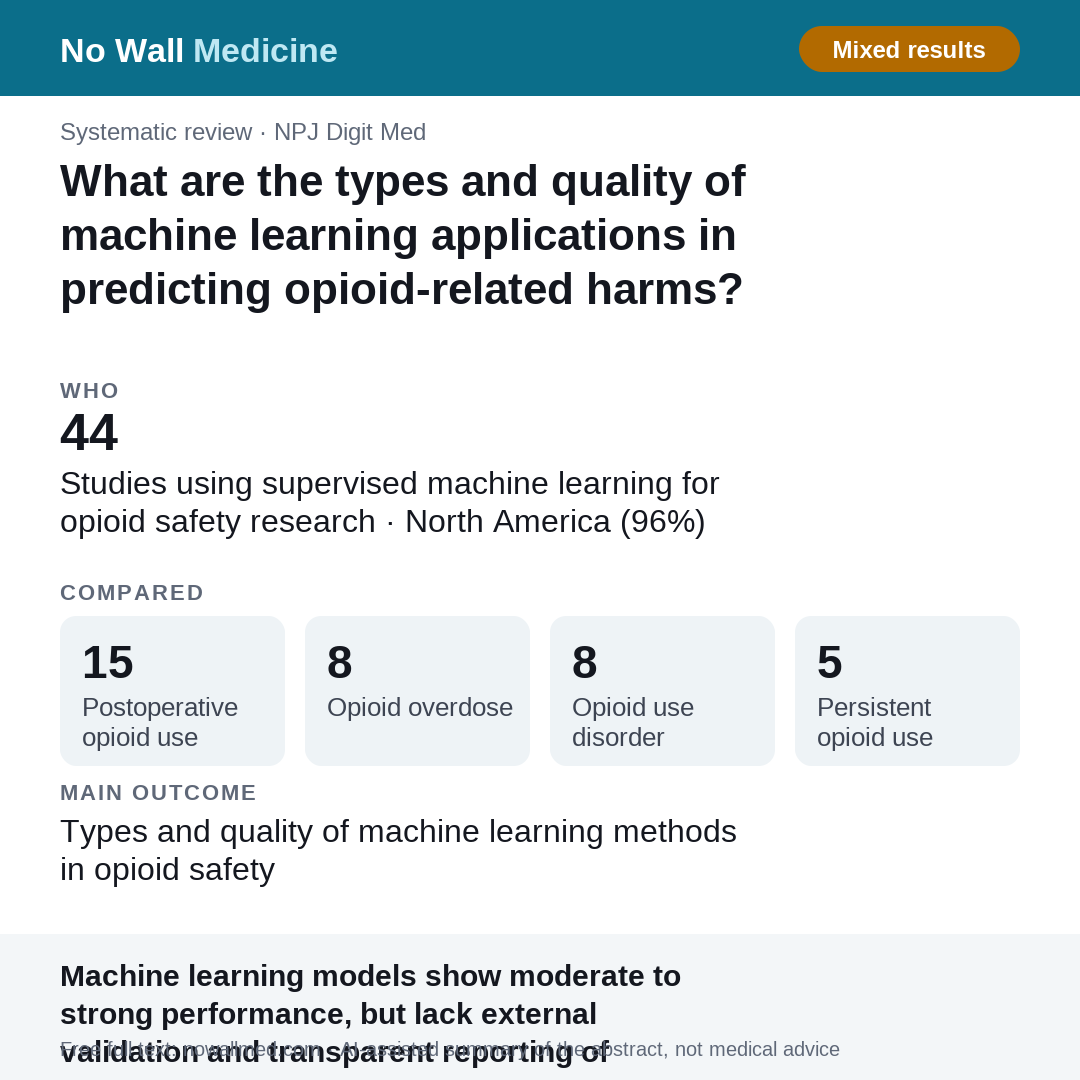
Clinical question: What are the types and quality of machine learning applications in predicting opioid-related harms?
Why it matters: It is unknown how well machine learning models for opioid safety perform across different populations or how consistently they are reported and validated.
Key points
- Researchers reviewed 44 studies using supervised machine learning, which is a type of artificial intelligence that learns from labeled data, to predict opioid-related harms.
- The most common predictions were postoperative opioid use (n = 15, 34%), opioid overdose (n = 8, 18%), and opioid use disorder (n = 8, 18%).
- While model performance was moderate to strong, 96% of studies were from North America and only 7% reported external validation.
Limitation the authors note: Infrequent external validation limited the generalizability of current models.
Headline and key points written with AI from the paper’s abstract, with every number checked against it. Read the paper before relying on them.
Cite this article
Ramírez Medina CR, Benitez-Aurioles J, Jenkins DA, Jani M. A systematic review of machine learning applications in predicting opioid associated adverse events. NPJ Digit Med. 2025. doi:10.1038/s41746-024-01312-4
Spotted a mistake? Suggest a correction