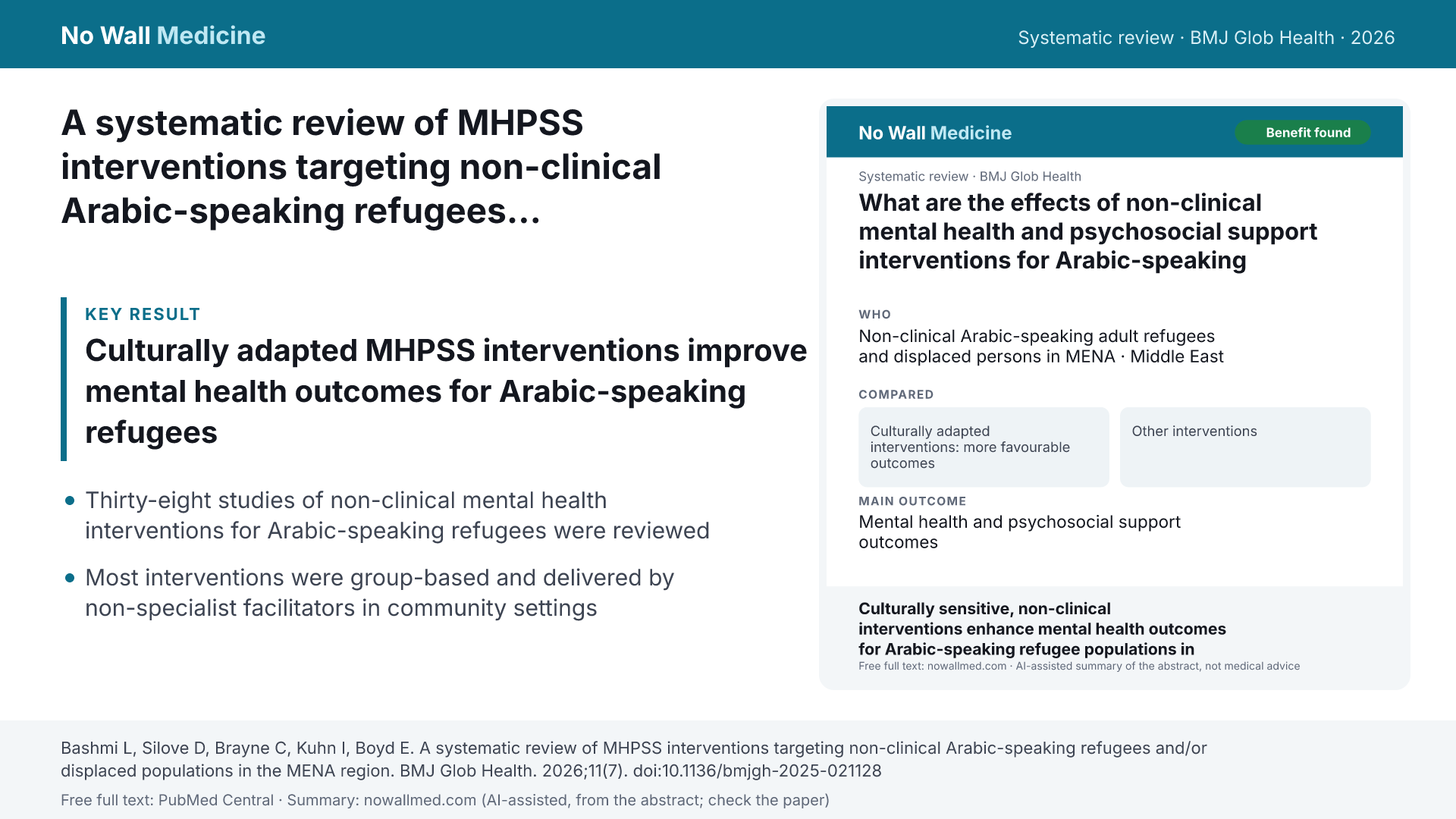
Culturally adapted MHPSS interventions improve mental health outcomes for Arabic-speaking refugees
A systematic review of MHPSS interventions targeting non-clinical Arabic-speaking refugees and/or displaced populations in the MENA region
Systematic reviewBenefit found
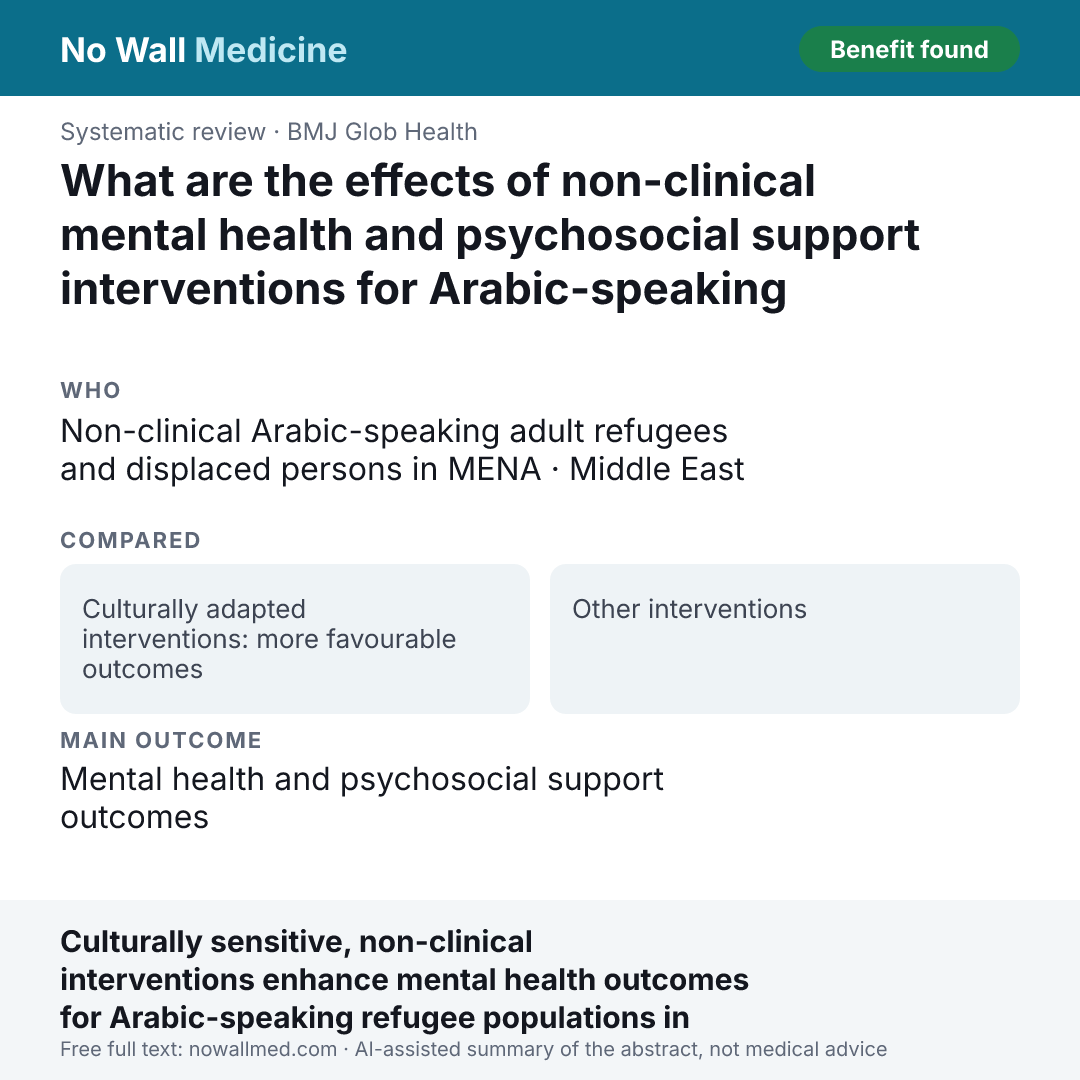
What are the effects of non-clinical mental health and psychosocial support interventions for Arabic-speaking refugees?
Who
Non-clinical Arabic-speaking adult refugees and displaced persons in MENA · Middle East and North Africa countries
Compared
Culturally adapted interventions: more favourable outcomes
Other interventions
Main outcome
Mental health and psychosocial support outcomes
Bottom line: Culturally sensitive, non-clinical interventions enhance mental health outcomes for Arabic-speaking refugee populations in the Middle East and North Africa.
BMJ Glob Health · 2026-07-30 · Save PNG
Clinical question: What are the effects of non-clinical mental health and psychosocial support interventions for Arabic-speaking refugees?
Key points
- Thirty-eight studies of non-clinical mental health interventions for Arabic-speaking refugees were reviewed.
- Most interventions were group-based and delivered by non-specialist facilitators in community settings.
- Culturally adapted interventions promoted complex thinking and relational healing with favourable outcomes.
Headline and key points written with AI from the paper’s abstract, with every number checked against it. Read the paper before relying on them.
Was this summary helpful?
Abstract
Background
Arabic-speaking refugees and displaced populations in the Middle East and North Africa (MENA) face ongoing adversity that negatively impacts their mental health. Despite increasing mental health needs, there is no published systematic review evaluating non-clinical mental health and psychosocial support (MHPSS) interventions in the MENA region for this population, particularly through a culturally grounded framework. Methods
We conducted a systematic review of MHPSS interventions published from 2011 to 2022 targeting non-clinical Arabic-speaking adult refugees and/or displaced persons in MENA countries. Following Preferred Reporting Items for Systematic Reviews and Meta-Analyses (PRISMA) 2020 guidelines and PROSPERO registration (CRD42023421057), we searched ten databases and grey literature sources. Objectives were to identify, appraise and synthesise eligible MHPSS interventions and assess their alignment with the Integrative Complexity (IC)-Adaptation and Development After Persecution and Trauma (ADAPT) framework. Studies were appraised using four validated quality assessment tools and a novel tool assessing links to the IC-ADAPT framework, which integrates an eco-psycho-social model (ADAPT) and a cognitive-interactionist model (IC). A subset of ten top-rated interventions was synthesised for IC-ADAPT alignment. Results
Thirty-eight studies met the inclusion criteria. Most interventions were conducted in Lebanon or Jordan, group-based and delivered by non-specialist facilitators in community settings. Parenting, resilience-building and trauma-focused therapies were the most common modalities. Most studies prioritised feasibility and effectiveness over efficacy. While none explicitly applied IC-ADAPT, several implicitly aligned with its eco-psychosocial systems (eg, bonds/networks, safety/security and roles/identities) and IC (eg, increased 'differentiation'), reporting reduced harsh parenting and improved reflective capacity. Culturally adapted interventions that promoted complex thinking, relational healing and community participation were linked with more favourable outcomes. Conclusion
This review highlights the value of culturally sensitive, non-clinical MHPSS interventions in enhancing mental health outcomes for Arabic-speaking refugee populations in MENA. Programmes grounded in eco-psychosocial and cognitive complexity frameworks-such as IC-ADAPT-offer effective, scalable strategies for addressing refugee mental health. Future work should embed these models explicitly to optimise intervention design, relevance and impact. Prospero registration number
CRD42023421057.
Abstract reproduced under the article’s CC BY licence.
Subject terms
Headline, design, result, key points, caveat and citation as plain text.
Cite this article
Bashmi L, Silove D, Brayne C, Kuhn I, Boyd E. A systematic review of MHPSS interventions targeting non-clinical Arabic-speaking refugees and/or displaced populations in the MENA region. BMJ Glob Health. 2026;11(7). doi:10.1136/bmjgh-2025-021128
Spotted a mistake? Suggest a correction