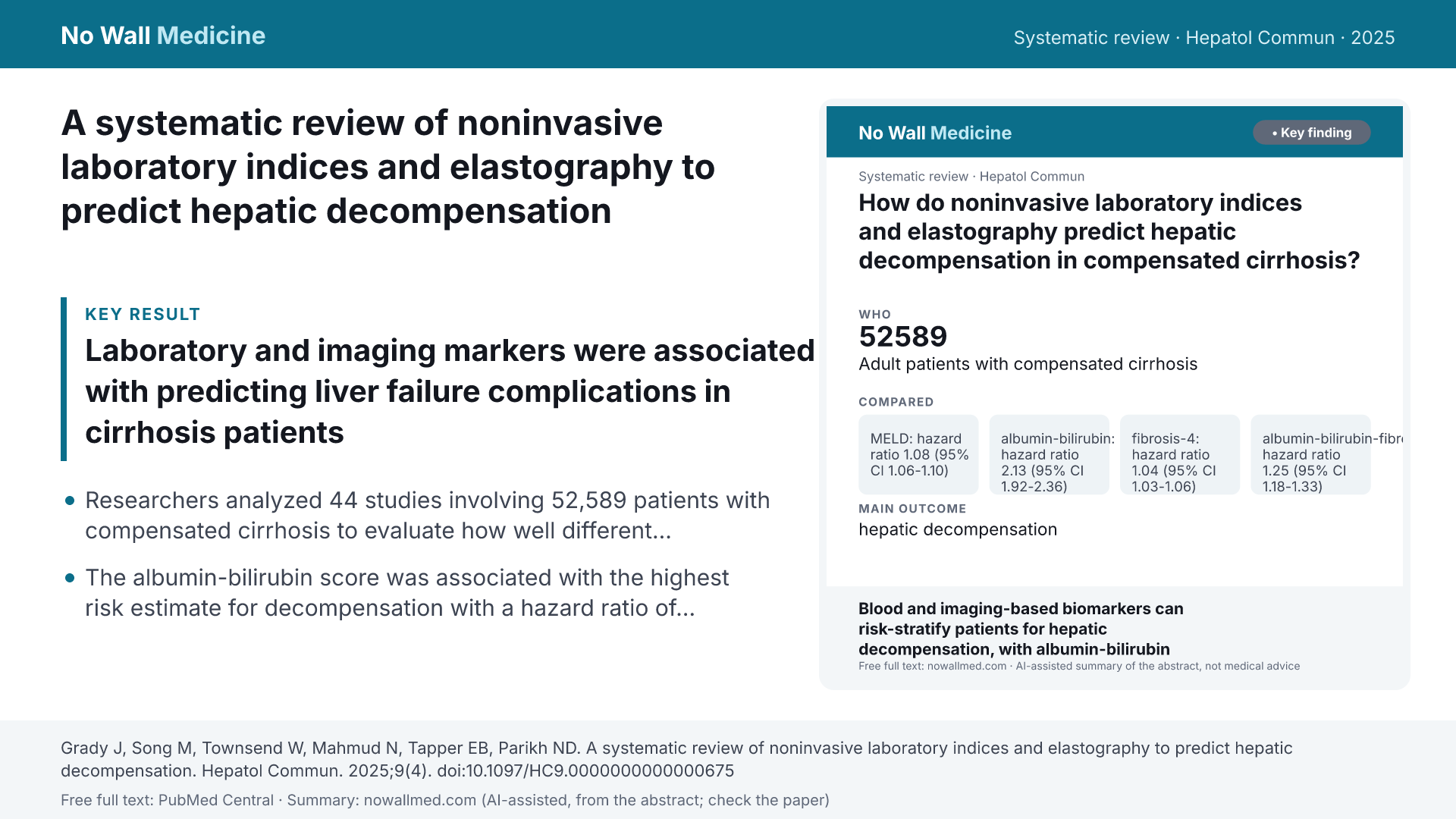
Laboratory and imaging markers were associated with predicting liver failure complications in cirrhosis patients
A systematic review of noninvasive laboratory indices and elastography to predict hepatic decompensation
Systematic reviewKey finding
How do noninvasive laboratory indices and elastography predict hepatic decompensation in compensated cirrhosis?
Who
52589
Adult patients with compensated cirrhosis
Compared
MELD: hazard ratio 1.08 (95% CI 1.06-1.10)
albumin-bilirubin: hazard ratio 2.13 (95% CI 1.92-2.36)
fibrosis-4: hazard ratio 1.04 (95% CI 1.03-1.06)
albumin-bilirubin-fibrosis-4: hazard ratio 1.25 (95% CI 1.18-1.33)
Main outcome
hepatic decompensation
Bottom line: Blood and imaging-based biomarkers can risk-stratify patients for hepatic decompensation, with albumin-bilirubin showing the highest discrimination.
Hepatol Commun · 2025-03-24 · Save PNG
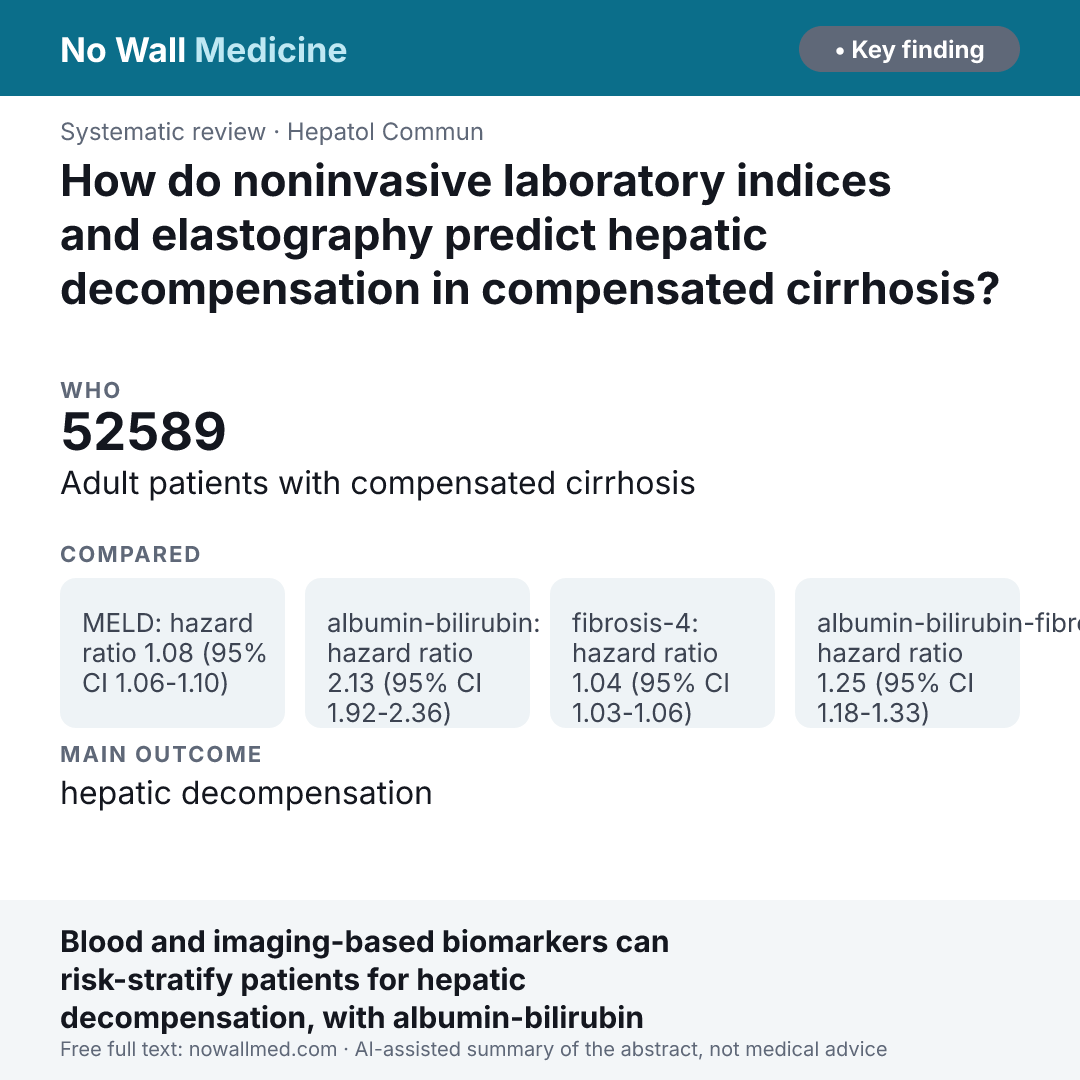
Clinical question: How do noninvasive laboratory indices and elastography predict hepatic decompensation in compensated cirrhosis?
Why it matters: Comparative data on how noninvasive laboratory and imaging tools perform in risk stratification for patients with compensated cirrhosis are lacking.
Key points
- Researchers analyzed 44 studies involving 52,589 patients with compensated cirrhosis to evaluate how well different markers predict hepatic decompensation, which includes fluid buildup, bleeding, or brain dysfunction.
- The albumin-bilirubin score was associated with the highest risk estimate for decompensation with a hazard ratio of 2.13 (95% CI: 1.92-2.36).
- Other markers associated with risk included MELD (HR: 1.08; 95% CI: 1.06-1.10), fibrosis-4 (HR: 1.04, 95% CI: 1.03-1.06), and liver stiffness measured by transient elastography (HR: 1.04; 95% CI: 1.04-1.05).
Headline and key points written with AI from the paper’s abstract, with every number checked against it. Read the paper before relying on them.
Was this summary helpful?
Subject terms
Headline, design, result, key points, caveat and citation as plain text.
Cite this article
Grady J, Song M, Townsend W, Mahmud N, Tapper EB, Parikh ND. A systematic review of noninvasive laboratory indices and elastography to predict hepatic decompensation. Hepatol Commun. 2025;9(4). doi:10.1097/HC9.0000000000000675
Spotted a mistake? Suggest a correction