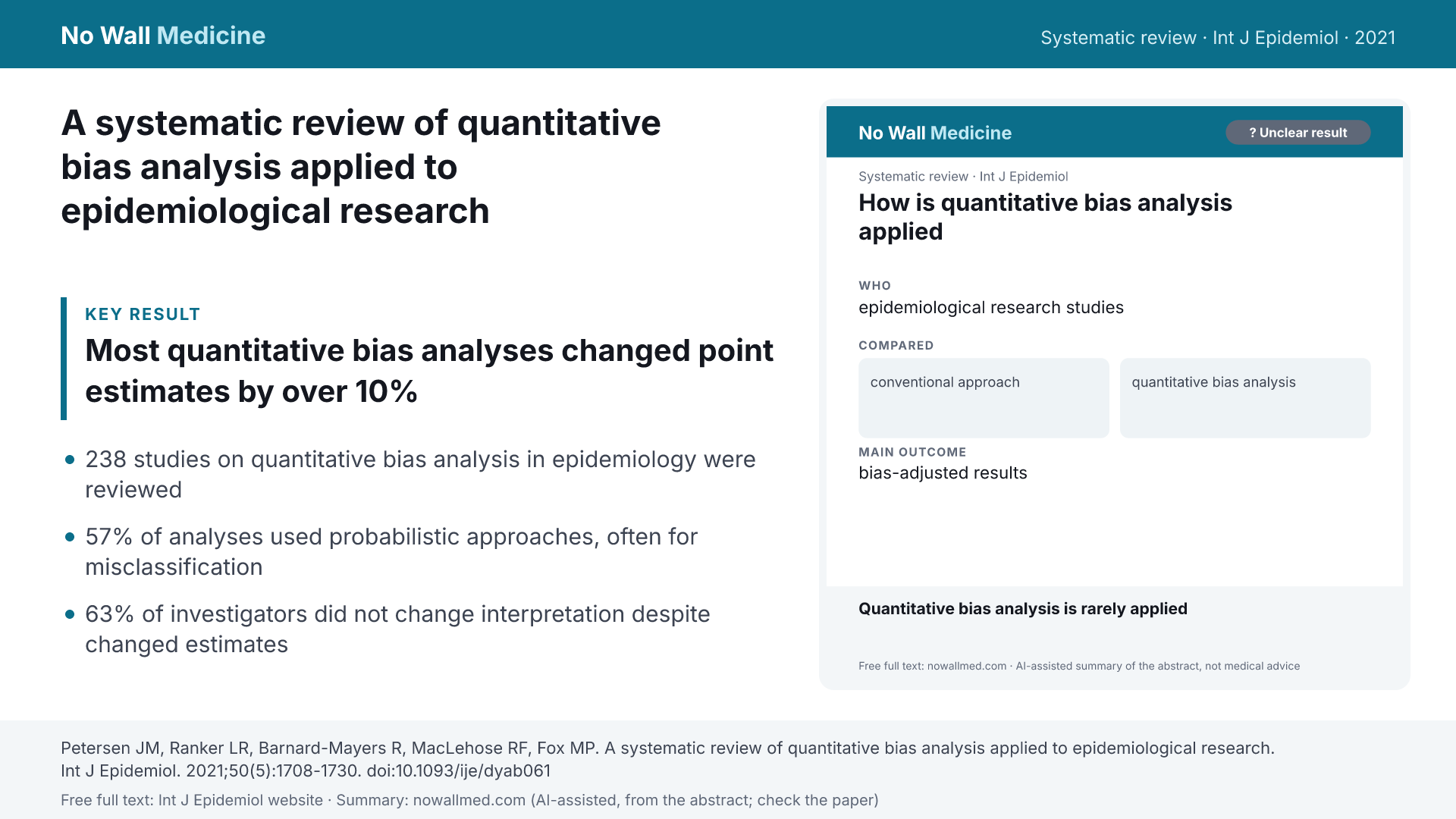
A systematic review of quantitative bias analysis applied to epidemiological research
Key result: Most quantitative bias analyses changed point estimates by over 10%
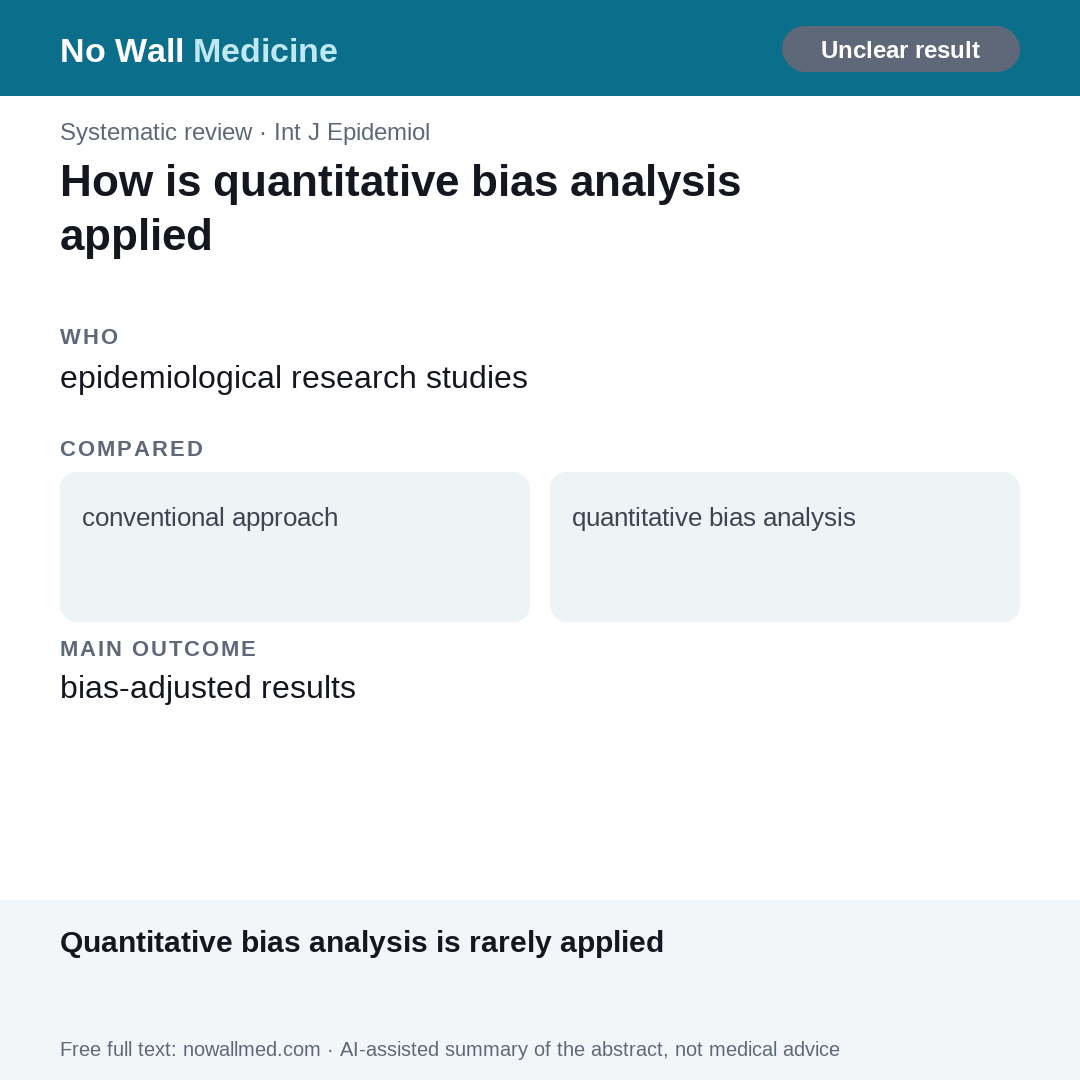
Systematic reviewUnclear result
How is quantitative bias analysis applied
Who
epidemiological research studies
Compared
conventional approach
quantitative bias analysis
Main outcome
bias-adjusted results
Bottom line: Quantitative bias analysis is rarely applied
Limitation: most did not consider multiple biases
Int J Epidemiol · 2021-04-22Download image
Key points
- 238 studies on quantitative bias analysis in epidemiology were reviewed.
- 57% of analyses used probabilistic approaches, often for misclassification.
- 63% of investigators did not change interpretation despite changed estimates.
Limitation the authors note: Most analyses did not consider multiple biases or correlations between errors
Discussion prompts
- Would these patients look like yours? Who was left out?
- Is the main outcome one that matters to patients?
- Is the difference large enough to change what you do?
Cite: Petersen JM, Ranker LR, Barnard-Mayers R, MacLehose RF, Fox MP. A systematic review of quantitative bias analysis applied to epidemiological research. Int J Epidemiol. 2021. doi:10.1093/ije/dyab061
Free full text: Int J Epidemiol website · Summary and visual abstract: nowallmed.com/a/a-systematic-review-of-quantitative-bias-analysis-applied-to-1san00o/ (AI-assisted from the abstract; check the paper before relying on it).