A Systematic Review Supporting the Endocrine Society Clinical Practice Guideline on the Treatment of Hypercalcemia of Malignancy in Adults
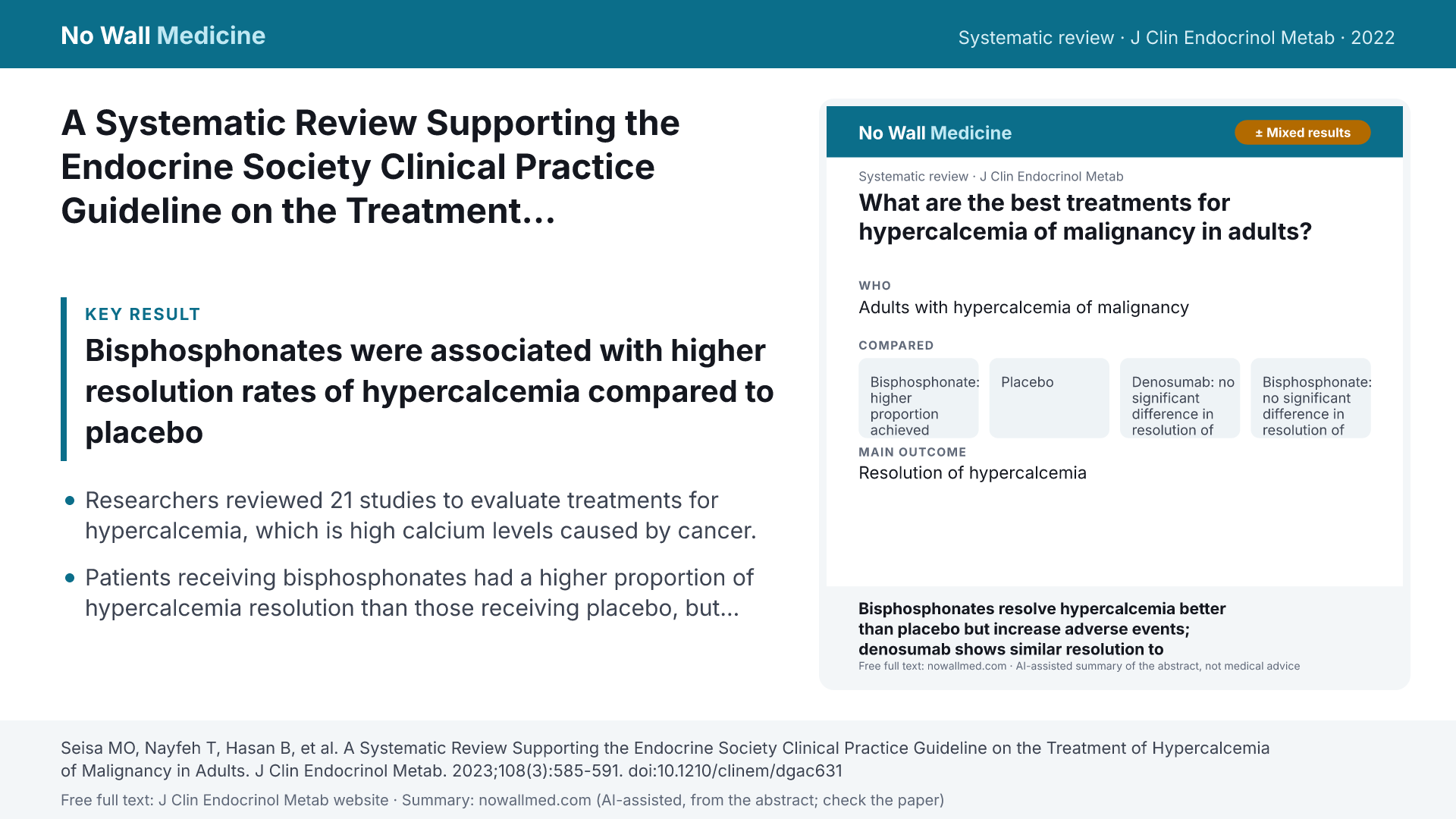
Key result: Bisphosphonates were associated with higher resolution rates of hypercalcemia compared to placebo
Key points
- Researchers reviewed 21 studies to evaluate treatments for hypercalcemia, which is high calcium levels caused by cancer.
- Patients receiving bisphosphonates had a higher proportion of hypercalcemia resolution than those receiving placebo, but also a significantly higher incidence of adverse events.
- Denosumab showed no significant difference in hypercalcemia resolution rates compared to bisphosphonates, and adding calcitonin did not affect resolution or time to normal calcium levels.
Why it matters: Clinical guidance is needed for managing high calcium levels caused by cancer, including how to treat cases that do not respond to initial therapies.
Limitation the authors note: The certainty of the evidence to address all 8 clinical questions was low to very low.
Discussion prompts
- Would these patients look like yours? Who was left out?
- Is the main outcome one that matters to patients?
- Is the difference large enough to change what you do?
Cite: Seisa MO, Nayfeh T, Hasan B, et al. A Systematic Review Supporting the Endocrine Society Clinical Practice Guideline on the Treatment of Hypercalcemia of Malignancy in Adults. J Clin Endocrinol Metab. 2023;108(3):585-591. doi:10.1210/clinem/dgac631
Free full text: J Clin Endocrinol Metab website · Summary and visual abstract: nowallmed.com/a/a-systematic-review-supporting-the-endocrine-society-clinical-1m78rz1/ (AI-assisted from the abstract; check the paper before relying on it).