Acute alcohol consumption was associated with delayed cortisol recovery but not changed cortisol reactivity
A systematic review with meta-analysis on the relation between acute stress, alcohol consumption and cortisol levels in individuals with a personal, familial or no alcohol use disorder
Systematic review and meta-analysisMixed results
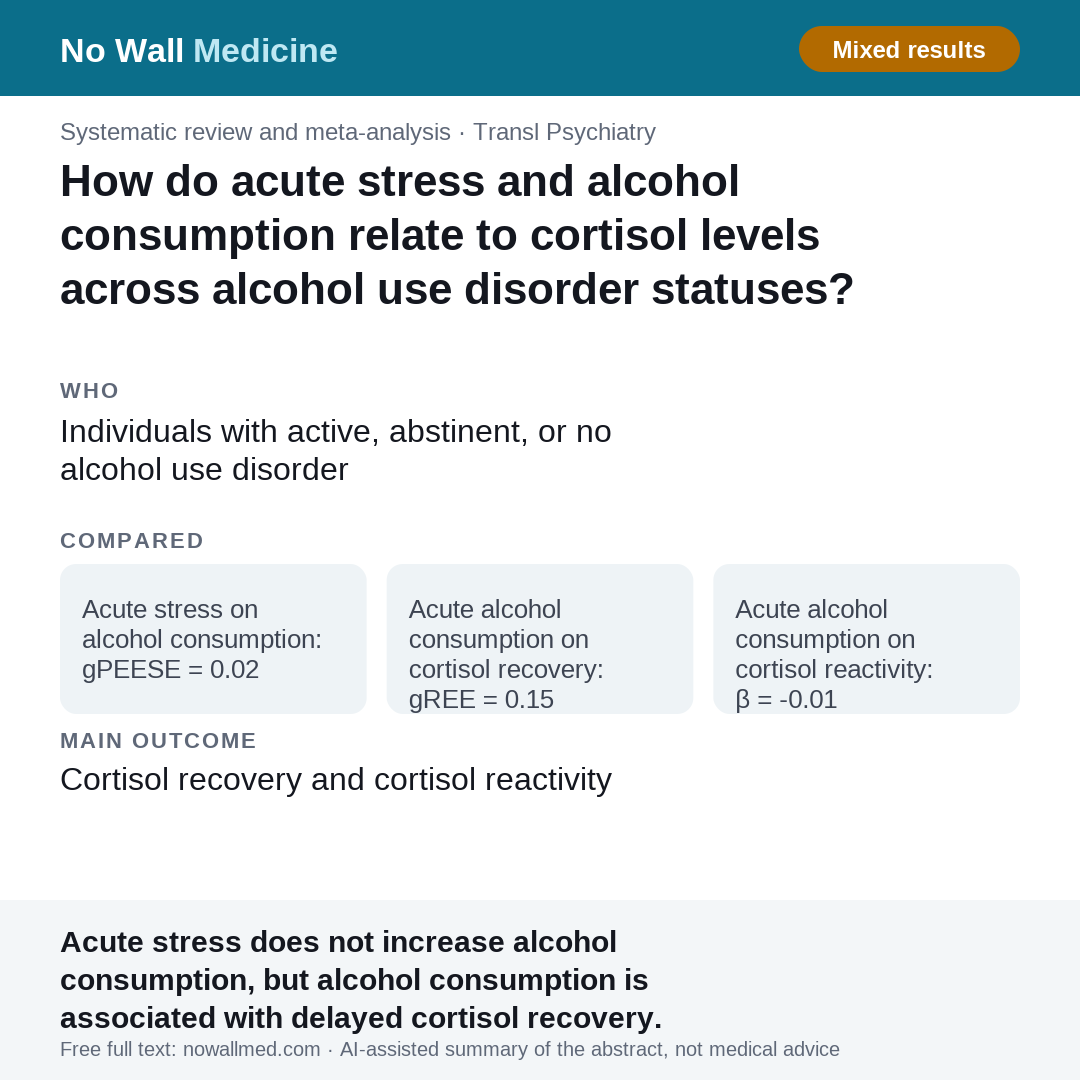
How do acute stress and alcohol consumption relate to cortisol levels across alcohol use disorder statuses?
Who
Individuals with active, abstinent, or no alcohol use disorder
Compared
Acute stress on alcohol consumption: gPEESE = 0.02
Acute alcohol consumption on cortisol recovery: gREE = 0.15
Acute alcohol consumption on cortisol reactivity: β = -0.01
Main outcome
Cortisol recovery and cortisol reactivity
Bottom line: Acute stress does not increase alcohol consumption, but alcohol consumption is associated with delayed cortisol recovery.
Limitation: Small-study effects influenced initial findings regarding stress and alcohol consumption.
Transl Psychiatry · 2025-10-20Download image
Clinical question: How do acute stress and alcohol consumption relate to cortisol levels across alcohol use disorder statuses?
Why it matters: Evidence regarding whether alcohol is used to cope with stress and its impact on physiological stress markers remains heterogeneous.
Key points
- Researchers analyzed 53 experimental and 31 observational studies to examine how acute stress and alcohol consumption relate to cortisol levels in people with or without alcohol use disorder.
- Acute alcohol consumption was associated with delayed cortisol recovery (gREE = 0.15), particularly in individuals with active alcohol use disorder (gREE = 0.46) or a family history of the disorder (gREE = 0.16).
- Acute stress was not linked to increased alcohol consumption after adjusting for small-study effects (gPEESE = 0.02), and alcohol intake did not significantly affect cortisol reactivity (β = -0.01).
Headline and key points written with AI from the paper’s abstract, with every number checked against it. Read the paper before relying on them.
Topics
Cite this article
Weckesser LJ, Pilhatsch M, Muehlhan M, Endraß T, Miller R. A systematic review with meta-analysis on the relation between acute stress, alcohol consumption and cortisol levels in individuals with a personal, familial or no alcohol use disorder. Transl Psychiatry. 2025. doi:10.1038/s41398-025-03641-8
Spotted a mistake? Suggest a correction