Tablet-based training changed brain responses to positive emotions in patients with major depressive disorder
A tablet-based attentional cognitive bias modification intervention for positive emotion processing in major depressive disorder: a single-blind randomised controlled two-centre trial
Single-blind randomised controlled trialBenefit found
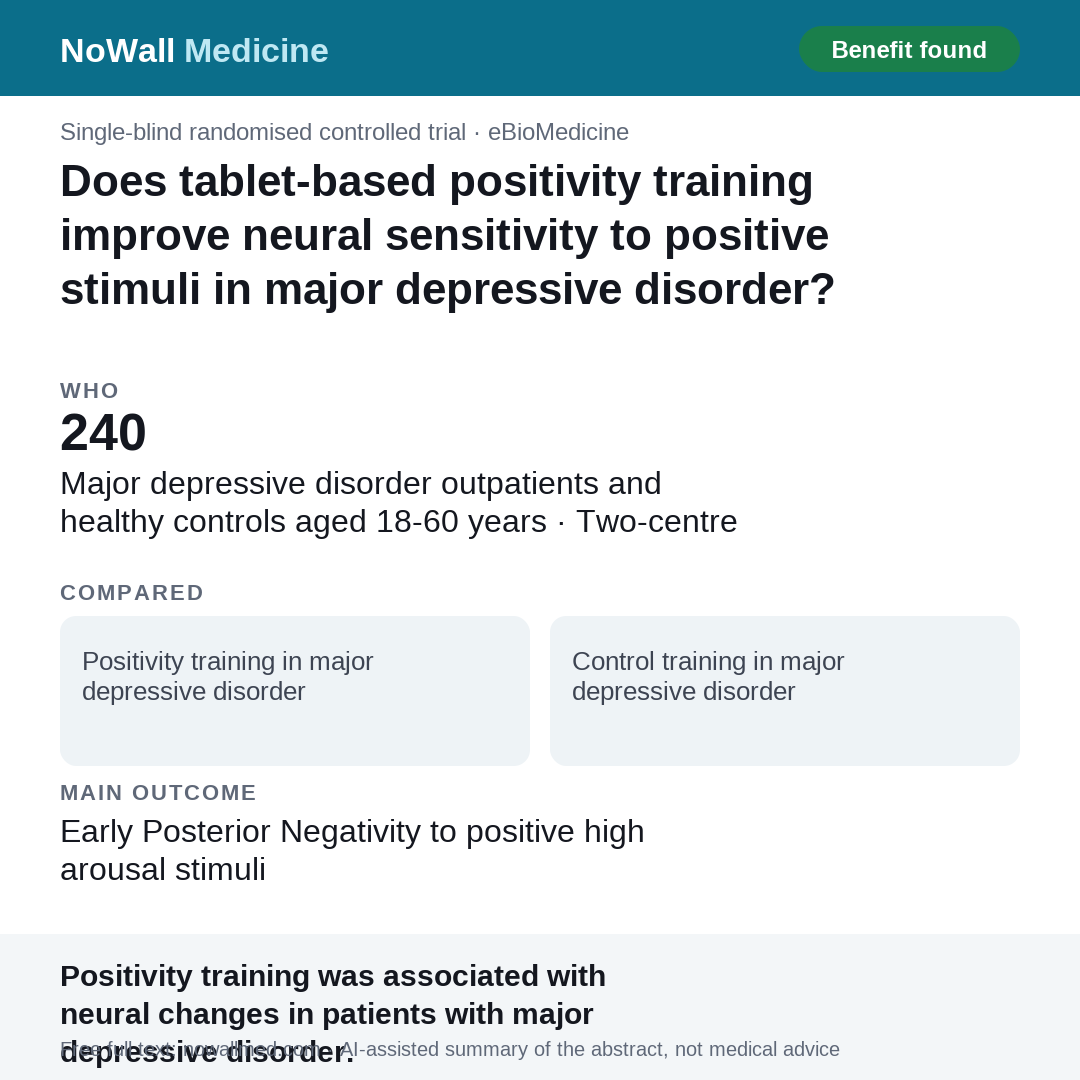
Does tablet-based positivity training improve neural sensitivity to positive stimuli in major depressive disorder?
Who
240
Major depressive disorder outpatients and healthy controls aged 18-60 years · Two-centre trial
Compared
Positivity training in major depressive disorder
Control training in major depressive disorder
Main outcome
Early Posterior Negativity to positive high arousal stimuli
Bottom line: Positivity training was associated with neural changes in patients with major depressive disorder.
Limitation: Further EEG follow-up and higher stimulus contrasts may clarify clinical relevance.
Funded by: DFG
eBioMedicine · 2026-09-01Download image
Clinical question: Does tablet-based positivity training improve neural sensitivity to positive stimuli in major depressive disorder?
Why it matters: Patients with major depressive disorder often show biased information processing, and researchers wanted to investigate if cognitive bias modification training could improve how they process positive emotions.
Key points
- Researchers studied 240 participants, including 119 people with major depressive disorder and 121 healthy controls, using tablet-based training sessions over 14 days.
- In patients with major depressive disorder, the positivity training led to changes in Early Posterior Negativity, a brain signal measured by electroencephalography (EEG) that tracks sensitivity to positive stimuli.
- The study found an interaction between time and training type for brain responses to positive high arousal stimuli in the depression group.
Limitation the authors note: The authors suggest that further electroencephalography follow-up and higher stimulus contrasts in training conditions may be needed to clarify clinical relevance.
Headline and key points written with AI from the paper’s abstract, with every number checked against it. Read the paper before relying on them.
Topics
Spotted a mistake? Suggest a correction
More in Psychiatry & Mental Health
Depressive symptoms linked to stronger defensive response in panic disorder patients
Defensive reactivity to interoceptive perturbation in panic disorder: Depressive symptom burden and panic severity dimensions
Genes linked to mitochondria implicated in psychiatric disorders
Brain-derived multi-omics prioritization of mitochondria-related genes in schizophrenia, bipolar disorder, and major depressive disorder
Brain structure variations linked to alcohol use severity in large studies
A reproducible structural brain axis of alcohol use severity
Most animal psychedelic studies use stress-inducing methods and brief testing
Animal models in psychedelic research - Tripping over translation