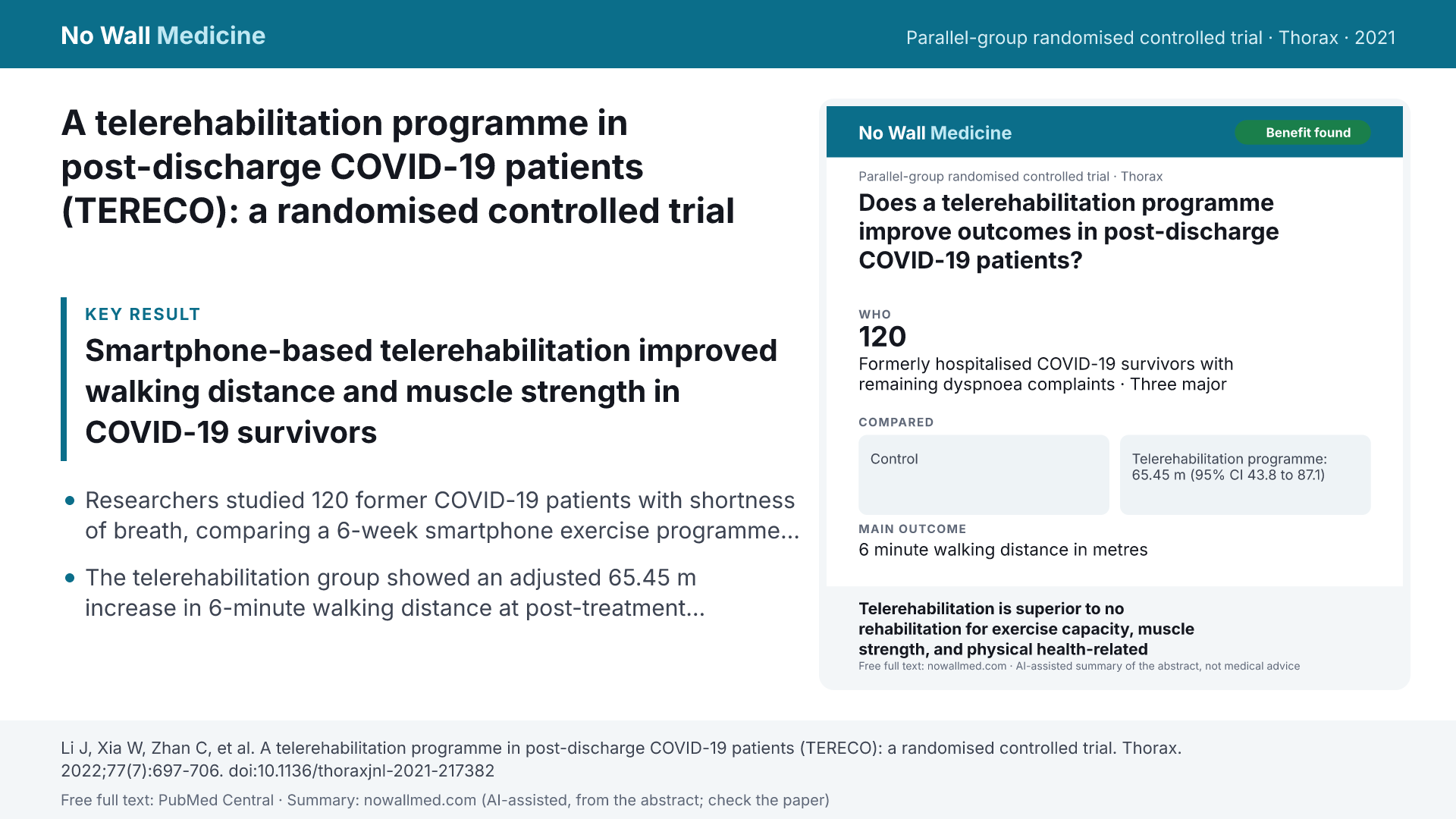
Smartphone-based telerehabilitation improved walking distance and muscle strength in COVID-19 survivors
A telerehabilitation programme in post-discharge COVID-19 patients (TERECO): a randomised controlled trial
Parallel-group randomised controlled trialBenefit found
Does a telerehabilitation programme improve outcomes in post-discharge COVID-19 patients?
Who
120
Formerly hospitalised COVID-19 survivors with remaining dyspnoea complaints · Three major hospitals in China
Compared
Control
Telerehabilitation programme: 65.45 m (95% CI 43.8 to 87.1)
Main outcome
6 minute walking distance in metres
Result: 65.45 m (95% CI 43.8 to 87.1)
Bottom line: Telerehabilitation is superior to no rehabilitation for exercise capacity, muscle strength, and physical health-related quality of life.
Thorax · 2021-07-26Download image
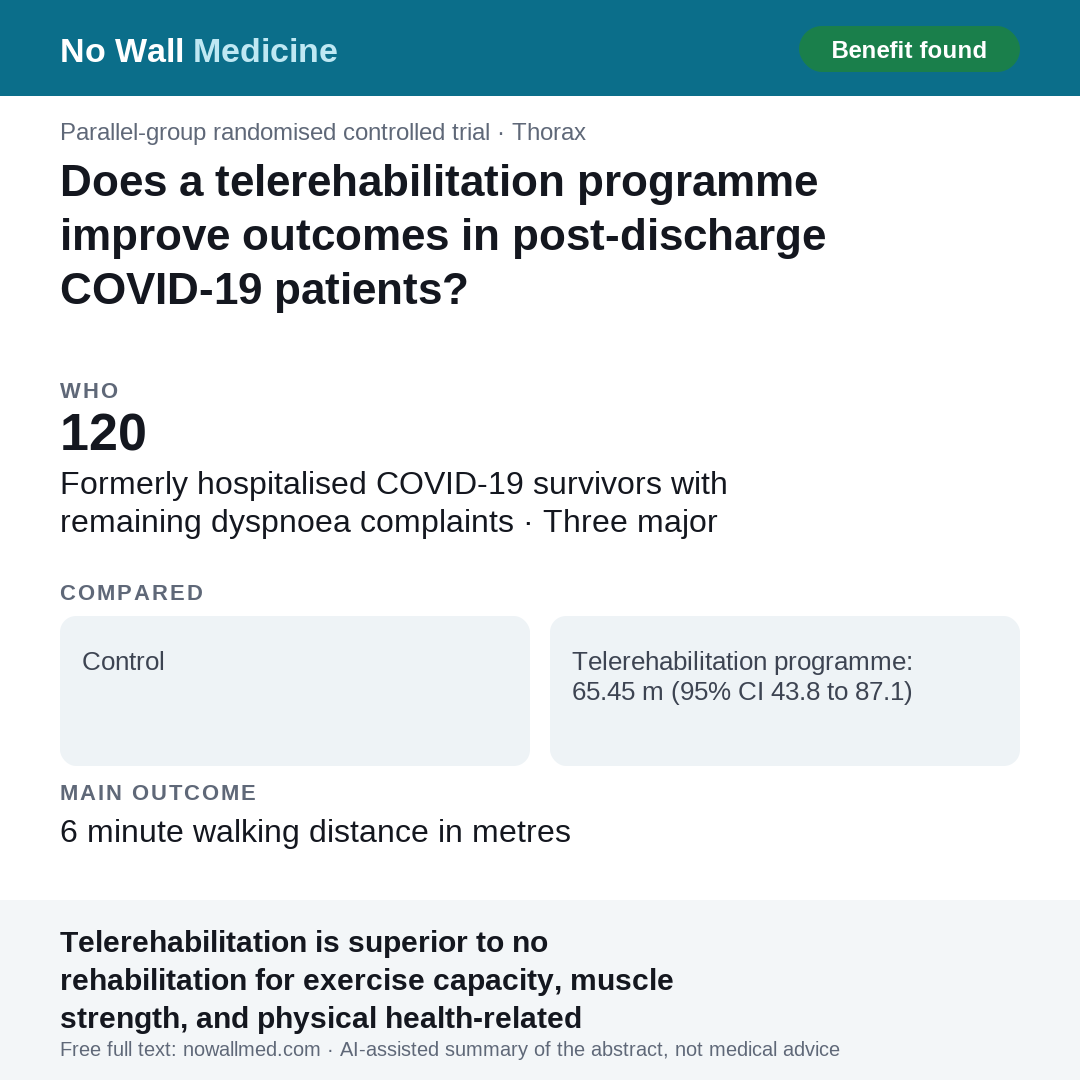
Clinical question: Does a telerehabilitation programme improve outcomes in post-discharge COVID-19 patients?
Why it matters: It was unknown if a remote, unsupervised exercise programme could improve physical capacity and muscle strength in people recovering from COVID-19.
Key points
- Researchers studied 120 former COVID-19 patients with shortness of breath, comparing a 6-week smartphone exercise programme to no rehabilitation.
- The telerehabilitation group showed an adjusted 65.45 m increase in 6-minute walking distance at post-treatment and 68.62 m at 28-week follow-up.
- Lower limb muscle strength increased by 20.12 s post-treatment and 22.23 s at follow-up, while physical health-related quality of life also improved.
Headline and key points written with AI from the paper’s abstract, with every number checked against it. Read the paper before relying on them.
Was this summary helpful?
Abstract
Objectives
To investigate superiority of a telerehabilitation programme for COVID-19 (TERECO) over no rehabilitation with regard to exercise capacity, lower limb muscle strength (LMS), pulmonary function, health-related quality of life (HRQOL) and dyspnoea. Design
Parallel-group randomised controlled trial with 1:1 block randomisation. Setting
Three major hospitals from Jiangsu and Hubei provinces, China. Participants
120 formerly hospitalised COVID-19 survivors with remaining dyspnoea complaints were randomised with 61 allocated to control and 59 to TERECO. Intervention
Unsupervised home-based 6-week exercise programme comprising breathing control and thoracic expansion, aerobic exercise and LMS exercise, delivered via smartphone, and remotely monitored with heart rate telemetry. Outcomes
Primary outcome was 6 min walking distance (6MWD) in metres. Secondary outcomes were squat time in seconds; pulmonary function assessed by spirometry; HRQOL measured with Short Form Health Survey-12 (SF-12) and mMRC-dyspnoea. Outcomes were assessed at 6 weeks (post-treatment) and 28 weeks (follow-up). Results
Adjusted between-group difference in change in 6MWD was 65.45 m (95% CI 43.8 to 87.1; p<0.001) at post-treatment and 68.62 m (95% CI 46.39 to 90.85; p<0.001) at follow-up. Treatment effects for LMS were 20.12 s (95% CI 12.34 to 27.9; p<0.001) post-treatment and 22.23 s (95% CI 14.24 to 30.21; p<0.001) at follow-up. No group differences were found for lung function except post-treatment maximum voluntary ventilation. Increase in SF-12 physical component was greater in the TERECO group with treatment effects estimated as 3.79 (95% CI 1.24 to 6.35; p=0.004) at post-treatment and 2.69 (95% CI 0.06 to 5.32; p=0.045) at follow-up. Conclusions
This trial demonstrated superiority of TERECO over no rehabilitation for 6MWD, LMS, and physical HRQOL. Trial registration number
ChiCTR2000031834.
Abstract reproduced under the article’s CC BY NC licence.
Subject terms
Cite this article
Li J, Xia W, Zhan C, et al. A telerehabilitation programme in post-discharge COVID-19 patients (TERECO): a randomised controlled trial. Thorax. 2021. doi:10.1136/thoraxjnl-2021-217382
Spotted a mistake? Suggest a correction