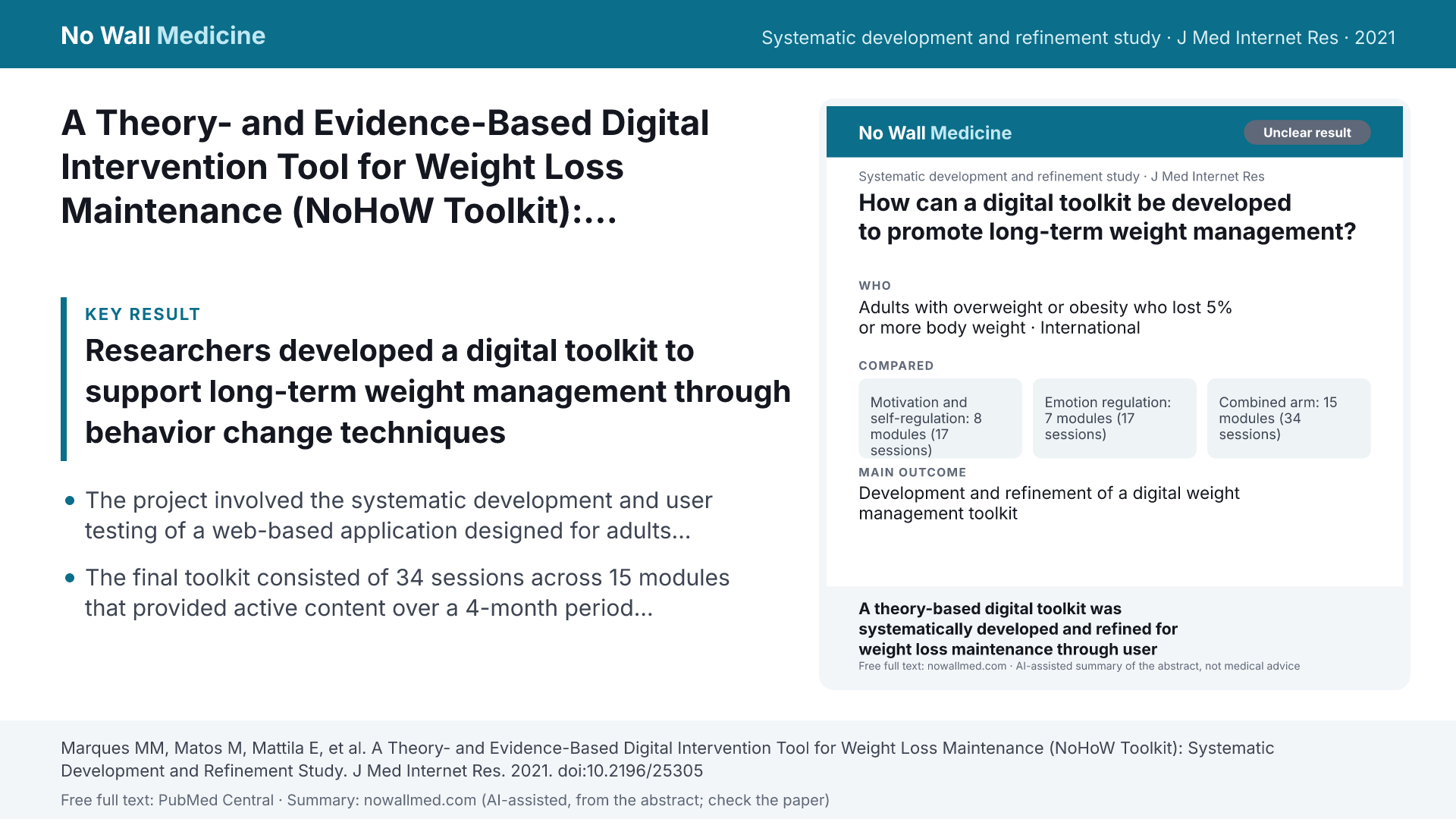
Researchers developed a digital toolkit to support long-term weight management through behavior change techniques
A Theory- and Evidence-Based Digital Intervention Tool for Weight Loss Maintenance (NoHoW Toolkit): Systematic Development and Refinement Study
Systematic development and refinement studyUnclear result
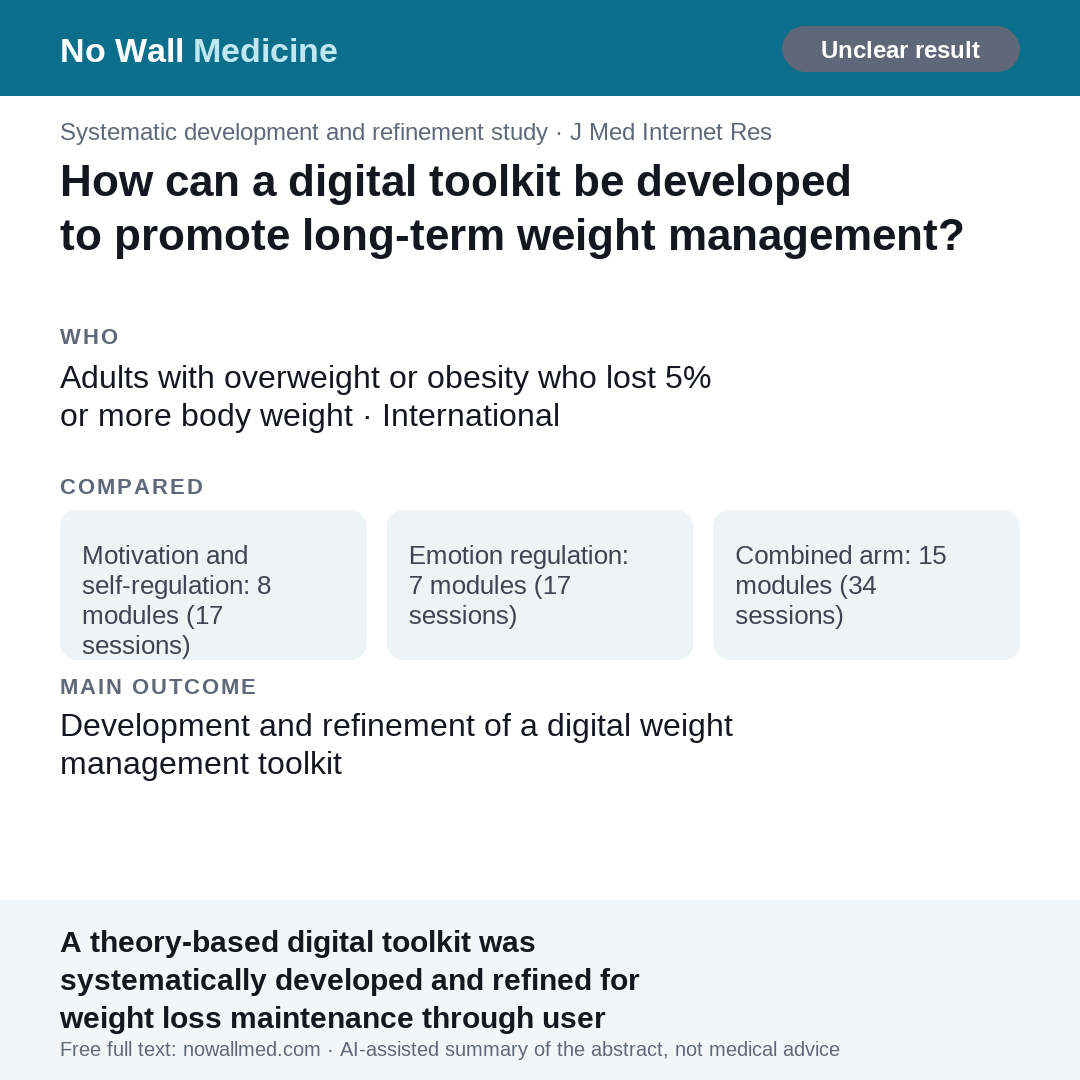
How can a digital toolkit be developed to promote long-term weight management?
Who
Adults with overweight or obesity who lost 5% or more body weight · International
Compared
Motivation and self-regulation: 8 modules (17 sessions)
Emotion regulation: 7 modules (17 sessions)
Combined arm: 15 modules (34 sessions)
Main outcome
Development and refinement of a digital weight management toolkit
Bottom line: A theory-based digital toolkit was systematically developed and refined for weight loss maintenance through user testing.
Funded by: European Union's Horizon 2020 research and innovation program
J Med Internet Res · 2021-12-03Download image
Clinical question: How can a digital toolkit be developed to promote long-term weight management?
Why it matters: Maintaining weight loss after initial success is difficult, and it is unknown how to effectively deliver behavior change approaches through low-cost digital technologies.
Key points
- The project involved the systematic development and user testing of a web-based application designed for adults with overweight or obesity who previously lost at least 5% of their body weight.
- The final toolkit consisted of 34 sessions across 15 modules that provided active content over a 4-month period using videos, testimonies, and questionnaires.
- The digital tool included five data tiles to monitor weight, steps, healthy eating, mood, and sleep using inputs from smart scales and activity trackers.
Headline and key points written with AI from the paper’s abstract, with every number checked against it. Read the paper before relying on them.
Was this summary helpful?
Subject terms
Cite this article
Marques MM, Matos M, Mattila E, et al. A Theory- and Evidence-Based Digital Intervention Tool for Weight Loss Maintenance (NoHoW Toolkit): Systematic Development and Refinement Study. J Med Internet Res. 2021. doi:10.2196/25305
Spotted a mistake? Suggest a correction