Six months of group exercise plus standard care reduced mental health symptom severity
A transdiagnostic group exercise intervention for mental health outpatients in Germany (ImPuls): results of a pragmatic, multisite, block-randomised, phase 3 controlled trial
Pragmatic, two-arm, multisite, randomised controlled trialBenefit found
Does a 6-month transdiagnostic group exercise intervention improve global symptom severity?
Who
400
Outpatients with depression, insomnia, PTSD, panic disorder, or agoraphobia · Ten outpatient rehabilitative and medical care facilities in Germany
Compared
ImPuls plus treatment-as-usual: adjusted difference on BSI-18 of 4·11
treatment-as-usual alone
Main outcome
global symptom severity measured by Brief Symptom Inventory
Result: adjusted difference on BSI-18 of 4·11 (95% CI 1·74-6·48)
Bottom line: A 6-month transdiagnostic group exercise intervention plus treatment-as-usual reduces global symptom severity in mental health outpatients.
Lancet Psychiatry · 2024-04-23Download image
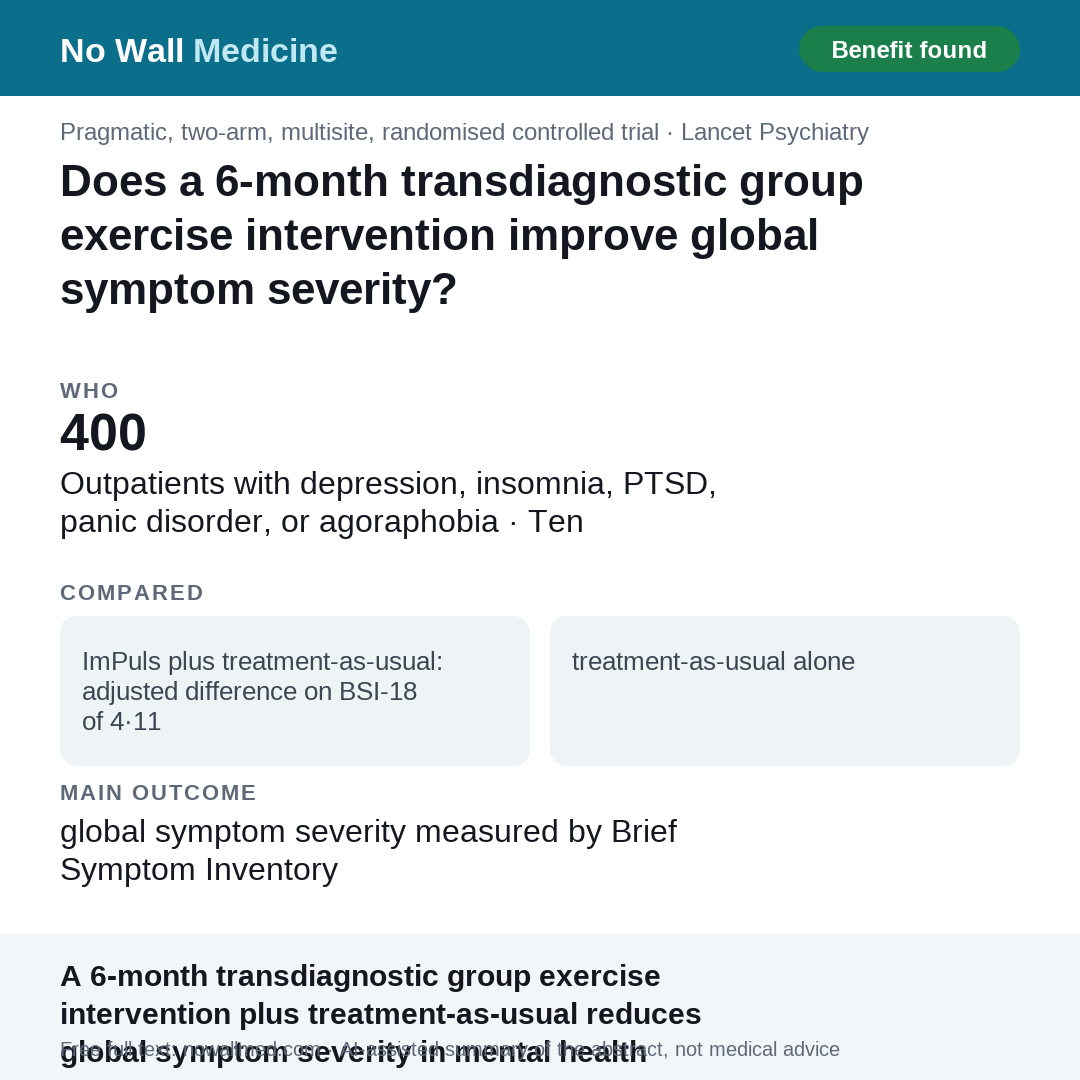
Clinical question: Does a 6-month transdiagnostic group exercise intervention improve global symptom severity?
Why it matters: It is unknown if adding a transdiagnostic group exercise program to standard outpatient care improves symptom severity for patients with various mental disorders.
Key points
- The study randomized 400 outpatients with conditions like depression, insomnia, or PTSD to receive either a 6-month group exercise program plus standard care or standard care alone.
- The group receiving the exercise intervention showed a superior reduction in global symptom severity at 6 months, with an adjusted difference on the Brief Symptom Inventory of 4.11.
- There were no significant differences in the total number of adverse events or serious adverse events between the two groups.
Headline and key points written with AI from the paper’s abstract, with every number checked against it. Read the paper before relying on them.
Was this summary helpful?
Abstract
Background
Globally, mental health conditions pose a substantial burden of disease. Despite the availability of evidence-based pharmacological and psychological treatments, the symptoms of a substantial subgroup of patients do not respond to these interventions, and only a minority of patients have access to them. This study aimed to assess the efficacy of ImPuls, a 6-month transdiagnostic group exercise intervention, plus treatment-as-usual, compared with treatment-as-usual alone in outpatients with various mental disorders. Methods
In this pragmatic, two-arm, multisite, randomised controlled trial in Germany, ten outpatient rehabilitative and medical care facilities were involved as study sites. Participants were outpatients diagnosed according to ICD-10 with one or more of the following disorders based on structured clinical interviews: moderate or severe depression, primary insomnia, post-traumatic stress disorder (PTSD), panic disorder, or agoraphobia. Participants were required to be aged between 18 years and 65 years, insured by the health insurers Allgemeine Ortskrankenkasse Baden-Württemberg or Techniker Krankenkasse, fluent in German, and without medical contraindications for exercise. Blocks of six participants were randomly allocated to ImPuls plus treatment-as-usual or treatment-as-usual alone (allocation ratio: 1:1), stratified by study site. The randomisation sequence was generated by an external data manager. The team responsible for data collection and management was masked to the randomisation sequence. The ImPuls intervention comprised evidence-based outdoor exercises lasting 30 min, and aimed at achieving at least moderate intensity. It also incorporated behavioural change techniques targeting motivational and volitional determinants of exercise behaviour. Treatment-as-usual was representative of typical outpatient health care in Germany, allowing patients access to any standard treatments. The primary outcome was global symptom severity at 6 months after randomisation, measured using self-report on the Brief Symptom Inventory (BSI-18) and analysed in the intention-to-treat sample. No individuals with lived experience of mental illness were involved in conducting the study or writing the final publication. Safety was assessed in all participants. The trial was registered with the German Clinical Trials Register (DRKS00024152) with a completion date of June 30, 2024. Findings
600 patients provided informed consent, were recruited to the study, and underwent a diagnostic interview between Jan 1, 2021, and May 31, 2022. Following this, 199 were excluded on the basis of inclusion and exclusion criteria and one withdrew consent during the baseline assessment. Of the 400 eligible participants, 284 (71%) self-identified as female, 106 (27%) self-identified as male, and nine (2%) self-identified as other. The mean age was 42·20 years (SD 13·23; range 19-65). Ethnicity data were not assessed. 287 (72%) participants met the criteria for moderate or severe depression, 81 (20%) for primary insomnia, 37 (9%) for agoraphobia, 46 (12%) for panic disorder, and 72 (18%) for PTSD. 199 participants were allocated to the intervention group of ImPuls plus treatment-as-usual and 201 to the control group of treatment-as-usual alone. 38 (19%) participants did not receive the minimum ImPuls intervention dose. ImPuls plus treatment-as-usual demonstrated superior efficacy to treatment-as-usual alone in reducing global symptom severity, with an adjusted difference on BSI-18 of 4·11 (95% CI 1·74-6·48; d=0·35 [95% CI 0·14-0·56]; p=0·0007) at 6 months. There were no significant differences in the total number of adverse events or serious adverse events between the two groups. There was one serious adverse event (male, torn ligament) related to the intervention. Interpretation
ImPuls is an efficacious transdiagnostic adjunctive treatment in outpatient mental health care. Our findings suggest that exercise therapy should be implemented in outpatient mental health care as an adjunctive transdiagnostic treatment for mental disorders such as depression, insomnia, panic disorder, agoraphobia, and PTSD. Transdiagnostic group exercise interventions might ameliorate the existing disparity in care provision between the many individuals in need of evidence-based treatment and the few who are receiving it. Funding
The German Innovation Fund of the Federal Joint Committee of Germany.
Abstract reproduced under the article’s CC BY licence.
Subject terms
Cite this article
Wolf S, Seiffer B, Zeibig JM, Frei AK, Studnitz T, Welkerling J. A transdiagnostic group exercise intervention for mental health outpatients in Germany (ImPuls): results of a pragmatic, multisite, block-randomised, phase 3 controlled trial. Lancet Psychiatry. 2024. doi:10.1016/S2215-0366(24)00069-5
Spotted a mistake? Suggest a correction
Top studies every Monday
The week’s key trials and guidelines in your specialties, plus any topics you follow. By email, free.
Get the weekly digest