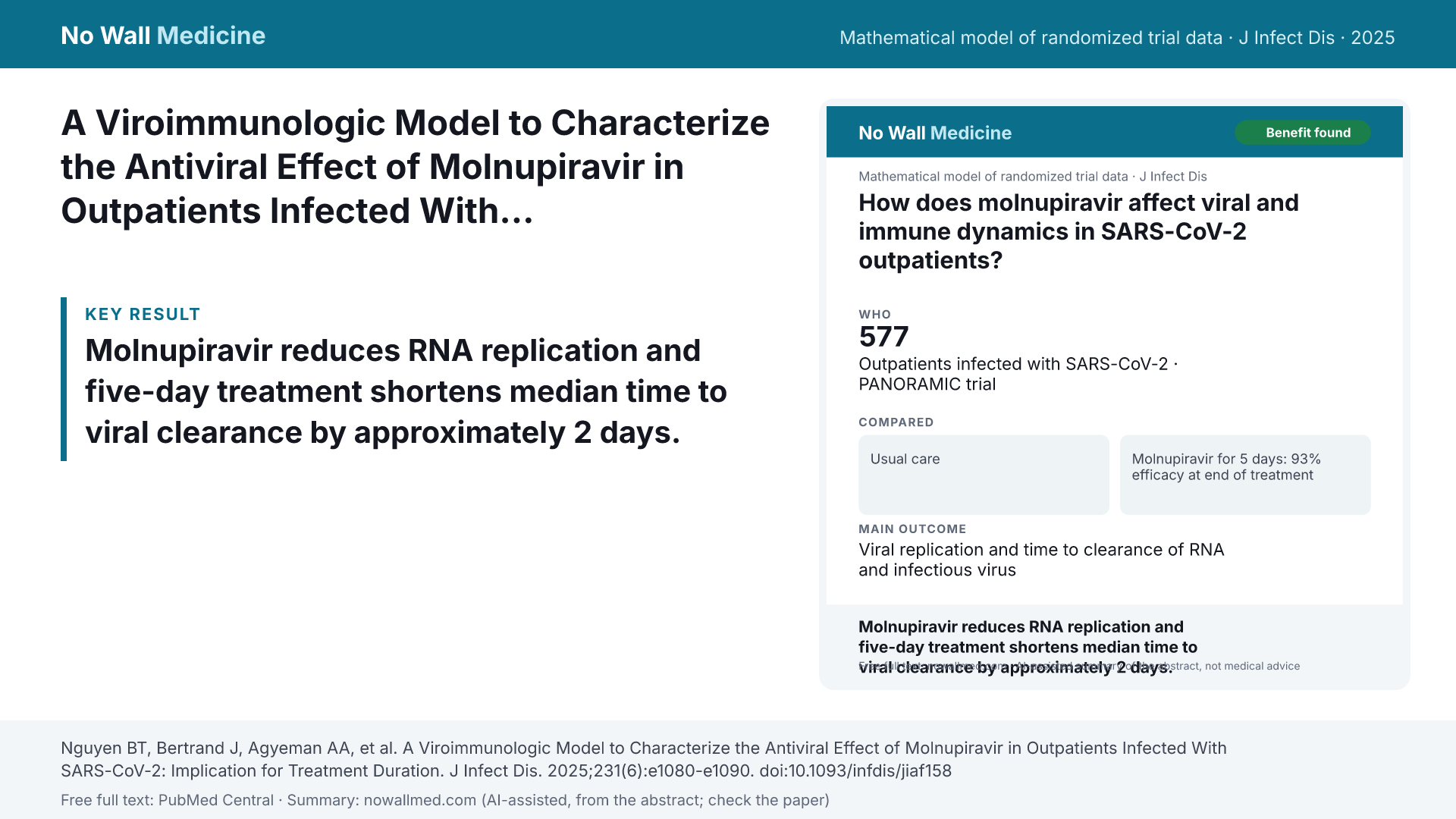
A Viroimmunologic Model to Characterize the Antiviral Effect of Molnupiravir in Outpatients Infected With SARS-CoV-2: Implication for Treatment Duration
Mathematical model of randomized trial dataBenefit found
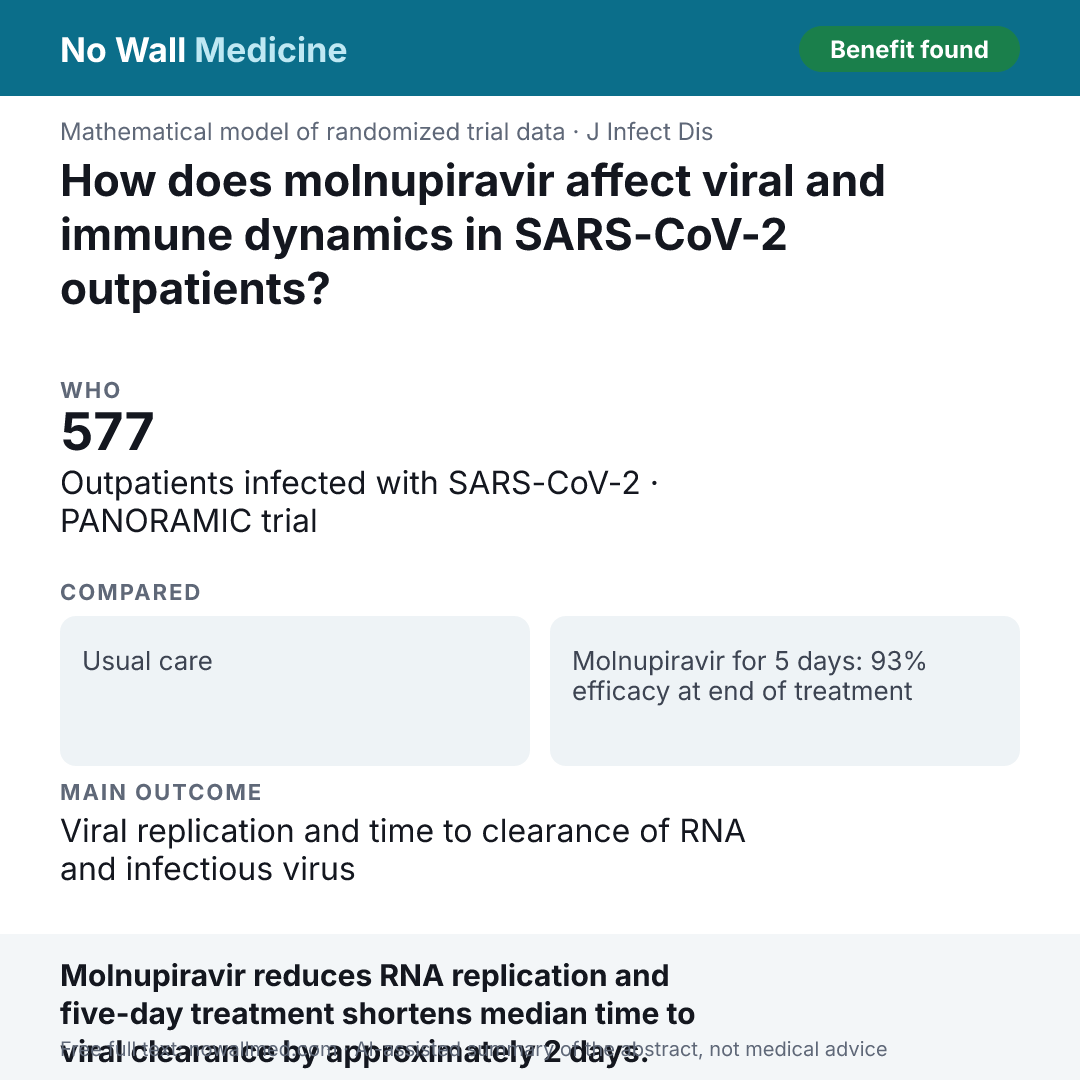
How does molnupiravir affect viral and immune dynamics in SARS-CoV-2 outpatients?
Who
577
Outpatients infected with SARS-CoV-2 · PANORAMIC trial
Compared
Usual care
Molnupiravir for 5 days: 93% efficacy at end of treatment
Main outcome
Viral replication and time to clearance of RNA and infectious virus
Bottom line: Molnupiravir reduces RNA replication and five-day treatment shortens median time to viral clearance by approximately 2 days.
J Infect Dis · 2025-04-01 · Save PNG
Clinical question: How does molnupiravir affect viral and immune dynamics in SARS-CoV-2 outpatients?
Abstract
Background
The antiviral efficacy of molnupiravir against SARS-CoV-2 is controversial. Here, we develop a model integrating viral and immune dynamics to characterize the mechanism of action of molnupiravir in vivo and its impact on viral dynamics during and after treatment. Methods
We analyzed data from the PANORAMIC trial, where 577 outpatients were randomized shortly after symptom onset to receive usual care or molnupiravir for 5 days, with viral and immunologic data collected within 2 weeks. We developed a mathematical model that characterized virus-host interaction, accounting for the impact of molnupiravir on viral replication and mutagenesis. The model was used to explore the impact of longer treatment duration. Results
Molnupiravir reduced RNA replication with an efficacy that reached 93% at the end of a 5-day treatment. This effect was mediated through 2 pathways: 1 that increased transition mutation frequency and 1 that directly inhibited viral production. Accordingly, 5-day treatment shortened the median time to clearance of RNA and infectious virus by approximately 2 days. Ten-day treatment could reduce the time to RNA clearance by 5 days and the occurrence of viral rebounds. Longer treatment durations might be needed for postexposure prophylaxis. Conclusions
Our model suggests that molnupiravir acts primarily on viral replication, and not specifically on viral infectivity. Longer administration of molnupiravir may reduce the rebound rate, shortening the time to viral clearance.
Subject terms
Headline, design, result, key points, caveat and citation as plain text.
Cite this article
Nguyen BT, Bertrand J, Agyeman AA, et al. A Viroimmunologic Model to Characterize the Antiviral Effect of Molnupiravir in Outpatients Infected With SARS-CoV-2: Implication for Treatment Duration. J Infect Dis. 2025;231(6):e1080-e1090. doi:10.1093/infdis/jiaf158
Spotted a mistake? Suggest a correction