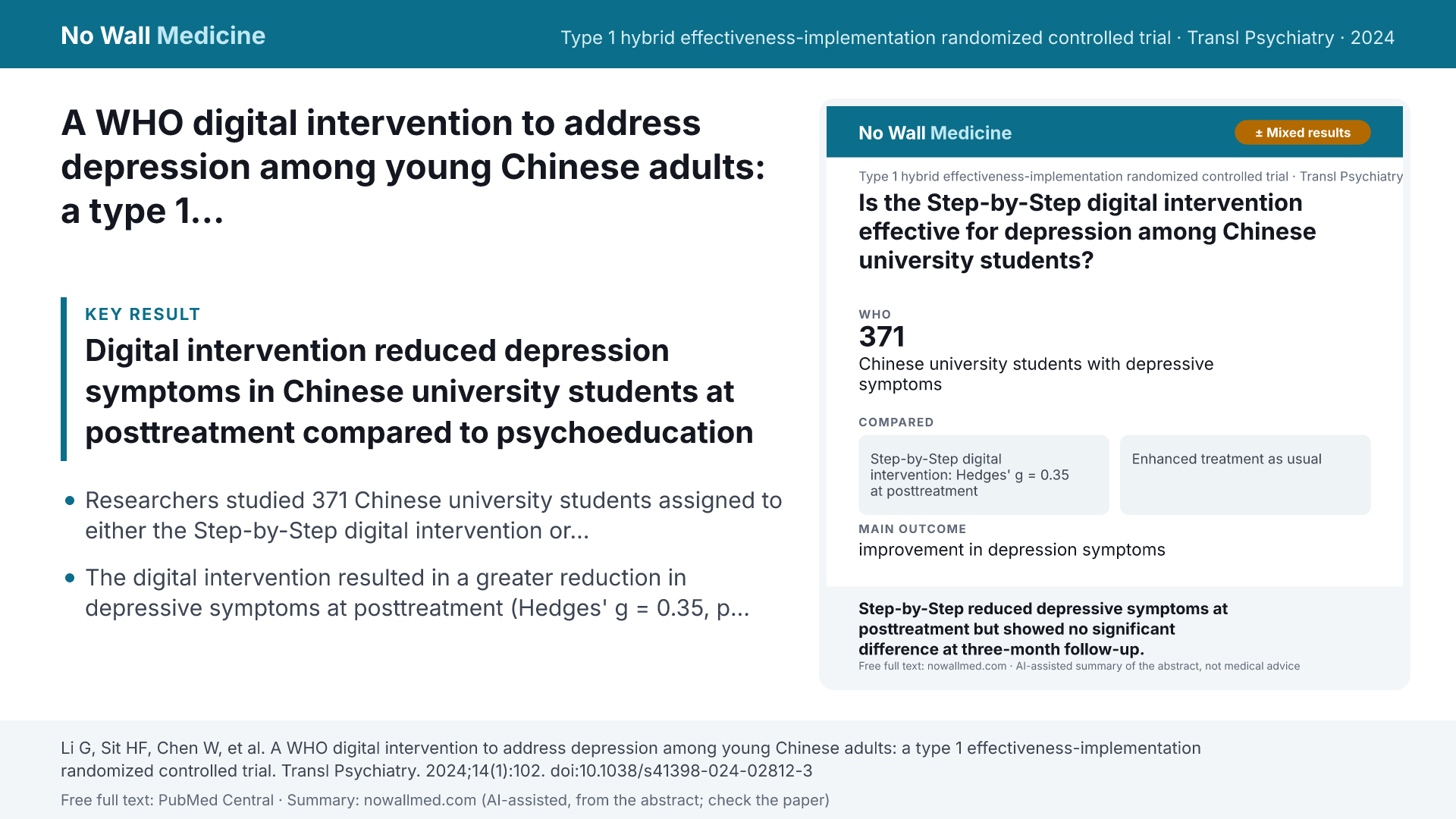
Digital intervention reduced depression symptoms in Chinese university students at posttreatment compared to psychoeducation
A WHO digital intervention to address depression among young Chinese adults: a type 1 effectiveness-implementation randomized controlled trial
Type 1 hybrid effectiveness-implementation randomized controlled trialMixed results
Is the Step-by-Step digital intervention effective for depression among Chinese university students?
Who
371
Chinese university students with depressive symptoms
Compared
Step-by-Step digital intervention: Hedges' g = 0.35 at posttreatment
Enhanced treatment as usual
Main outcome
improvement in depression symptoms
Result: Hedges' g = 0.35 (p = 0.004) at posttreatment
Bottom line: Step-by-Step reduced depressive symptoms at posttreatment but showed no significant difference at three-month follow-up.
Limitation: The sustained effect on depression needs further investigation.
Transl Psychiatry · 2024-02-20Download image
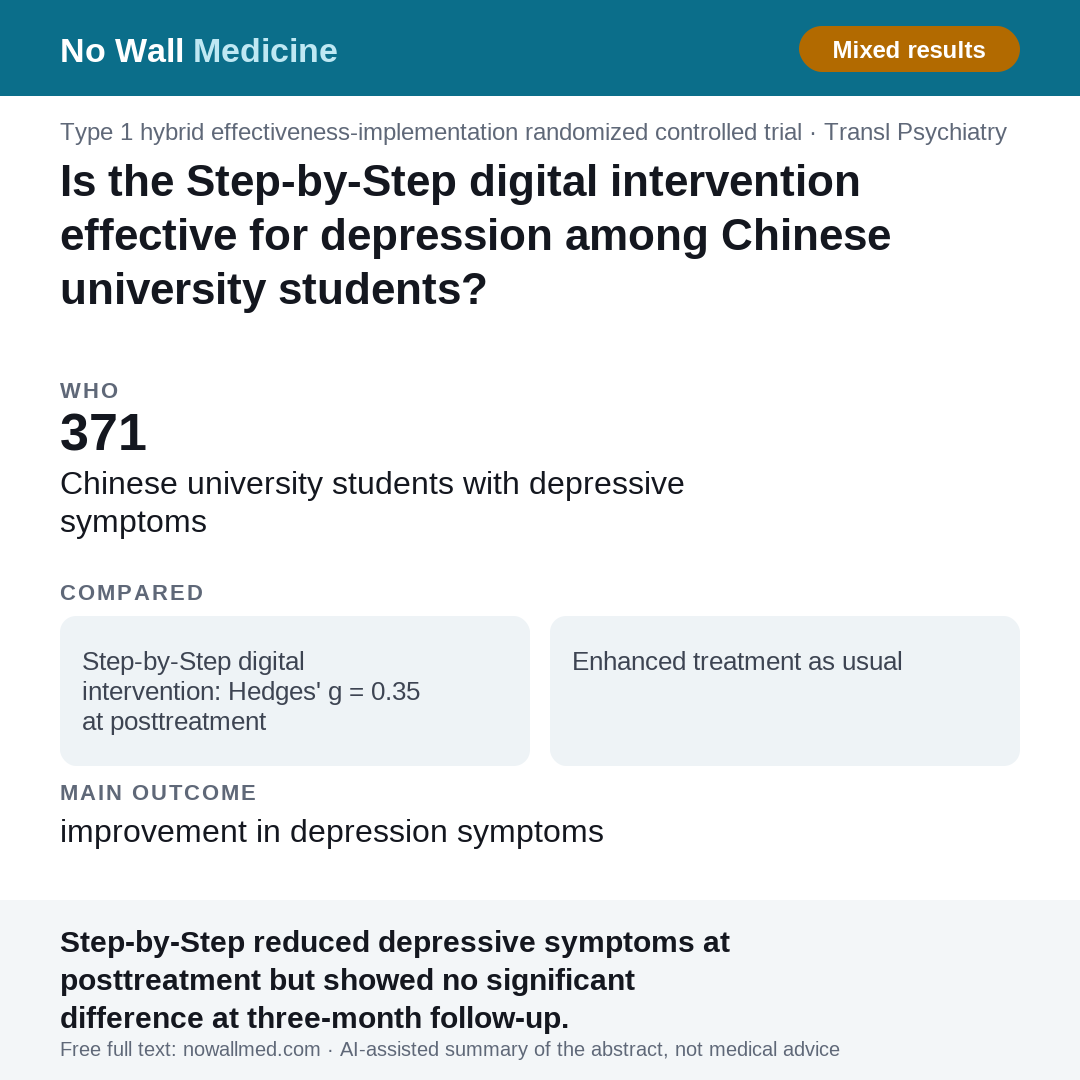
Clinical question: Is the Step-by-Step digital intervention effective for depression among Chinese university students?
Why it matters: Current university-based interventions are inadequate to address the rising global need for evidence-based mental health support among young people.
Key points
- Researchers studied 371 Chinese university students assigned to either the Step-by-Step digital intervention or enhanced treatment as usual, which consisted of psychoeducation.
- The digital intervention resulted in a greater reduction in depressive symptoms at posttreatment (Hedges' g = 0.35, p = 0.004), but no significant difference was observed at three-month follow-up (Hedges' g = 0.16, p = 0.179).
- The digital intervention was associated with more improvement in anxiety symptoms at posttreatment (Hedges' g = 0.26, p = 0.029), but not at the three-month follow-up (Hedges' g = 0.13, p = 0.265).
Limitation the authors note: The sustained effect on depression needs further investigation.
Headline and key points written with AI from the paper’s abstract, with every number checked against it. Read the paper before relying on them.
Was this summary helpful?
Subject terms
Cite this article
Li G, Sit HF, Chen W, et al. A WHO digital intervention to address depression among young Chinese adults: a type 1 effectiveness-implementation randomized controlled trial. Transl Psychiatry. 2024. doi:10.1038/s41398-024-02812-3
Spotted a mistake? Suggest a correction