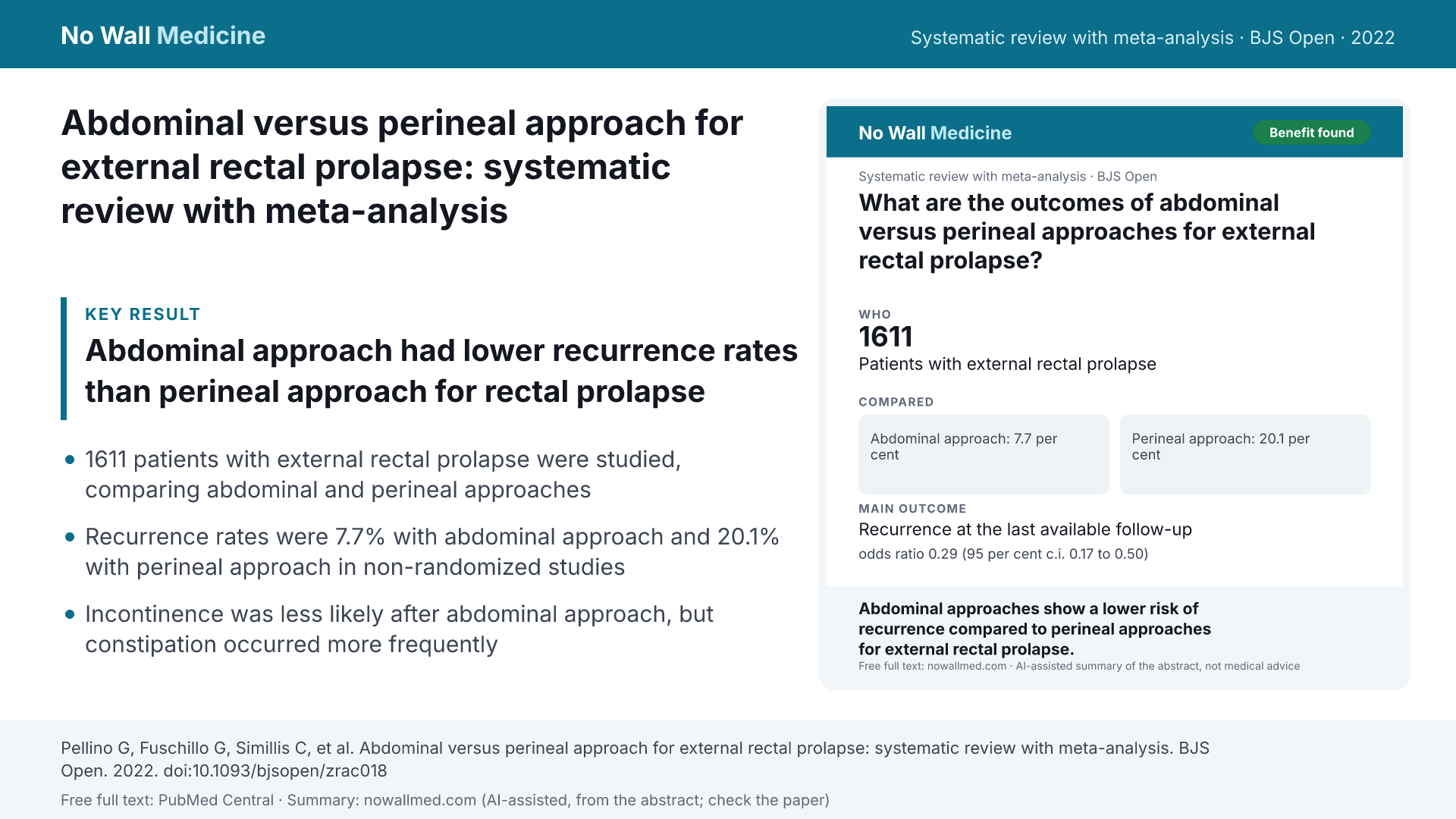
Abdominal versus perineal approach for external rectal prolapse: systematic review with meta-analysis
Key result: Abdominal approach had lower recurrence rates than perineal approach for rectal prolapse
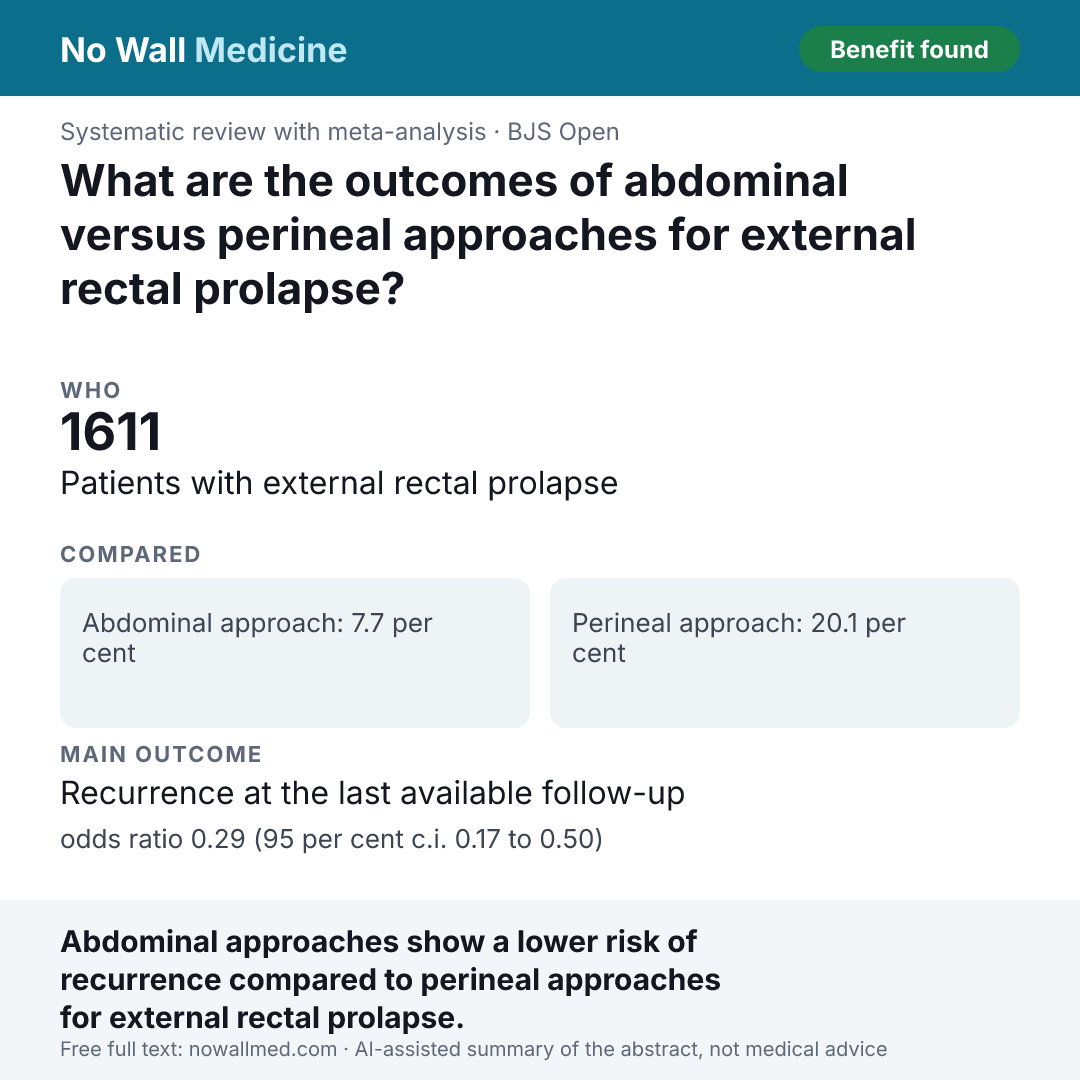
Systematic review with meta-analysisBenefit found
What are the outcomes of abdominal versus perineal approaches for external rectal prolapse?
Who
1611
Patients with external rectal prolapse
Compared
Abdominal approach: 7.7 per cent
Perineal approach: 20.1 per cent
Main outcome
Recurrence at the last available follow-up
Result: odds ratio 0.29 (95 per cent c.i. 0.17 to 0.50)
Bottom line: Abdominal approaches show a lower risk of recurrence compared to perineal approaches for external rectal prolapse.
Limitation: Most studies were retrospective and randomized controlled trial outcomes were inconsistent with non-randomized studies.
BJS Open · 2022-04-07 · Save PNG
Key points
- 1611 patients with external rectal prolapse were studied, comparing abdominal and perineal approaches.
- Recurrence rates were 7.7% with abdominal approach and 20.1% with perineal approach in non-randomized studies.
- Incontinence was less likely after abdominal approach, but constipation occurred more frequently.
Limitation the authors note: Most studies were retrospective, and several outcomes from randomized controlled trials were not consistent with those observed in non-randomized studies
Discussion prompts
- Would these patients look like yours? Who was left out?
- Is the main outcome one that matters to patients?
- Is the difference large enough to change what you do?
Cite: Pellino G, Fuschillo G, Simillis C, et al. Abdominal versus perineal approach for external rectal prolapse: systematic review with meta-analysis. BJS Open. 2022. doi:10.1093/bjsopen/zrac018
Free full text: PubMed Central · Summary and visual abstract: nowallmed.com/a/abdominal-versus-perineal-approach-for-external-rectal-prolapse-1svgd8j/ (AI-assisted from the abstract; check the paper before relying on it).