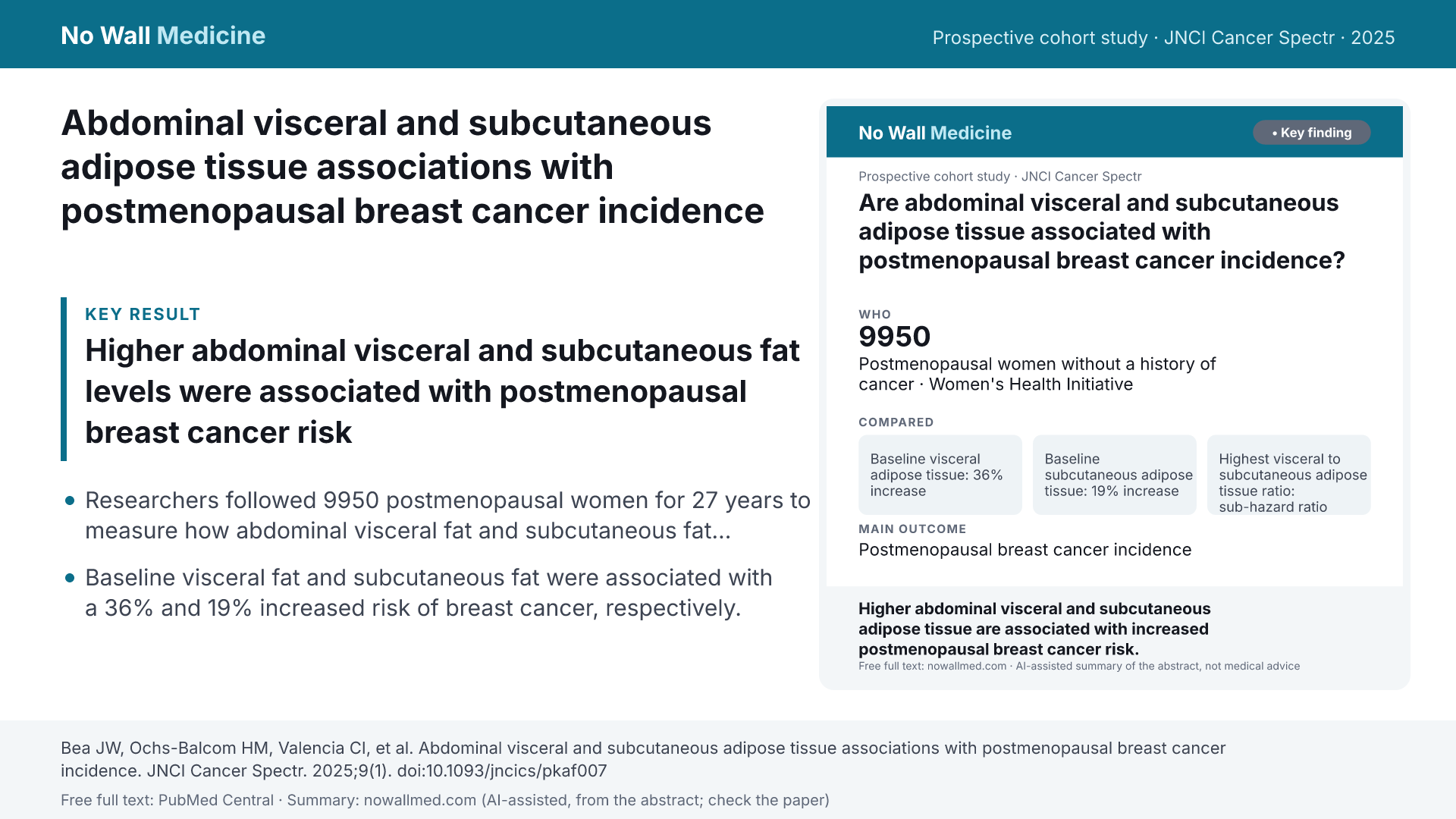
Higher abdominal visceral and subcutaneous fat levels were associated with postmenopausal breast cancer risk
Abdominal visceral and subcutaneous adipose tissue associations with postmenopausal breast cancer incidence
Prospective cohort studyKey finding
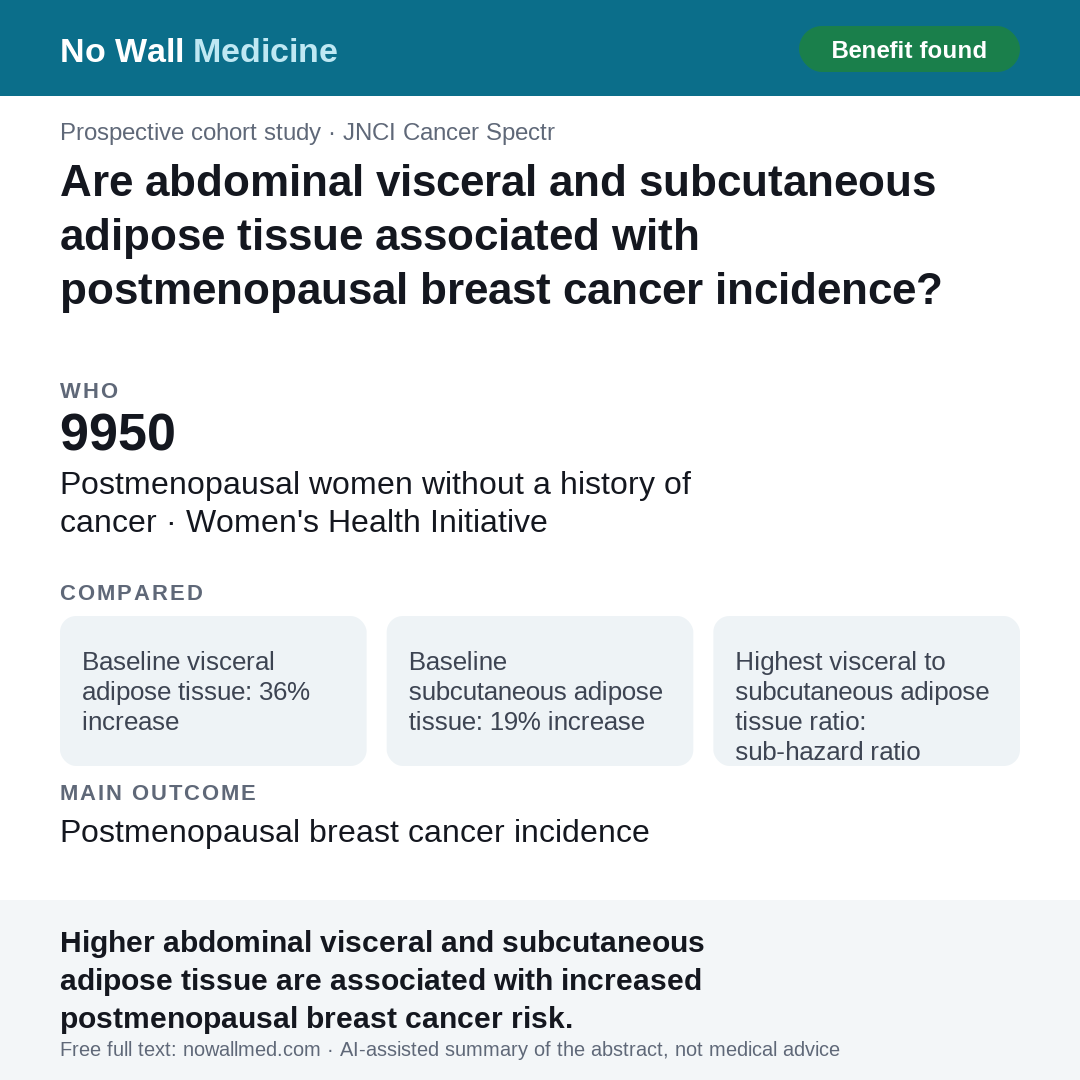
Are abdominal visceral and subcutaneous adipose tissue associated with postmenopausal breast cancer incidence?
Who
9950
Postmenopausal women without a history of cancer · Women's Health Initiative
Compared
Baseline visceral adipose tissue: 36% increase
Baseline subcutaneous adipose tissue: 19% increase
Highest visceral to subcutaneous adipose tissue ratio: sub-hazard ratio 1.49 (95% CI 1.18 to 1.87)
Main outcome
Postmenopausal breast cancer incidence
Result: sub-hazard ratio 1.49 (95% CI 1.18 to 1.87)
Bottom line: Higher abdominal visceral and subcutaneous adipose tissue are associated with increased postmenopausal breast cancer risk.
JNCI Cancer Spectr · 2025-01-23Download image
Clinical question: Are abdominal visceral and subcutaneous adipose tissue associated with postmenopausal breast cancer incidence?
Why it matters: The associations between abdominal visceral fat, subcutaneous fat, and breast cancer risk remain unclear despite the known link between body mass index and cancer risk.
Key points
- Researchers followed 9950 postmenopausal women for 27 years to measure how abdominal visceral fat and subcutaneous fat related to breast cancer incidence.
- Baseline visceral fat and subcutaneous fat were associated with a 36% and 19% increased risk of breast cancer, respectively.
- An increasing ratio of visceral fat to subcutaneous fat was associated with an 8% increase in incident breast cancer.
Headline and key points written with AI from the paper’s abstract, with every number checked against it. Read the paper before relying on them.
Was this summary helpful?
Subject terms
Cite this article
Bea JW, Ochs-Balcom HM, Valencia CI, et al. Abdominal visceral and subcutaneous adipose tissue associations with postmenopausal breast cancer incidence. JNCI Cancer Spectr. 2025. doi:10.1093/jncics/pkaf007
Spotted a mistake? Suggest a correction