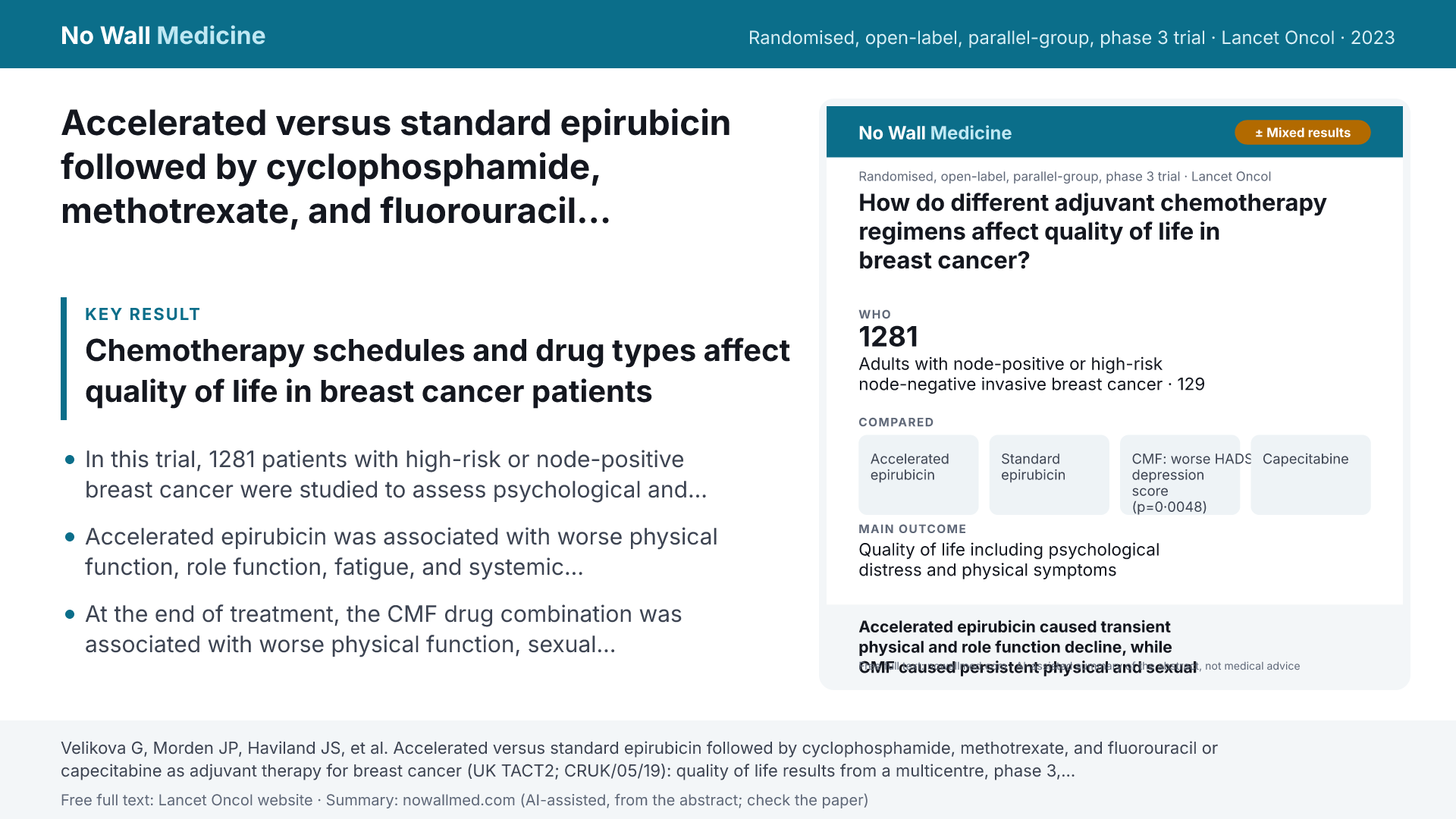
Chemotherapy schedules and drug types affect quality of life in breast cancer patients
Accelerated versus standard epirubicin followed by cyclophosphamide, methotrexate, and fluorouracil or capecitabine as adjuvant therapy for breast cancer (UK TACT2; CRUK/05/19): quality of life results from a multicentre, phase 3, open-label, randomised, controlled trial
Randomised, open-label, parallel-group, phase 3 trialMixed results
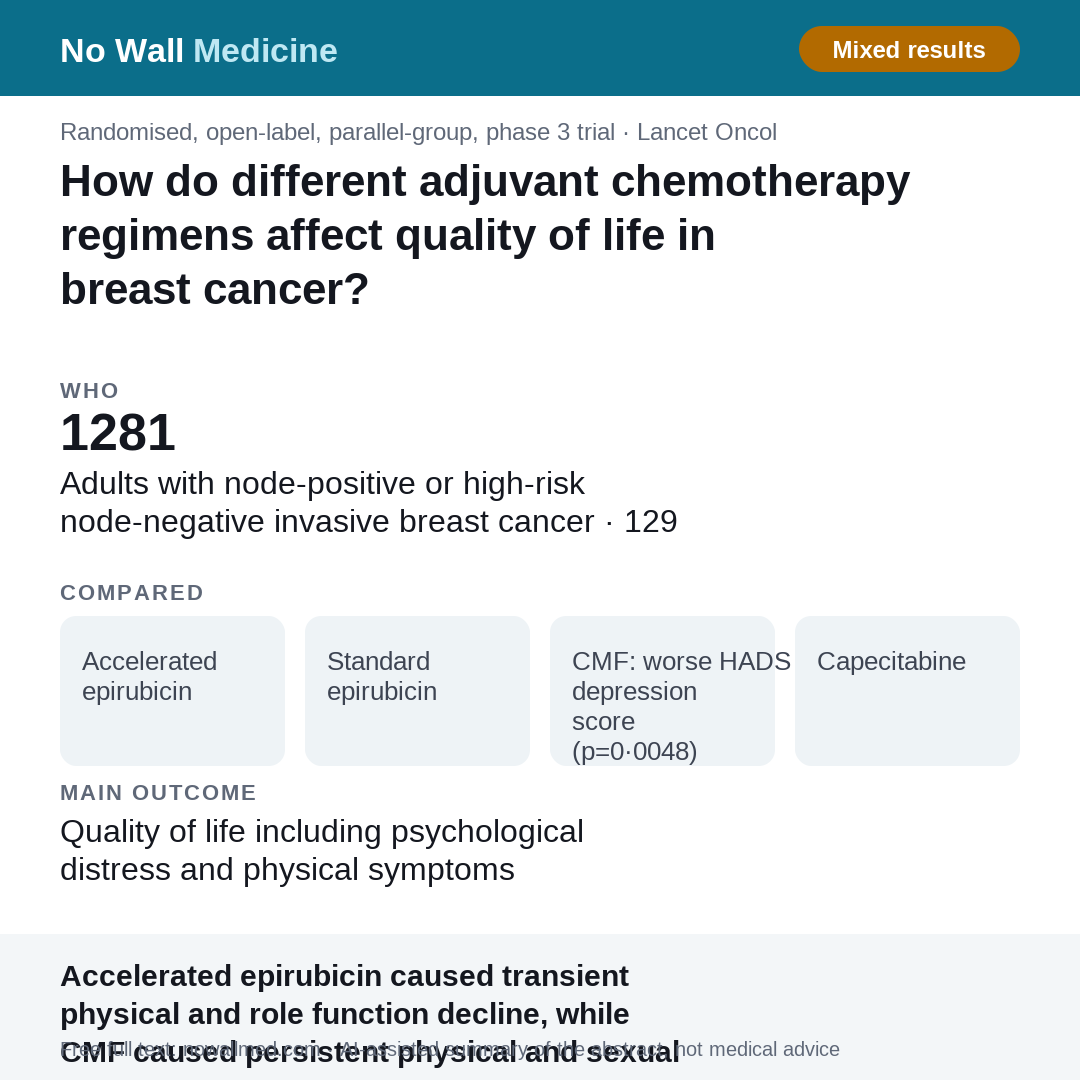
How do different adjuvant chemotherapy regimens affect quality of life in breast cancer?
Who
1281
Adults with node-positive or high-risk node-negative invasive breast cancer · 129 United Kingdom centres
Compared
Accelerated epirubicin
Standard epirubicin
CMF: worse HADS depression score (p=0·0048)
Capecitabine
Main outcome
Quality of life including psychological distress and physical symptoms
Bottom line: Accelerated epirubicin caused transient physical and role function decline, while CMF caused persistent physical and sexual function issues compared to capecitabine.
Lancet Oncol · 2023-11-02Download image
Clinical question: How do different adjuvant chemotherapy regimens affect quality of life in breast cancer?
Why it matters: It was unknown how different chemotherapy schedules and drug combinations affect psychological distress, physical symptoms, and functional domains in breast cancer patients.
Key points
- In this trial, 1281 patients with high-risk or node-positive breast cancer were studied to assess psychological and physical quality of life.
- Accelerated epirubicin was associated with worse physical function, role function, fatigue, and systemic side-effects during treatment compared to standard epirubicin.
- At the end of treatment, the CMF drug combination was associated with worse physical function, sexual function, fatigue, and systemic side-effects than capecitabine.
Headline and key points written with AI from the paper’s abstract, with every number checked against it. Read the paper before relying on them.
Was this summary helpful?
Abstract
Background
Adjuvant chemotherapy for patients with early breast cancer improves outcomes but its toxicity affects patients' quality of life (QOL). The UK TACT2 trial investigated whether accelerated epirubicin improves time to recurrence and if oral capecitabine is non-inferior to cyclophosphamide, methotrexate, and fluorouracil (CMF) for efficacy with less toxicity. Results showed no benefit for accelerated epirubicin and capecitabine was non-inferior. As part of the QOL substudy, we aimed to assess the effect of chemotherapies on psychological distress, physical symptoms, and functional domains. Methods
TACT2 was a multicentre, phase 3, open-label, parallel-group, randomised, controlled trial done in 129 UK centres. Participants were aged 18 years or older with histologically confirmed node-positive or high-risk node-negative invasive primary breast cancer, who had undergone complete excision, and due to receive adjuvant chemotherapy. Patients were randomly assigned (1:1:1:1) to four cycles of 100 mg/m2 epirubicin either every 3 weeks (standard epirubicin) or every 2 weeks with 6 mg pegfilgrastim on day 2 of each cycle (accelerated epirubicin), followed by four 4-week cycles of either CMF (600 mg/m2 cyclophosphamide intravenously on days 1 and 8 or 100 mg/m2 orally on days 1-14; 40 mg/m2 methotrexate intravenously on days 1 and 8; and 600 mg/m2 fluorouracil intravenously on days 1 and 8 of each cycle) or four 3-week cycles of 2500 mg/m2 capecitabine (1250 mg/m2 given twice daily on days 1-14 of each cycle). The randomisation schedule was computer generated in random permuted blocks, stratified by centre, number of nodes involved (none vs 1-3 vs ≥4), age (≤50 years vs >50 years), and planned endocrine treatment (yes vs no). QOL was one of the secondary outcomes and is reported here. All patients from a subset of 44 centres were invited to complete QOL questionnaires (Hospital Anxiety and Depression Scale [HADS] and European Organisation for Research and Treatment of Cancer [EORTC] Quality of Life Questionnaire 30-item core module [QLQ-C30] and Quality of Life Questionnaire breast module [QLQ-BR23]) at baseline, end of standard or accelerated epirubicin, end of CMF or capecitabine, and at 12 and 24 months after randomisation. The QOL substudy prespecified two coprimary QOL outcomes assessed in the intention-to-treat population: overall QOL (reported elsewhere) and HADS total score. Prespecified secondary QOL outcomes were EORTC QLQ-C30 subscales of physical function, role function, and fatigue and EORTC QLQ-BR23 subscales of sexual function and systemic therapy side-effects. This trial is registered with ISRCTN, ISRCTN68068041, and ClinicalTrials.gov, NCT00301925. Findings
From Dec 16, 2005, to Dec 5, 2008, 4391 patients (20 [0·5%] of whom were male) were enrolled in TACT2; 1281 (85·8%) of 1493 eligible patients were included in the QOL substudy. Eight (0·6%) participants in the QOL substudy were male and 1273 (99·4%) were female. Median follow-up was 85·6 months (IQR 80·6-95·9). Analysis was performed on the complete QOL dataset (as of Sept 15, 2011) when all participants had passed the 24-month timepoint. Prerandomisation questionnaires were completed by 1172 (91·5%) patients and 1179 (92·0%) completed at least one postrandomisation questionnaire. End-of-treatment HADS depression score (p=0·0048) and HADS total change score (p=0·0093) were worse for CMF versus capecitabine. Accelerated epirubicin led to worse physical function (p=0·0065), role function (p<0·0001), fatigue (p=0·0002), and systemic side-effects (p=0·0001), but not sexual function (p=0·36), compared with standard epirubicin during treatment, but the effect did not persist. Worse physical function (p=0·0048), sexual function (p=0·0053), fatigue (p<0·0001), and systemic side-effects (p<0·0001), but not role functioning (p=0·013), were seen for CMF versus capecitabine at end of treatment; these differences persisted at 12 months and 24 months. Interpretation
Accelerated epirubicin was associated with worse QOL than was standard epirubicin but only during treatment. These findings will help patients and clinicians make an informed choice about accelerated chemotherapy. CMF had worse QOL effects than did capecitabine, which were persistent for 24 months. The favourable capecitabine QOL compared with CMF supports its use as an adjuvant option after neoadjuvant chemotherapy in patients with triple-negative breast cancer. Funding
Cancer Research UK, Amgen, Pfizer, and Roche.
Abstract reproduced under the article’s CC BY NC ND licence.
Subject terms
Cite this article
Velikova G, Morden JP, Haviland JS, Emery C, Barrett-Lee P, Earl H. Accelerated versus standard epirubicin followed by cyclophosphamide, methotrexate, and fluorouracil or capecitabine as adjuvant therapy for breast cancer (UK TACT2; CRUK/05/19): quality of life results from a multicentre, phase 3, open-label, randomised, controlled trial. Lancet Oncol. 2023. doi:10.1016/S1470-2045(23)00460-6
Spotted a mistake? Suggest a correction
Top studies every Monday
The week’s key trials and guidelines in your specialties, plus any topics you follow. By email, free.
Get the weekly digest