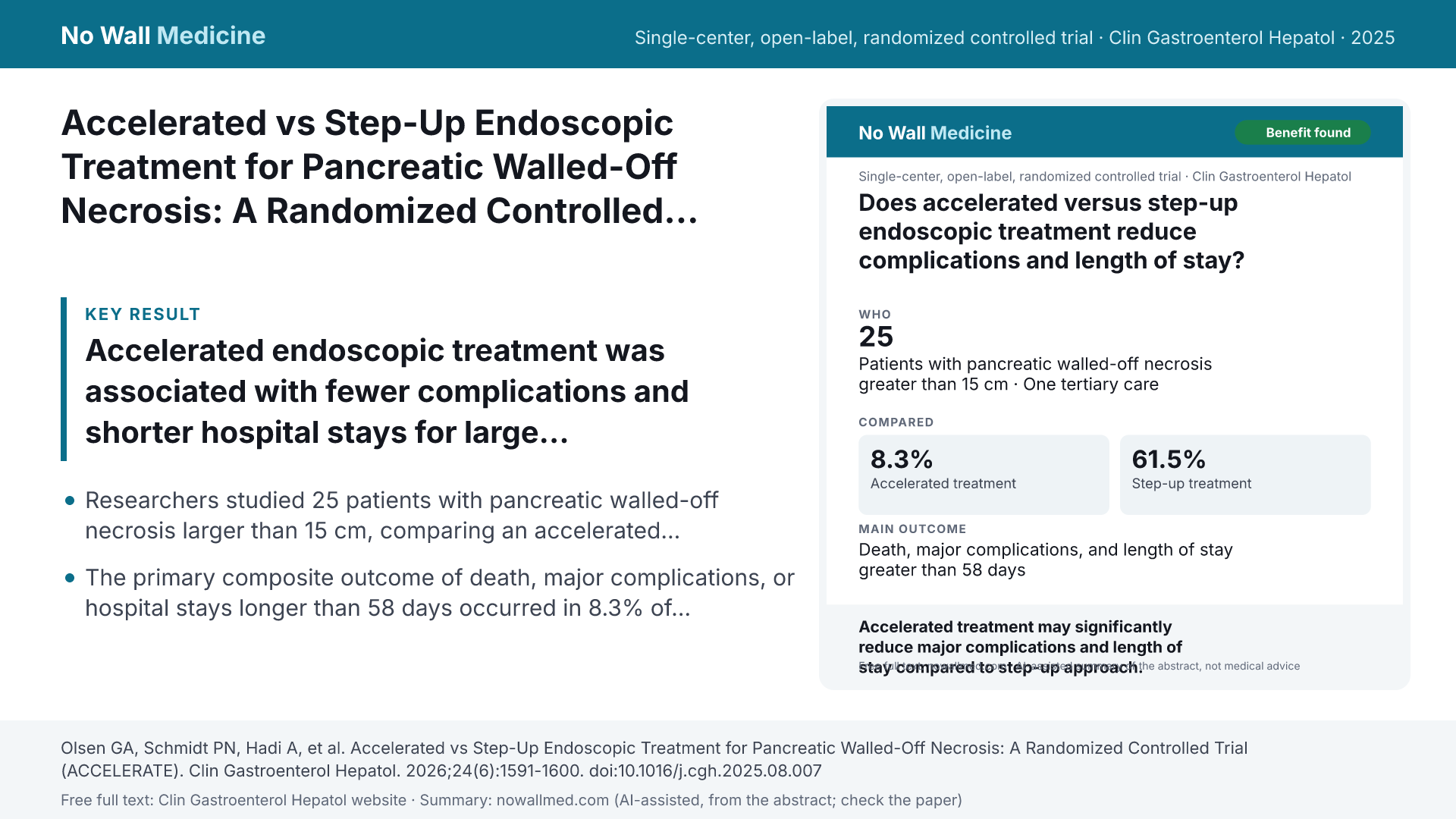
Accelerated endoscopic treatment was associated with fewer complications and shorter hospital stays for large pancreatic necrosis
Accelerated vs Step-Up Endoscopic Treatment for Pancreatic Walled-Off Necrosis: A Randomized Controlled Trial (ACCELERATE)
Single-center, open-label, randomized controlled trialBenefit found
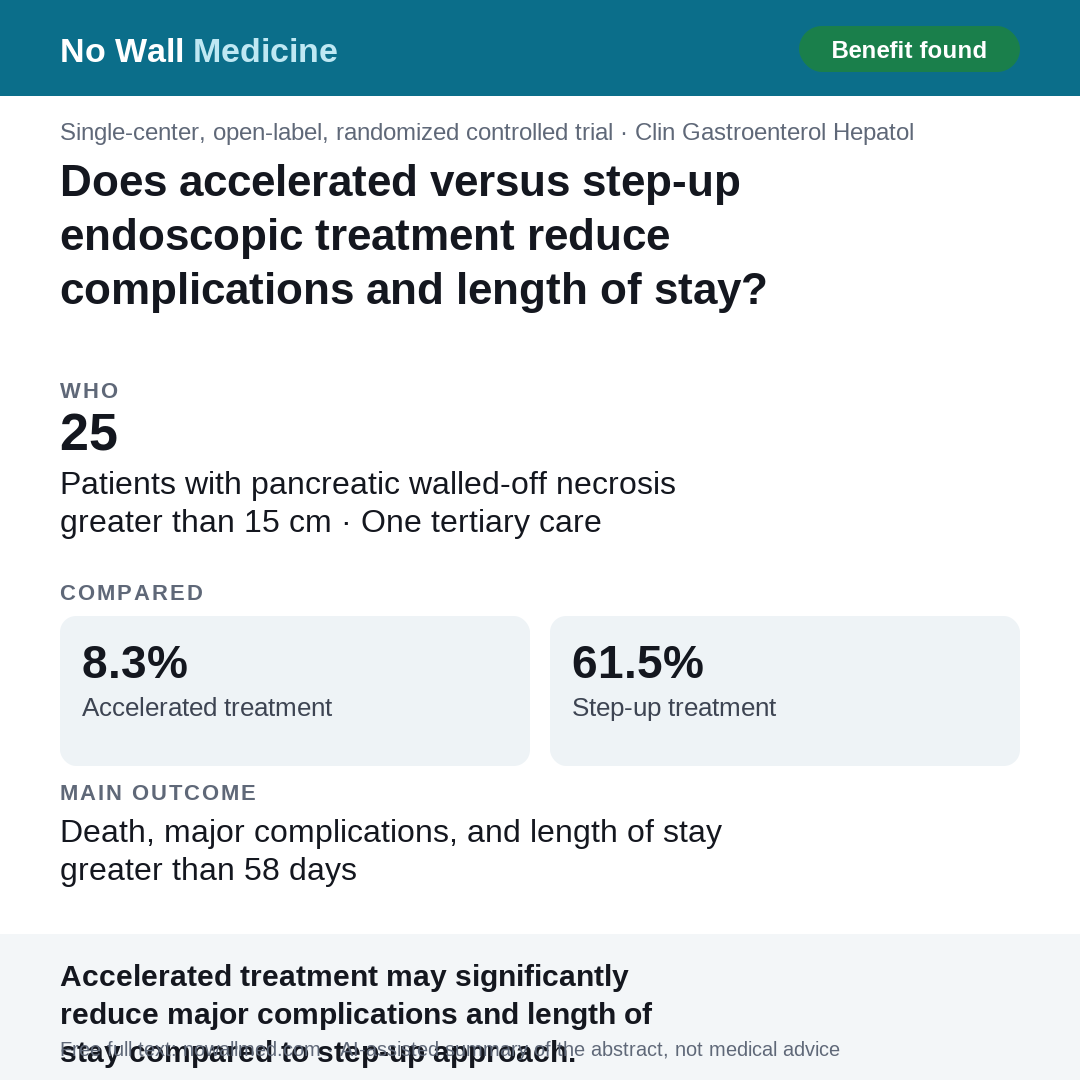
Does accelerated versus step-up endoscopic treatment reduce complications and length of stay?
Who
25
Patients with pancreatic walled-off necrosis greater than 15 cm · One tertiary care facility in Denmark
Compared
8.3%Accelerated treatment
61.5%Step-up treatment
Main outcome
Death, major complications, and length of stay greater than 58 days
Result: relative risk 0.14
Bottom line: Accelerated treatment may significantly reduce major complications and length of stay compared to step-up approach.
Limitation: The trial was prematurely terminated due to safety concerns in the step-up group.
Clin Gastroenterol Hepatol · 2025-08-18Download image
Clinical question: Does accelerated versus step-up endoscopic treatment reduce complications and length of stay?
Why it matters: Current standard treatment for large pancreatic walled-off necrosis involves a step-up approach that is associated with long hospital stays.
Key points
- Researchers studied 25 patients with pancreatic walled-off necrosis larger than 15 cm, comparing an accelerated treatment approach to a step-up approach.
- The primary composite outcome of death, major complications, or hospital stays longer than 58 days occurred in 8.3% of the accelerated group versus 61.5% in the step-up group.
- Major complications occurred in 0.0% of the accelerated group compared to 46.2% in the step-up group, and the median hospital stay was 32.5 days versus 68.5 days.
Limitation the authors note: The trial was prematurely terminated due to concerns for the safety of the patients in the step-up group based on a benefit-to-risk assessment.
Headline and key points written with AI from the paper’s abstract, with every number checked against it. Read the paper before relying on them.
Was this summary helpful?
Subject terms
Cite this article
Olsen GA, Schmidt PN, Hadi A, Prahm AP, Werge MP, Roug S. Accelerated vs Step-Up Endoscopic Treatment for Pancreatic Walled-Off Necrosis: A Randomized Controlled Trial (ACCELERATE). Clin Gastroenterol Hepatol. 2025. doi:10.1016/j.cgh.2025.08.007
Spotted a mistake? Suggest a correction
Top studies every Monday
The week’s key trials and guidelines in your specialties, plus any topics you follow. By email, free.
Get the weekly digest