Multimodal therapy shows feasibility in patients with high-risk localized or low-volume metastatic prostate cancer
Accelerating Drug Development in Hormone-Naïve Prostate Cancer through Multimodal Therapy Strategies: The MetaCURE Phase 2 Randomized Clinical Trial
Randomized trialBenefit found
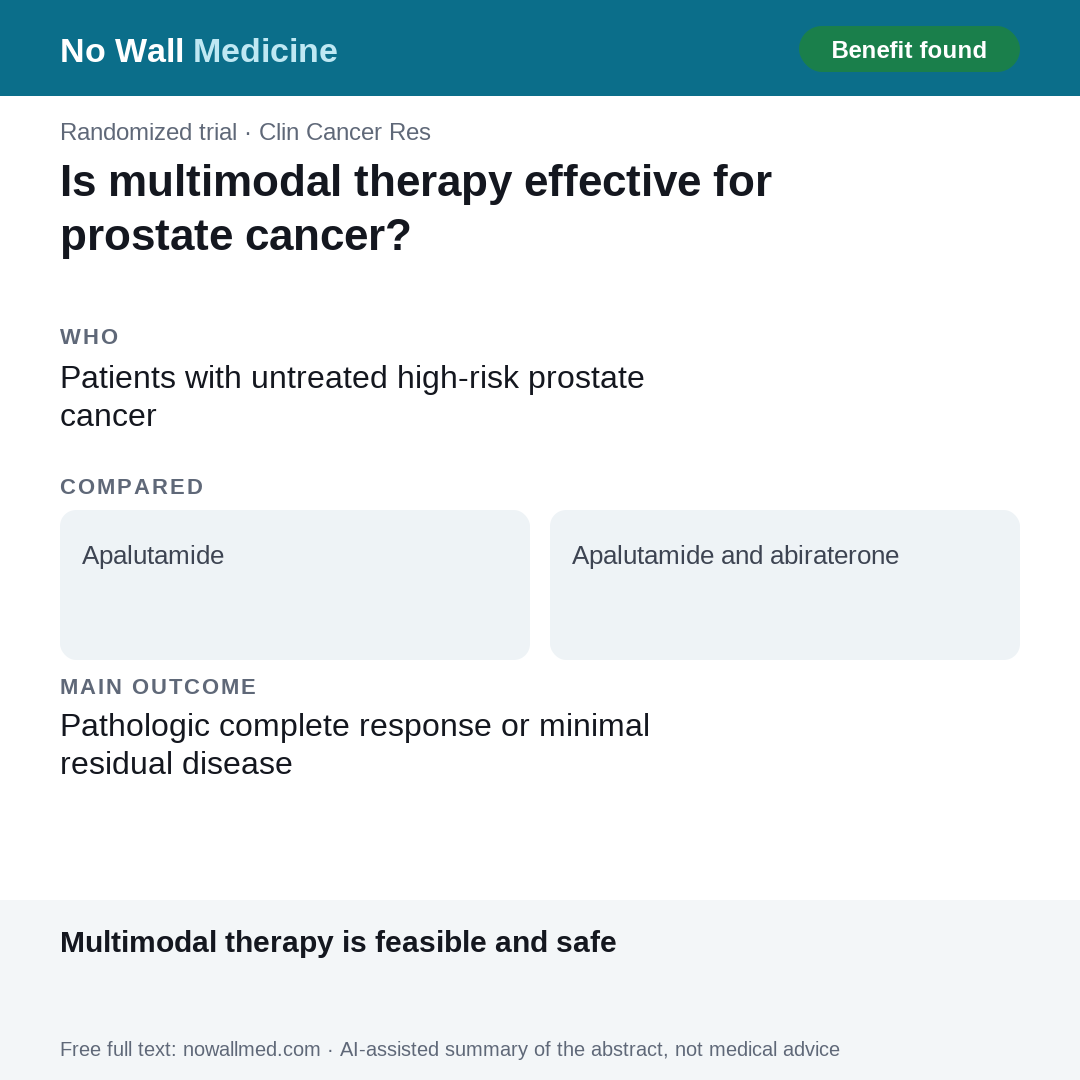
Is multimodal therapy effective for prostate cancer?
Who
Patients with untreated high-risk prostate cancer
Compared
Apalutamide
Apalutamide and abiraterone
Main outcome
Pathologic complete response or minimal residual disease
Bottom line: Multimodal therapy is feasible and safe
Clin Cancer Res · 2025-11-20Download image
Clinical question: Is multimodal therapy effective for prostate cancer?
Why it matters: Researchers aimed to establish a framework for using multimodal therapy and intermediate endpoints to accelerate the identification of promising prostate cancer treatments.
Key points
- Patients with untreated high-risk localized or low-volume metastatic prostate cancer were randomized to receive apalutamide or a combination of apalutamide, abiraterone acetate, prednisone, and androgen deprivation therapy.
- A pathologic complete response or minimal residual disease was achieved in 12% of cohort A and 15% of cohort B patients.
- Undetectable prostate-specific antigen levels following testosterone recovery at 24 months occurred in 61% of cohort A and 39% of cohort B.
Headline and key points written with AI from the paper’s abstract, with every number checked against it. Read the paper before relying on them.
Topics
Cite this article
McHugh D, Dallos M, Teo MY, McBride SM, Gopalan A, Arfe A. Accelerating Drug Development in Hormone-Naïve Prostate Cancer through Multimodal Therapy Strategies: The MetaCURE Phase 2 Randomized Clinical Trial. Clin Cancer Res. 2025. doi:10.1158/1078-0432.CCR-25-2679
Spotted a mistake? Suggest a correction