Visual abstractsVisuals
Randomized trialCritical Care · Aug 4, 2026

Intermittent oro-esophageal feeding shortened time to tracheostomy tube removal in patients with swallowing difficulties

Accelerating tracheostomy decannulation with intermittent oro-esophageal feeding in neurogenic dysphagia: a multicenter randomized controlled trial

Li Q, Hu D, Yang B, Zhang C, Zhou T, Li P, et al
Critical CareAdult
Multicenter randomized controlled trialBenefit found
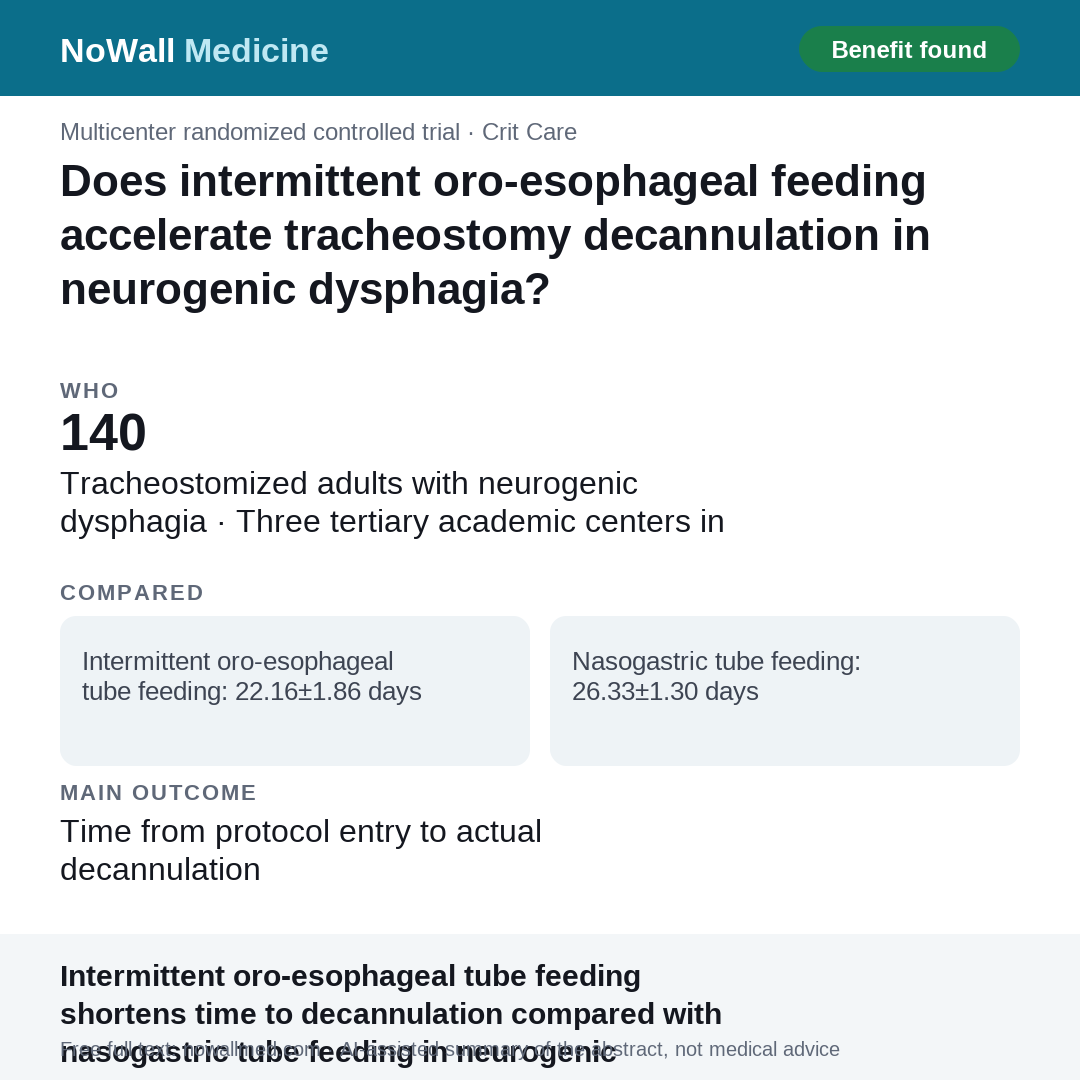
Does intermittent oro-esophageal feeding accelerate tracheostomy decannulation in neurogenic dysphagia?
Who
140
Tracheostomized adults with neurogenic dysphagia · Three tertiary academic centers in China
Compared
Intermittent oro-esophageal tube feeding: 22.16±1.86 days
Nasogastric tube feeding: 26.33±1.30 days
Main outcome
Time from protocol entry to actual decannulation
Result: between-group difference, 4.17 days; 95% confidence interval [CI], 1.90-6.44
Bottom line: Intermittent oro-esophageal tube feeding shortens time to decannulation compared with nasogastric tube feeding in neurogenic dysphagia.
Crit Care · 2026-08-04Download image

Clinical question: Does intermittent oro-esophageal feeding accelerate tracheostomy decannulation in neurogenic dysphagia?

Why it matters: High-quality evidence is lacking on whether intermittent oro-esophageal feeding can accelerate the removal of breathing tubes compared to conventional nasogastric tube feeding.

Key points

Headline and key points written with AI from the paper’s abstract, with every number checked against it. Read the paper before relying on them.
Read the full paper free at PubMed Central ↗

Topics

Humans; Deglutition Disorders; Tracheostomy Decannulation; Female; Male; Aged; Middle Aged; China; Enteral Nutrition; Intubation, Gastrointestinal; Time Factors; Tracheostomy

DOI: 10.1186/s13054-026-06235-y · PubMed: 42968156 · Registered: NCT06791590

Spotted a mistake? Suggest a correction

More in Critical Care

Meta-analysisCrit Care · Nov 19, 2026 · Critical Care

Corticosteroids in sepsis have conflicting mortality conclusions in reviews

Discordant evidence on corticosteroids in sepsis: a meta-research study

ResearchPediatricResuscitation · Nov 17, 2026 · Critical Care

Eighty-nine percent of infants survived 28 days after chest compressions at birth in 2024

Survival after neonatal chest compressions at birth: Temporal trends and prognostic factors in a population-based cohort, Queensland, Australia

ResearchResuscitation · Nov 17, 2026 · Critical Care

Bystanders attaching AEDs had highest 30-day survival rate of 28 percent

Survival after out of hospital cardiac arrest in relation to AED usage in a multi response system including AED equipped drones

ResearchResuscitation · Nov 17, 2026 · Critical Care

Foreign body airway obstruction caused 1.1% of out-of-hospital cardiac arrests

Out-of-hospital cardiac arrests due to foreign body airway obstruction: A CanROC registry, retrospective cohort study

ResearchResuscitation · Nov 17, 2026 · Critical Care

Commercially available multimodal LLMs for EEG-based prognostication after cardiac arrest