General public and healthcare professionals find personalized cancer screening approaches generally acceptable
Acceptability and perceptions of personalised risk-based cancer screening among health-care professionals and the general public: a systematic review and meta-analysis
Systematic review and meta-analysisBenefit found
What are the acceptability and perceptions of personalised risk-based cancer screening?
Who
63
General public and health-care professionals · North America and Europe
Compared
78%General public (95% CI 66-88)
86%Health-care professionals (64-99)
Main outcome
Acceptability of personalised risk-based cancer screening
Bottom line: Both the general public and health-care professionals generally found personalised risk-based cancer screening acceptable.
Funded by: National Cancer Institute and Cancer Prevention and Research Institute of Texas
Lancet Public Health · 2025-02-06Download image
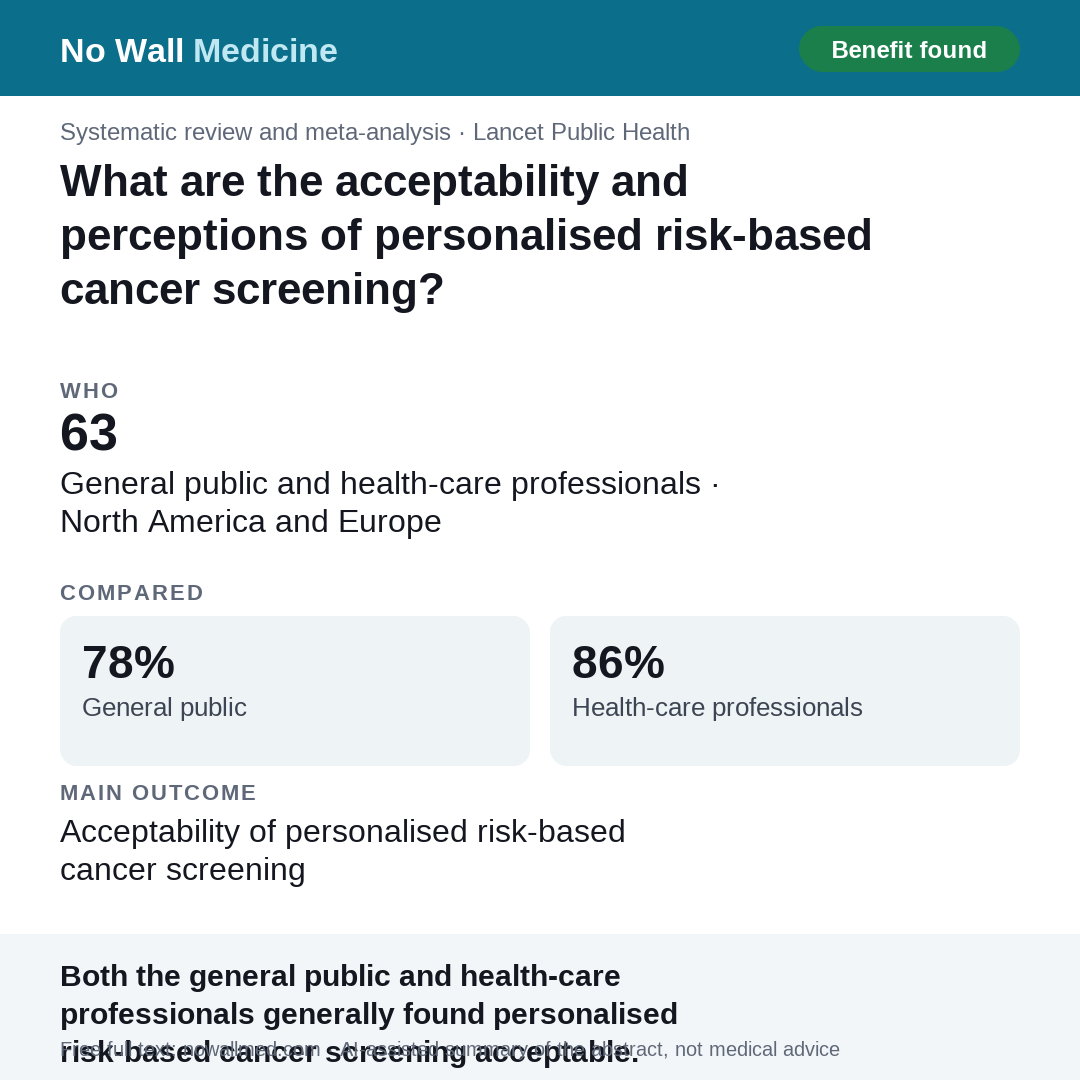
Clinical question: What are the acceptability and perceptions of personalised risk-based cancer screening?
Why it matters: It was unknown how much the general public and healthcare professionals support or accept implementing personalized risk-based cancer screening programs.
Key points
- Researchers analyzed 63 studies involving the general public and healthcare professionals regarding personalized risk-based cancer screening for breast, cervical, colorectal, lung, and prostate cancers.
- The pooled acceptability of personalized risk-based screening was 78% (95% CI 66-88) among the general public and 86% (64-99) among healthcare professionals.
- Both groups expressed caution regarding reducing screening frequency for low-risk individuals and requested more information on risk calculation accuracy and methods.
Headline and key points written with AI from the paper’s abstract, with every number checked against it. Read the paper before relying on them.
Abstract
Background
Personalised risk-based screening (PRBS) can enhance the efficiency of cancer screening programnes, but little is known about support for its implementation among the general public and health-care professionals. We aimed to summarise the acceptability and perceptions of PRBS for breast, cervical, colorectal, lung, and prostate cancer screening among these groups. Methods
We conducted a systematic review and meta-analysis of original research studies reporting on breast, cervical, colorectal, lung, and prostate cancer screening; personalised risk assessments to guide PRBS; and the acceptability of and receptibility towards these approaches among the general public, health-care professionals, or both. We searched MEDLINE, Embase, Cochrane Central, PsycINFO, and CINAHL Plus for articles published between Jan 1, 2010, and April 30, 2024. Studies not reporting on the outcomes of interest and with insufficient data for analysis were excluded. Six reviewers independently screened articles, and risk of bias was assessed using the Mixed Methods Appraisal Tool. Qualitative data were analysed thematically. Quantitative data were analysed with use of random-effects meta-analysis for outcomes that had at least two studies. The study protocol was registered at PROSPERO, CRD42022354287. Findings
Our search identified 4491 unique records. After screening, 63 studies were included in our analysis, of which 36 (57%) included the general public, 21 (33%) included health-care professionals, and six (11%) included both. The majority of studies focused on breast cancer screening (43 [68%] studies), and were from North America (28 [44%]) and Europe (28 [44%]). Qualitative findings were analysed thematically, and the extracted quantitative findings were synthesised under the following topics: acceptability and perceptions of personalised risk assessments among the general public; acceptability and perceptions of PRBS among the general public; acceptability and perceptions of PRBS among health-care professionals; and barriers and facilitators to PRBS implementation among health-care professionals. The general public and health-care professionals generally found PRBS acceptable, but they needed more information about how risk was calculated and the accuracy of risk scores. Additionally, both groups were cautious about reducing screening frequencies for individuals at low risk and cited barriers such as the time and resources needed to implement an effective PRBS programme. The pooled estimate for acceptability of PRBS was 78% (95% CI 66-88) among the general public and 86% (64-99) among health-care professionals. Interpretation
The general public and health-care professionals both viewed personalised risk assessments as providing valuable information and PRBS as a logical next step to increase the quality of patient care and improve cancer mortality. However, implementation barriers at the public, health-care professional, and system level need to be addressed. Funding
National Cancer Institute and Cancer Prevention and Research Institute of Texas.
Abstract reproduced under the article’s CC BY licence.
Topics
Cite this article
Tan NQP, Nargund RS, Douglas EE, Lopez-Olivo MA, Resong PJ, Ishizawa S. Acceptability and perceptions of personalised risk-based cancer screening among health-care professionals and the general public: a systematic review and meta-analysis. Lancet Public Health. 2025. doi:10.1016/S2468-2667(24)00278-0
Spotted a mistake? Suggest a correction
Top studies every Monday
The week’s key trials and guidelines in your specialties, by email. Free.
Get the weekly digest