Acceptability and uptake of HIV self-testing in emergency care settings: A systematic review and meta-analysis
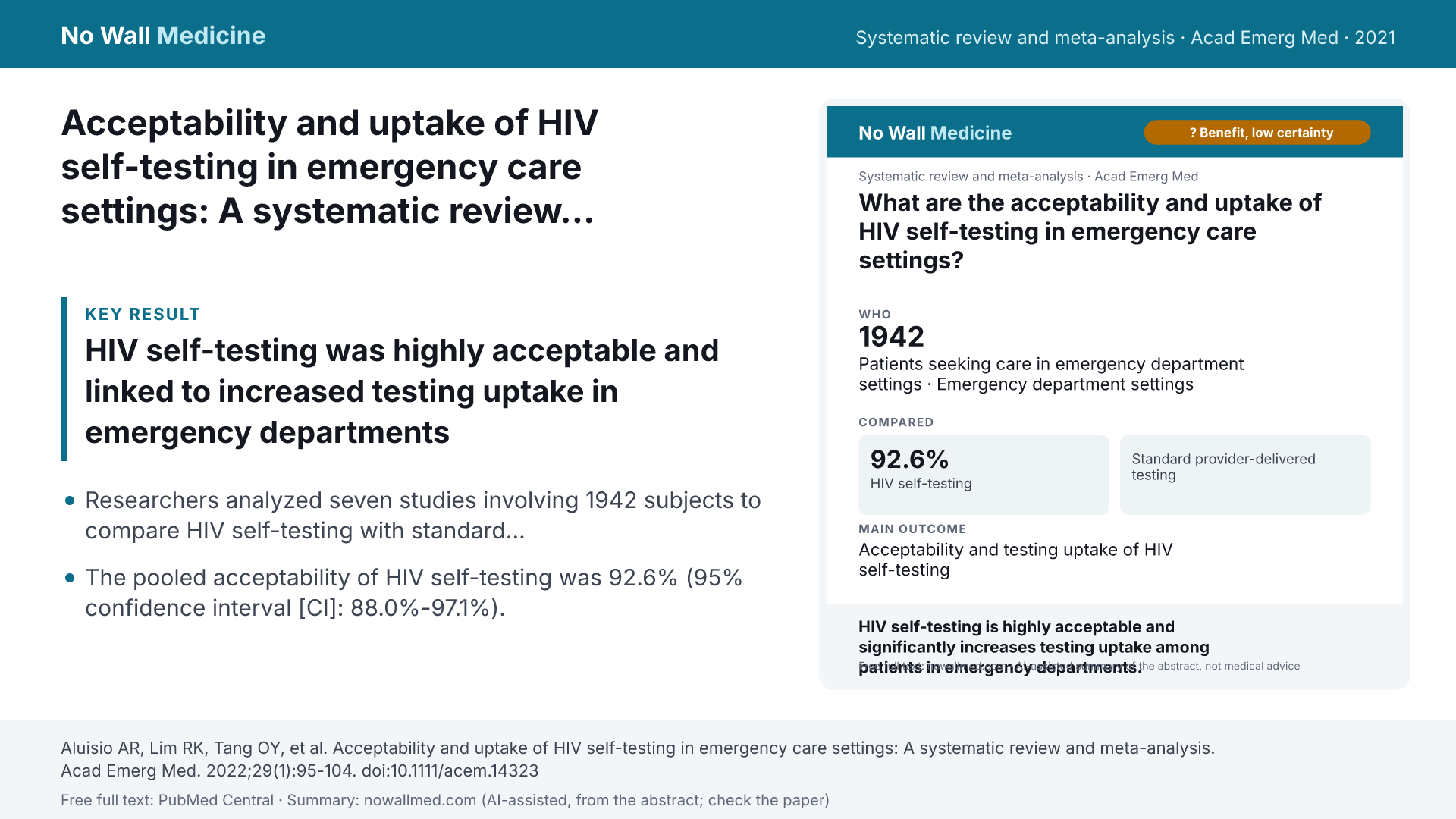
Key result: HIV self-testing was highly acceptable and linked to increased testing uptake in emergency departments
Systematic review and meta-analysisBenefit, low certainty
What are the acceptability and uptake of HIV self-testing in emergency care settings?
Who
1942
Patients seeking care in emergency department settings · Emergency department settings
Compared
92.6%HIV self-testing (95% confidence interval 88.0%-97.1%)
Standard provider-delivered testing
Main outcome
Acceptability and testing uptake of HIV self-testing
Result: risk ratio 4.41 (95% CI 1.95-10.10)
Bottom line: HIV self-testing is highly acceptable and significantly increases testing uptake among patients in emergency departments.
Limitation: The overall quality of evidence was low or very low.
Acad Emerg Med · 2021-07-21
Key points
- Researchers analyzed seven studies involving 1942 subjects to compare HIV self-testing with standard provider-delivered testing in emergency care settings.
- The pooled acceptability of HIV self-testing was 92.6% (95% confidence interval [CI]: 88.0%-97.1%).
- Data from two randomized controlled trials showed HIV self-testing was associated with increased testing uptake compared to standard programs (risk ratio [RR] = 4.41, 95% CI: 1.95-10.10).
Discussion prompts
- Would these patients look like yours? Who was left out?
- Is the main outcome one that matters to patients?
- Is the difference large enough to change what you do?
Cite: Aluisio AR, Lim RK, Tang OY, et al. Acceptability and uptake of HIV self-testing in emergency care settings: A systematic review and meta-analysis. Acad Emerg Med. 2022;29(1):95-104. doi:10.1111/acem.14323
Free full text: PubMed Central · Summary and visual abstract: nowallmed.com/a/acceptability-and-uptake-of-hiv-self-testing-in-emergency-care-xnqjhm/ (AI-assisted from the abstract; check the paper before relying on it).