Acceptance and Commitment Therapy improved quality of life for people with motor neuron disease
Acceptance and Commitment Therapy plus usual care for improving quality of life in people with motor neuron disease (COMMEND): a multicentre, parallel, randomised controlled trial in the UK
Multicentre, parallel, randomised controlled trialBenefit found
Does acceptance and commitment therapy plus usual care improve quality of life in motor neuron disease?
Who
191
People aged 18 or older with motor neuron disease · 16 UK motor neuron disease care centres or clinics
Compared
Acceptance and Commitment Therapy plus usual care
Usual care alone
Main outcome
Quality of life using the McGill Quality of Life Questionnaire-Revised
Result: adjusted mean difference 0·66 (95% CI 0·22-1·10)
Bottom line: Acceptance and commitment therapy plus usual care is clinically effective for maintaining or improving quality of life in motor neuron disease.
Funded by: National Institute for Health and Care Research and Motor Neurone Disease Association
Lancet · 2024-05-09Download image
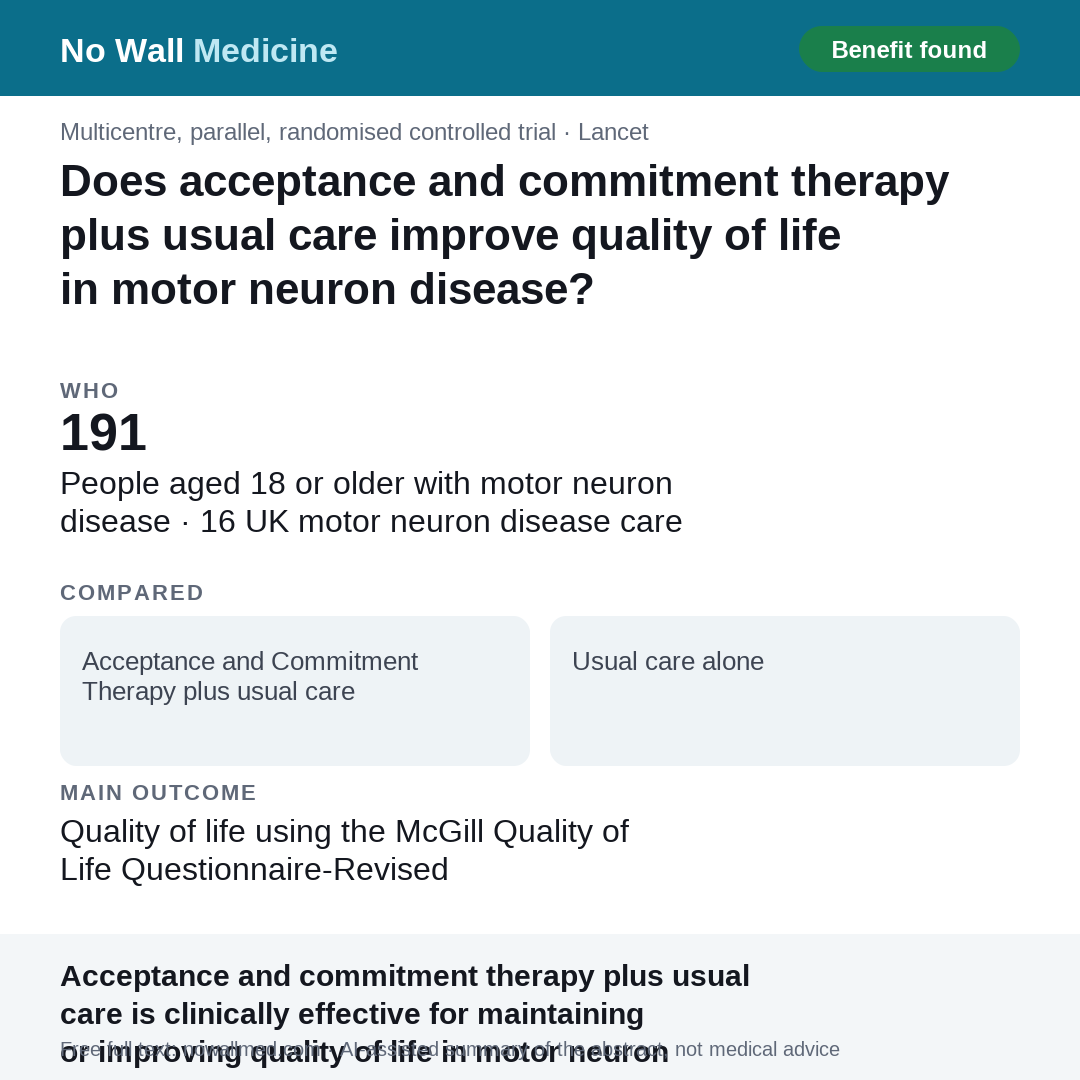
Clinical question: Does acceptance and commitment therapy plus usual care improve quality of life in motor neuron disease?
Why it matters: It was unclear if Acceptance and Commitment Therapy, a psychological therapy using mindfulness and behavior change, could improve quality of life for people with motor neuron disease.
Key points
- Researchers conducted a randomized controlled trial with 191 people with motor neuron disease to compare usual care with usual care plus Acceptance and Commitment Therapy.
- At 6 months, the group receiving Acceptance and Commitment Therapy had a higher quality of life score than the usual care group (adjusted mean difference 0.66; p=0.0031).
- While 75 adverse events were reported, including 38 serious events, none were deemed to be associated with the psychological intervention.
Headline and key points written with AI from the paper’s abstract, with every number checked against it. Read the paper before relying on them.
Was this summary helpful?
Abstract
Background
Motor neuron disease is a progressive, fatal neurodegenerative disease for which there is no cure. Acceptance and Commitment Therapy (ACT) is a psychological therapy incorporating acceptance, mindfulness, and behaviour change techniques. We aimed to evaluate the effectiveness of ACT plus usual care, compared with usual care alone, for improving quality of life in people with motor neuron disease. Methods
We conducted a parallel, multicentre, two-arm randomised controlled trial in 16 UK motor neuron disease care centres or clinics. Eligible participants were aged 18 years or older with a diagnosis of definite or laboratory-supported probable, clinically probable, or possible familial or sporadic amyotrophic lateral sclerosis; progressive muscular atrophy; or primary lateral sclerosis; which met the World Federation of Neurology's El Escorial diagnostic criteria. Participants were randomly assigned (1:1) to receive up to eight sessions of ACT adapted for people with motor neuron disease plus usual care or usual care alone by a web-based system, stratified by site. Participants were followed up at 6 months and 9 months post-randomisation. Outcome assessors and trial statisticians were masked to treatment allocation. The primary outcome was quality of life using the McGill Quality of Life Questionnaire-Revised (MQOL-R) at 6 months post-randomisation. Primary analyses were multi-level modelling and modified intention to treat among participants with available data. This trial was pre-registered with the ISRCTN Registry (ISRCTN12655391). Findings
Between Sept 18, 2019, and Aug 31, 2022, 435 people with motor neuron disease were approached for the study, of whom 206 (47%) were assessed for eligibility, and 191 were recruited. 97 (51%) participants were randomly assigned to ACT plus usual care and 94 (49%) were assigned to usual care alone. 80 (42%) of 191 participants were female and 111 (58%) were male, and the mean age was 63·1 years (SD 11·0). 155 (81%) participants had primary outcome data at 6 months post-randomisation. After controlling for baseline scores, age, sex, and therapist clustering, ACT plus usual care was superior to usual care alone for quality of life at 6 months (adjusted mean difference on the MQOL-R of 0·66 [95% CI 0·22-1·10]; d=0·46 [0·16-0·77]; p=0·0031). Moderate effect sizes were clinically meaningful. 75 adverse events were reported, 38 of which were serious, but no adverse events were deemed to be associated with the intervention. Interpretation
ACT plus usual care is clinically effective for maintaining or improving quality of life in people with motor neuron disease. As further evidence emerges confirming these findings, health-care providers should consider how access to ACT, adapted for the specific needs of people with motor neuron disease, could be provided within motor neuron disease clinical services. Funding
National Institute for Health and Care Research Health Technology Assessment and Motor Neurone Disease Association.
Abstract reproduced under the article’s CC BY licence.
Subject terms
Cite this article
Gould RL, McDermott CJ, Thompson BJ, Rawlinson CV, Bursnall M, Bradburn M. Acceptance and Commitment Therapy plus usual care for improving quality of life in people with motor neuron disease (COMMEND): a multicentre, parallel, randomised controlled trial in the UK. Lancet. 2024. doi:10.1016/S0140-6736(24)00533-6
Spotted a mistake? Suggest a correction
Top studies every Monday
The week’s key trials and guidelines in your specialties, plus any topics you follow. By email, free.
Get the weekly digest