Access or continuity: a zero sum game? A systematic review of the literature examining the relationship between access and continuity in primary healthcare
Systematic reviewMixed results
How are continuity of care and access to care interrelated in primary healthcare?
Who
Patients and healthcare professionals in primary care settings · Any country
Compared
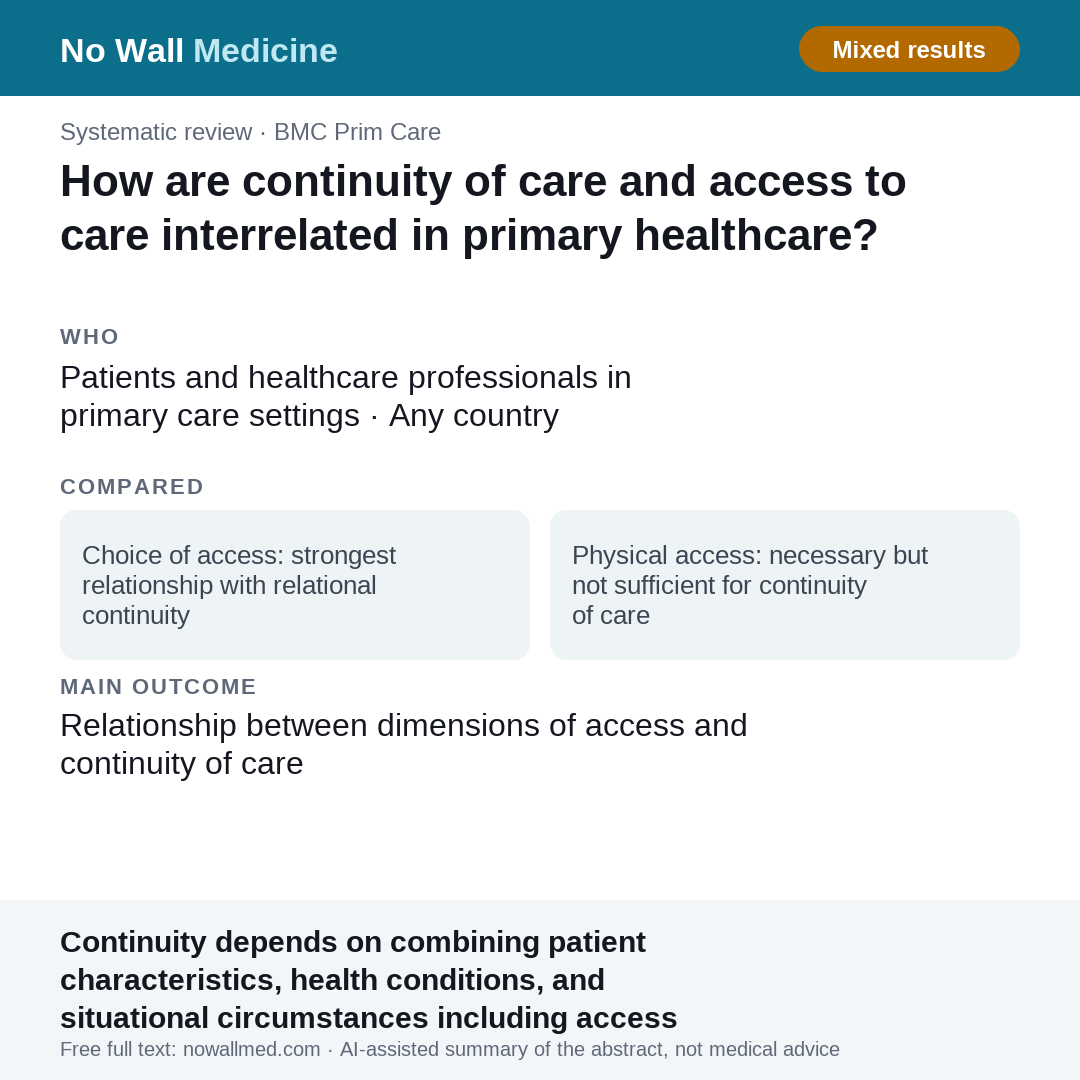
Choice of access: strongest relationship with relational continuity
Physical access: necessary but not sufficient for continuity of care
Main outcome
Relationship between dimensions of access and continuity of care
Bottom line: Continuity depends on combining patient characteristics, health conditions, and situational circumstances including access dimensions.
BMC Prim Care · 2025-07-02Download image
Clinical question: How are continuity of care and access to care interrelated in primary healthcare?
Abstract
Background
In recent years there has been a policy drive in the UK to improve patients' access to appointments in primary care. However, the focus on timely access could undermine continuity of care. This paper aims to investigate how continuity of care and access to care are interrelated and their relative importance for patients and healthcare professionals. Methods
A systematic review was conducted using six academic databases (EMBASE, PubMed, Scopus, Web of Science, CINAHL and PsycINFO). Reference lists of included studies and Google Scholar were searched for additional papers. Included were peer-reviewed journal articles in English based on studies in primary care settings from any country, publication date and study design, based on data from any stakeholders. Conference abstracts, opinion papers, reports and literature reviews, studies in secondary or tertiary care or continuity between healthcare settings and studies about development of instruments to measure continuity of care or examining outcomes only were excluded. Fifty-six papers were identified for inclusion in the review. Studies presented differing perspectives on continuity and access, conceptualisations of access and continuity, and, measures used. We conducted thematic analysis of the literature and used Haggerty et al.'s (2003) conceptualization of continuity and Boyle et al.'s (2020) conceptualization of access to synthesise the data. Findings
Themes arising were: system-level, practice-level and patient-level factors that influence access and continuity of care, what is important to patients, and how providers can support access and continuity of care. We found that 'choice of access' has the strongest relationship with relational continuity, however, 'physical access', or the ability to get and 'attend' an appointment, supersedes other dimensions of access as necessary but not sufficient for continuity of care. Conclusions
Our synthesis provides evidence that experiencing continuity depend on the combination of patients' demographic characteristics and health conditions, with situational circumstances, including characteristics of the health system and provider, which are more or less changeable. We propose a theoretical framing of the relationships between the dimensions of access and continuity. It can support policymakers and providers in understanding how to balance providing both access and continuity for patients.
Topics
Cite this article
Goff M, Hindi A, Hammond J, Jacobs S. Access or continuity: a zero sum game? A systematic review of the literature examining the relationship between access and continuity in primary healthcare. BMC Prim Care. 2025. doi:10.1186/s12875-025-02860-8
Spotted a mistake? Suggest a correction
Top studies every Monday
The week’s key trials and guidelines in your specialties, plus any topics you follow. By email, free.
Get the weekly digest