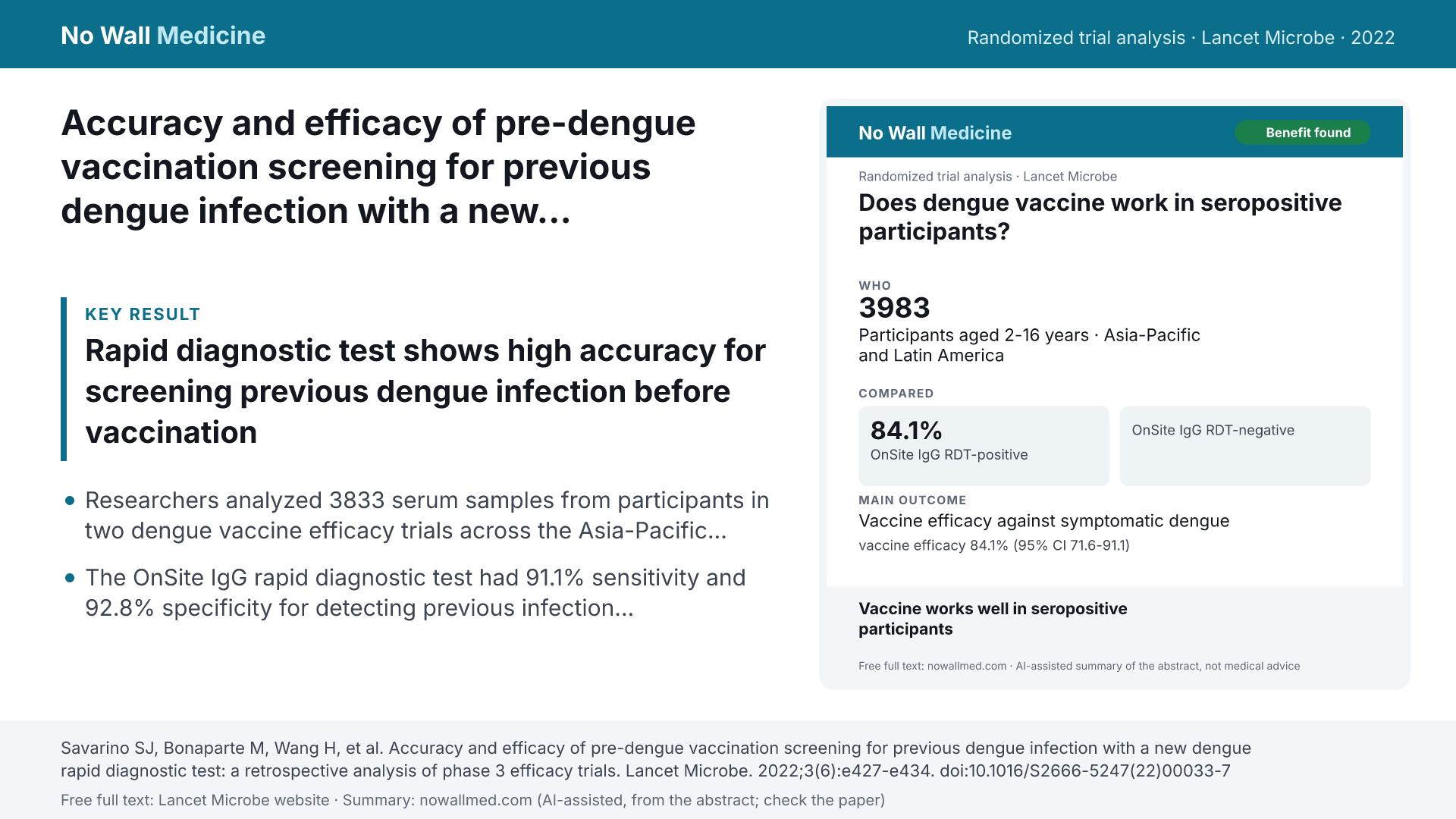
Rapid diagnostic test shows high accuracy for screening previous dengue infection before vaccination
Accuracy and efficacy of pre-dengue vaccination screening for previous dengue infection with a new dengue rapid diagnostic test: a retrospective analysis of phase 3 efficacy trials
Randomized trial analysisBenefit found
Does dengue vaccine work in seropositive participants?
Who
3983
Participants aged 2-16 years · Asia-Pacific and Latin America
Compared
84.1%OnSite IgG RDT-positive (95% CI 71.6-91.1)
OnSite IgG RDT-negative
Main outcome
Vaccine efficacy against symptomatic dengue
Result: vaccine efficacy 84.1% (95% CI 71.6-91.1)
Bottom line: Vaccine works well in seropositive participants
Funded by: Sanofi Pasteur
Lancet Microbe · 2022-05-04Download image
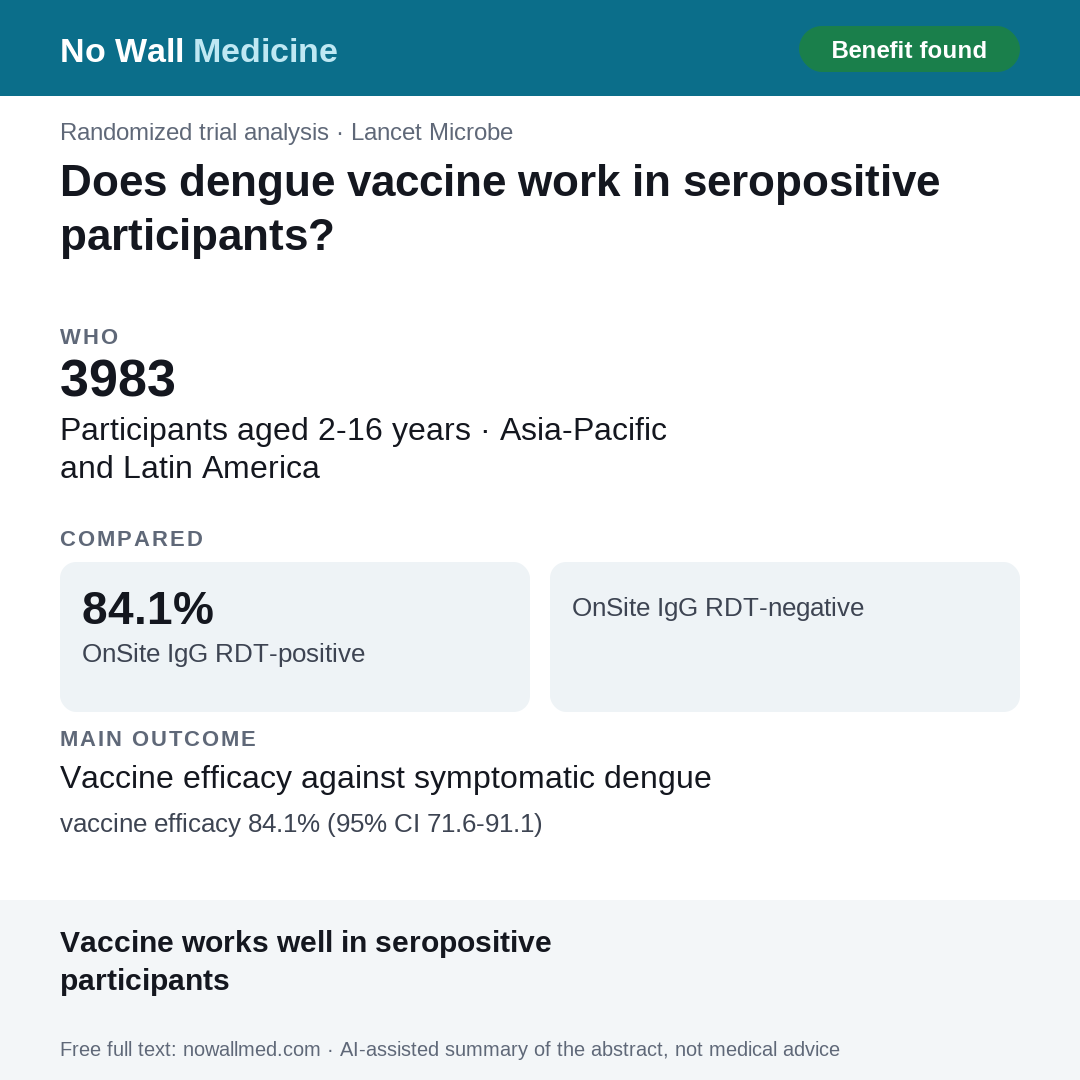
Clinical question: Does dengue vaccine work in seropositive participants?
Why it matters: A convenient, highly specific, and highly sensitive test is needed to screen for previous dengue infection before administering the CYD-TDV vaccine.
Key points
- Researchers analyzed 3833 serum samples from participants in two dengue vaccine efficacy trials across the Asia-Pacific and Latin America.
- The OnSite IgG rapid diagnostic test had 91.1% sensitivity and 92.8% specificity for detecting previous infection in participants aged 2-16 years.
- In participants who tested positive for previous infection, the vaccine efficacy was 84.1% against symptomatic virologically confirmed dengue.
Headline and key points written with AI from the paper’s abstract, with every number checked against it. Read the paper before relying on them.
Was this summary helpful?
Abstract
Background
A dengue pre-vaccination test that is convenient, highly specific, and highly sensitive is still needed. The OnSite Dengue IgG rapid diagnostic test (RDT) is a new rapid diagnostic test specifically designed for pre-vaccination screening. We aimed to retrospectively assess the efficacy of a tetravalent dengue vaccine (CYD-TDV) in participants determined to be dengue seropositive by the OnSite IgG RDT and to evaluate assay performances. Methods
This was a complementary study using pre-vaccination samples from two CYD-TDV efficacy trials done in five countries in the Asia-Pacific region (NCT01373281) and five countries in Latin America (NCT01374516). Baseline dengue serostatus was determined by the OnSite IgG RDT on samples from the immunogenicity subsets of the two trials. In participants who were test positive, we calculated CYD-TDV vaccine efficacy against symptomatic virologically confirmed dengue (VCD) over 25 months, and against hospitalisation with VCD over 72 months of follow-up after the first vaccination. We used a reference algorithm to determine the reference dengue serostatus for each sample, and sensitivity and specificity of the OnSite IgG RDT were calculated. Analyses were done on the whole population (aged 2-16 years), and on those aged 6 years or older and those aged 9 years or older. Findings
Of 3983 participants in the immunogenicity subsets of the efficacy trials CYD14 and CYD15, 3962 had complete dengue reference test results enabling baseline serostatus classification and 3833 had sufficient serum samples remaining for evaluation with the OnSite IgG RDT. Of the samples tested, 2486 (64·9%) of 3833 were OnSite IgG RDT-positive. In participants aged 2-16 years who were OnSite IgG RDT-positive, vaccine efficacy was 84·1% (95% CI 71·6-91·1) against symptomatic VCD, and 69·2% (38·8-84·5) against hospitalisation with VCD, with similar findings in those aged 6 years or older and those aged 9 years or older. The OnSite IgG RDT showed very high sensitivity (91·1%, 89·9-92·1) and high specificity (92·8%, 91·2-94·2) in participants aged 2-16 years, with significantly higher specificity in those aged 9 years or older (96·6%, 94·9-97·8). Interpretation
The OnSite IgG RDT should provide a valuable tool for screening for previous dengue infection at the point of vaccination. In individuals who were OnSite IgG RDT-positive, the vaccine efficacy of CYD-TDV was high across all three age groups. Funding
Sanofi Pasteur.
Abstract reproduced under the article’s CC BY NC ND licence.
Subject terms
Cite this article
Savarino SJ, Bonaparte M, Wang H, Dayan GH, Forrat R, Zhu M. Accuracy and efficacy of pre-dengue vaccination screening for previous dengue infection with a new dengue rapid diagnostic test: a retrospective analysis of phase 3 efficacy trials. Lancet Microbe. 2022. doi:10.1016/S2666-5247(22)00033-7
Spotted a mistake? Suggest a correction