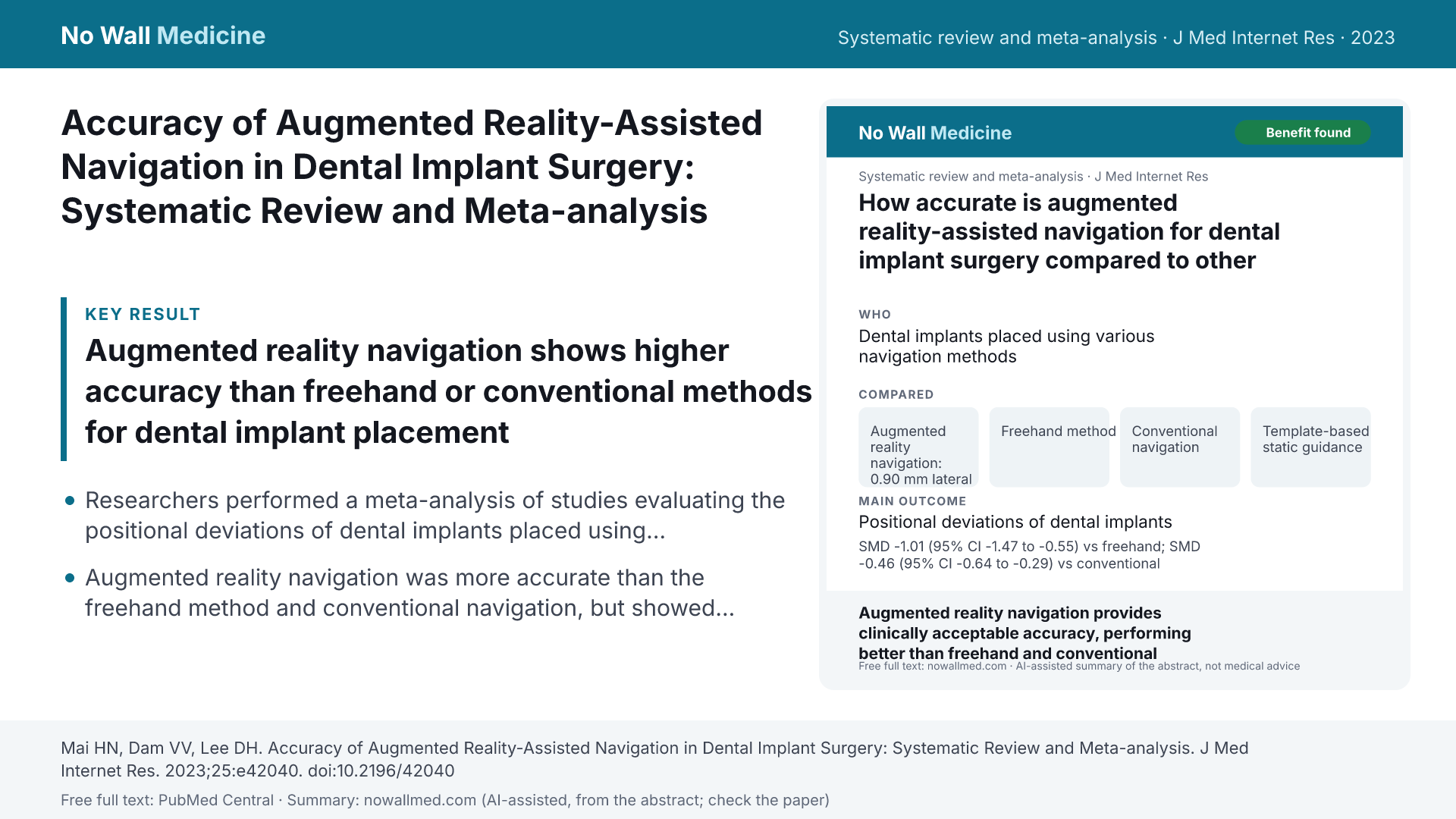
Augmented reality navigation shows higher accuracy than freehand or conventional methods for dental implant placement
Accuracy of Augmented Reality-Assisted Navigation in Dental Implant Surgery: Systematic Review and Meta-analysis
Systematic review and meta-analysisBenefit found
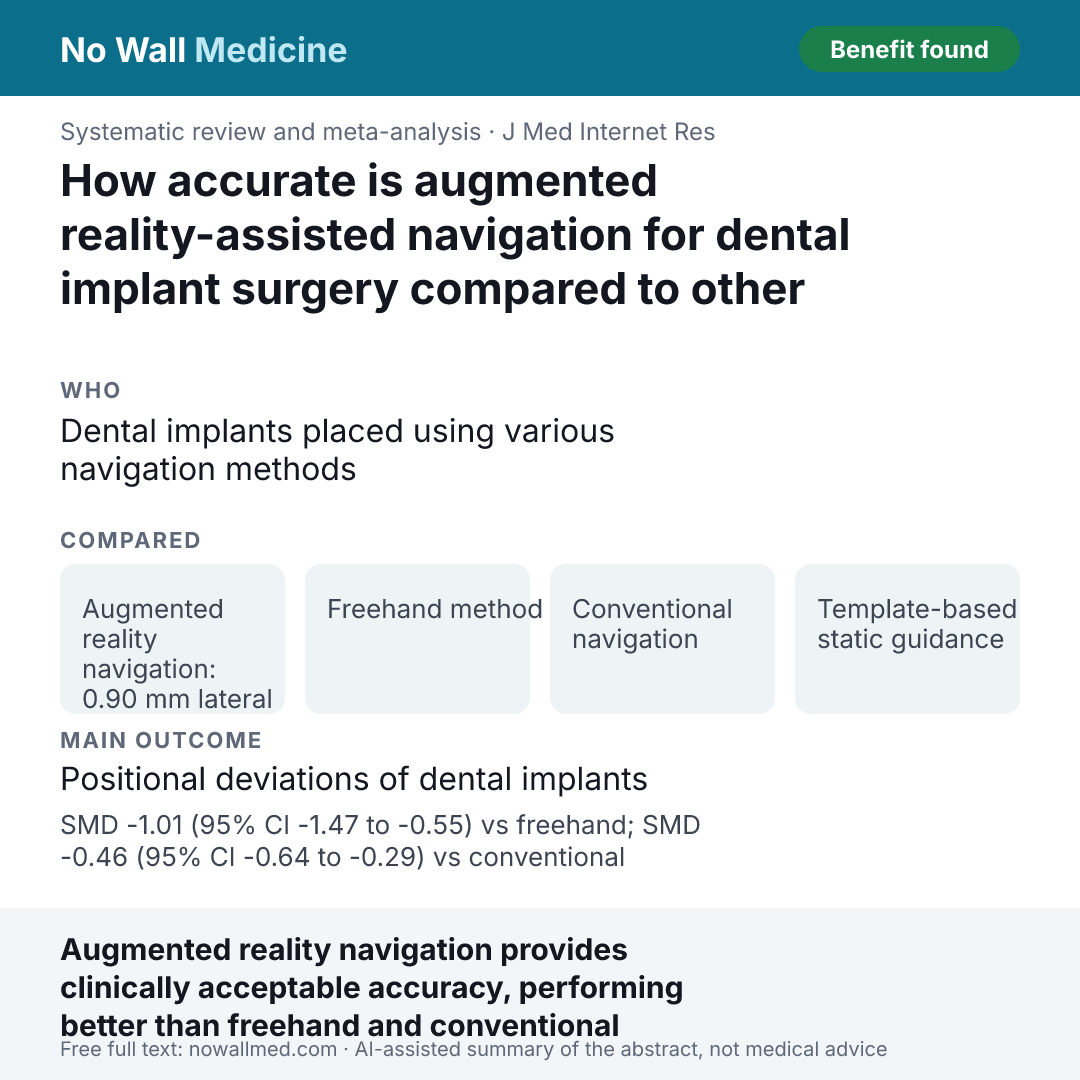
How accurate is augmented reality-assisted navigation for dental implant surgery compared to other methods?
Who
Dental implants placed using various navigation methods
Compared
Augmented reality navigation: 0.90 mm lateral deviation
Freehand method
Conventional navigation
Template-based static guidance
Main outcome
Positional deviations of dental implants
Result: SMD -1.01 (95% CI -1.47 to -0.55) vs freehand; SMD -0.46 (95% CI -0.64 to -0.29) vs conventional navigation
Bottom line: Augmented reality navigation provides clinically acceptable accuracy, performing better than freehand and conventional navigation, but similarly to template-based guidance.
J Med Internet Res · 2023-01-04 · Save PNG
Clinical question: How accurate is augmented reality-assisted navigation for dental implant surgery compared to other methods?
Key points
- Researchers performed a meta-analysis of studies evaluating the positional deviations of dental implants placed using augmented reality, which uses 3D technology to visualize surgical plans.
- Augmented reality navigation was more accurate than the freehand method and conventional navigation, but showed similar accuracy to template-based static guidance.
- The mean deviations for augmented reality navigation were 0.90 mm laterally, 1.18 mm globally, 0.78 mm in depth, and 3.96° in angle.
Headline and key points written with AI from the paper’s abstract, with every number checked against it. Read the paper before relying on them.
Was this summary helpful?
Subject terms
Headline, design, result, key points, caveat and citation as plain text.
Cite this article
Mai HN, Dam VV, Lee DH. Accuracy of Augmented Reality-Assisted Navigation in Dental Implant Surgery: Systematic Review and Meta-analysis. J Med Internet Res. 2023;25:e42040. doi:10.2196/42040
Spotted a mistake? Suggest a correction