Deep learning models show favorable accuracy in detecting cerebral microbleeds on magnetic resonance imaging
Accuracy of Deep Learning in Detecting Cerebral Microbleeds: Systematic Review and Meta-Analysis
Meta-analysis of studiesBenefit found
Deep learning accuracy in detecting cerebral microbleeds
Who
Patients with cerebral microbleeds
Compared
Deep learning models
Traditional detection
Main outcome
Diagnostic accuracy
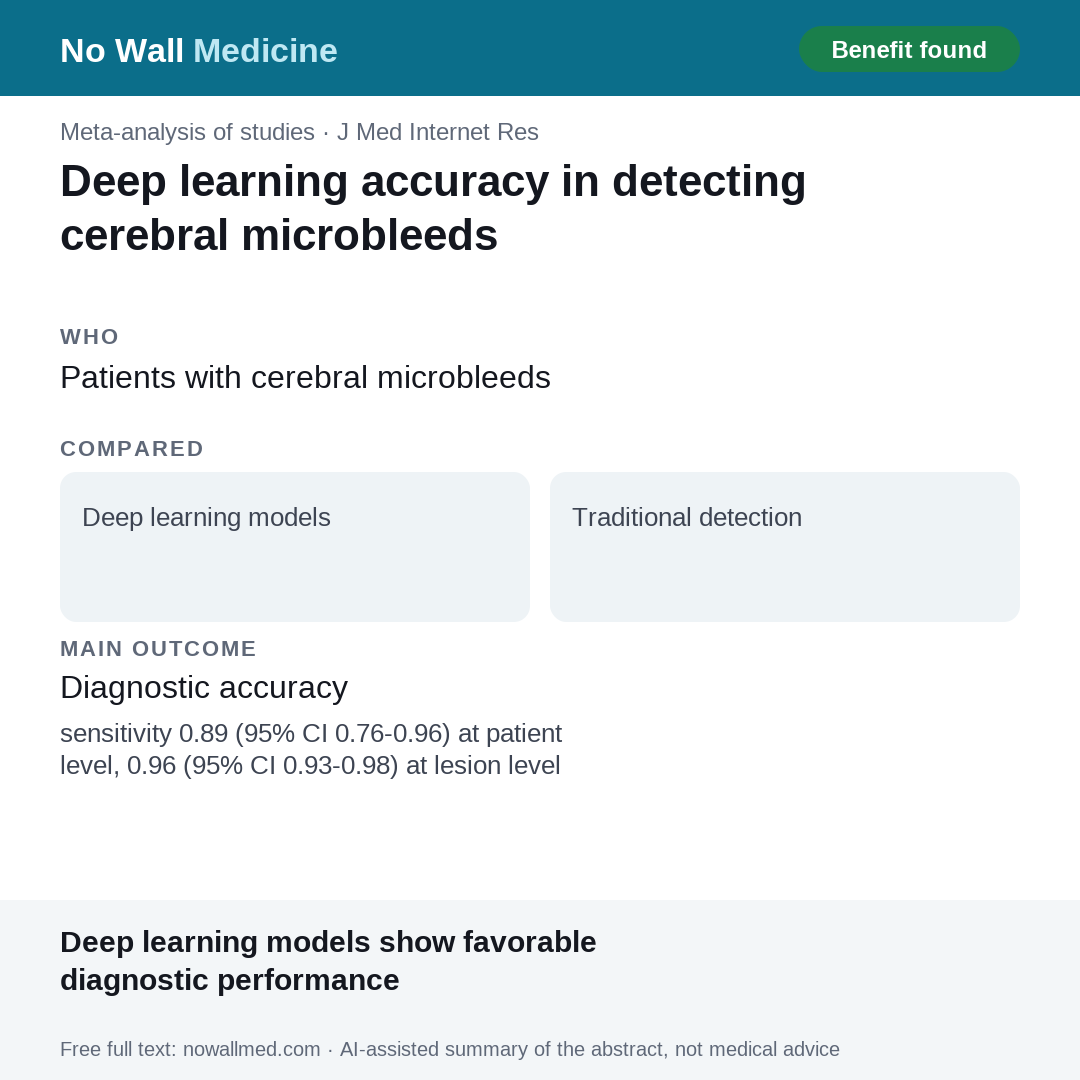
Result: sensitivity 0.89 (95% CI 0.76-0.96) at patient level, 0.96 (95% CI 0.93-0.98) at lesion level
Bottom line: Deep learning models show favorable diagnostic performance
Limitation: small number of included studies
J Med Internet Res · 2026-09-21Download image
Why it matters: Manual detection of cerebral microbleeds requires expert interpretation and is costly, but systematic evidence regarding the accuracy of deep learning models is lacking.
Key points
- Researchers conducted a systematic review and meta-analysis of studies using deep learning, a type of artificial intelligence, to detect cerebral microbleeds on magnetic resonance imaging.
- At the patient level, five studies reported a sensitivity of 0.89 and a specificity of 0.86 for detecting these small brain bleeds.
- At the lesion level, the models showed a sensitivity of 0.96 and a specificity of 0.98.
Limitation the authors note: The authors state that there was a small number of included studies and more multicenter studies are needed for generalizable tools.
Headline and key points written with AI from the paper’s abstract, with every number checked against it. Read the paper before relying on them.
Topics
Cite this article
Feng Y, Zheng L, Zhang B, Zou W. Accuracy of Deep Learning in Detecting Cerebral Microbleeds: Systematic Review and Meta-Analysis. J Med Internet Res. 2026. doi:10.2196/95041
Spotted a mistake? Suggest a correction