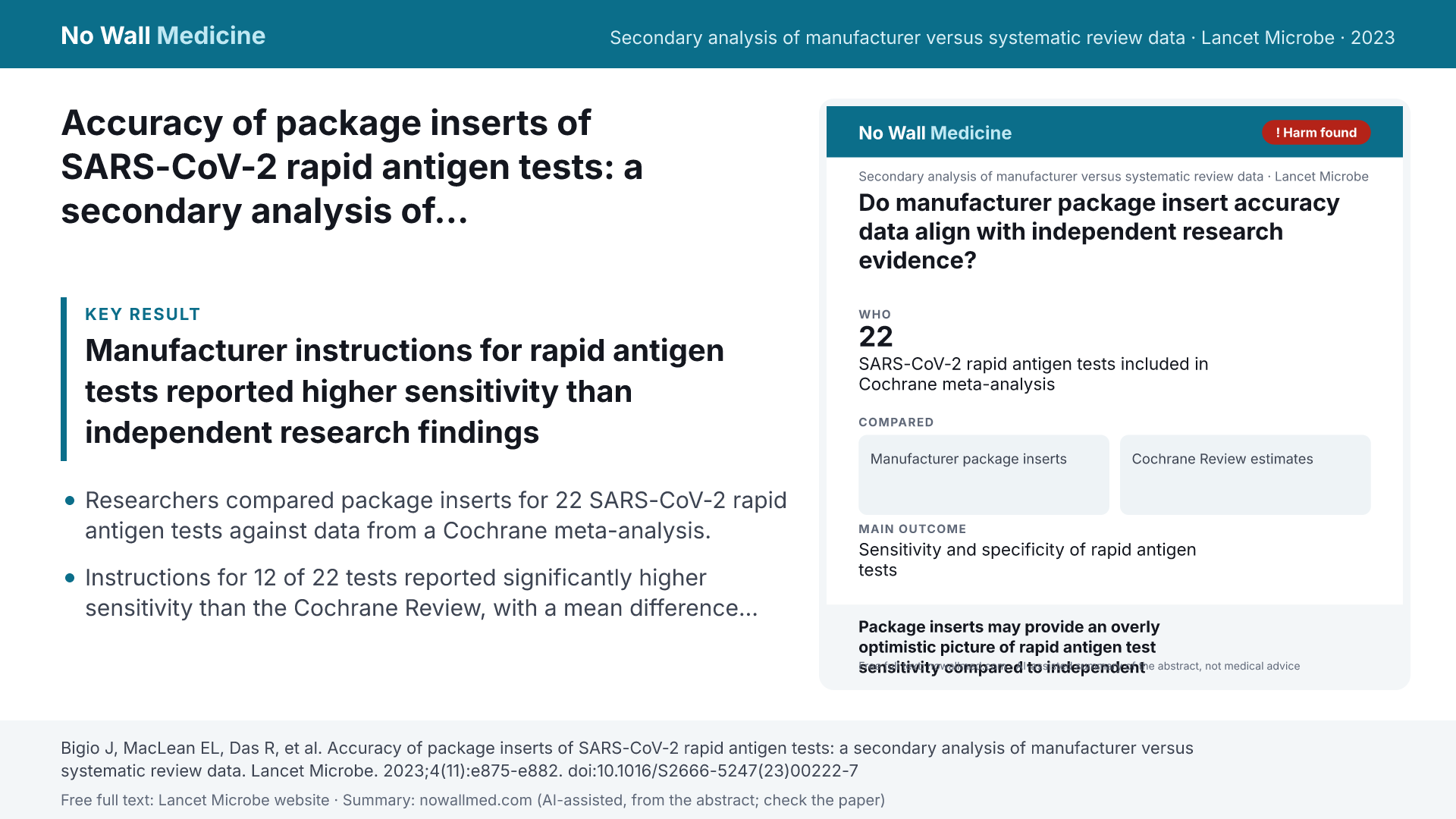
Manufacturer instructions for rapid antigen tests reported higher sensitivity than independent research findings
Accuracy of package inserts of SARS-CoV-2 rapid antigen tests: a secondary analysis of manufacturer versus systematic review data
Secondary analysis of manufacturer versus systematic review dataHarm found
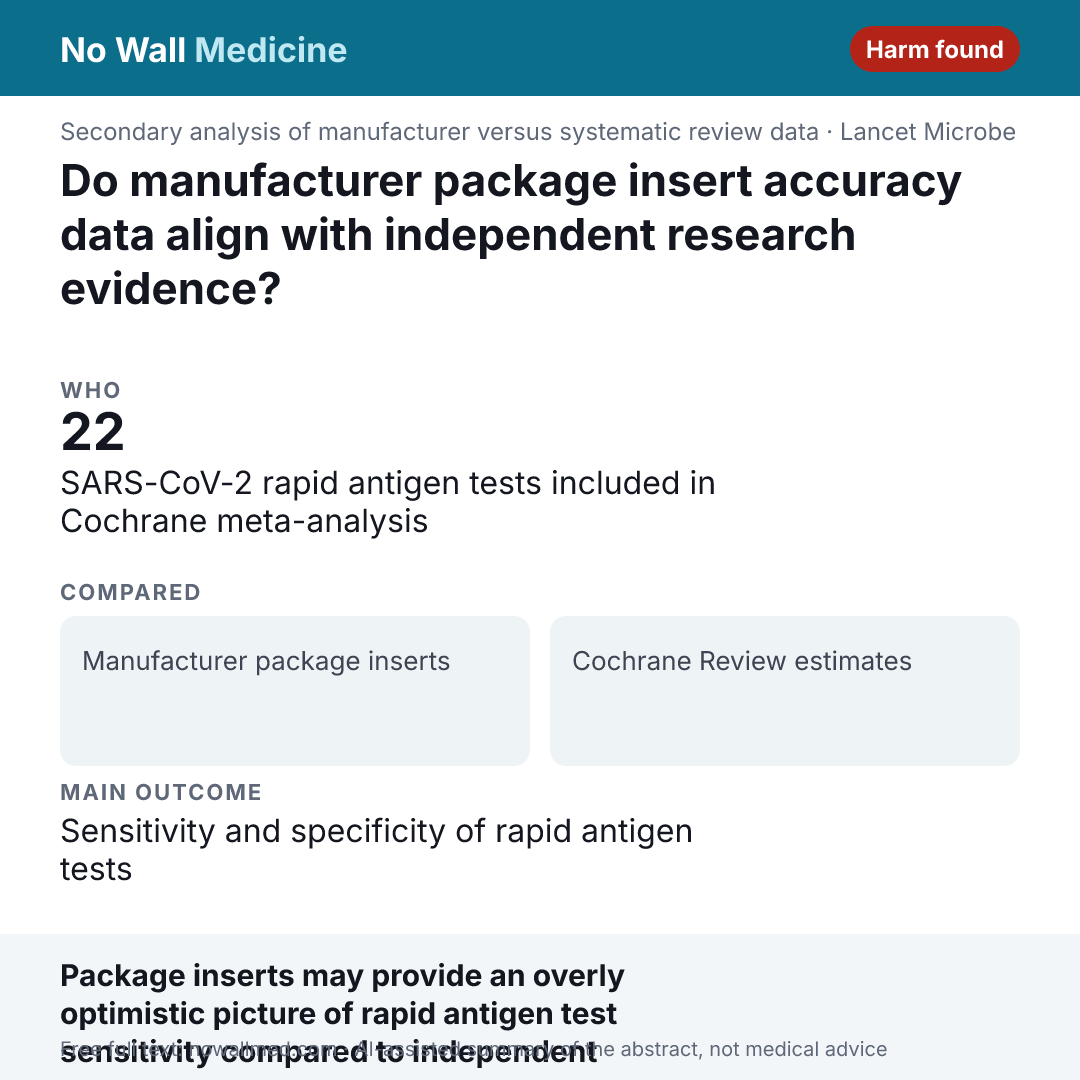
Do manufacturer package insert accuracy data align with independent research evidence?
Who
22
SARS-CoV-2 rapid antigen tests included in Cochrane meta-analysis
Compared
Manufacturer package inserts
Cochrane Review estimates
Main outcome
Sensitivity and specificity of rapid antigen tests
Result: mean sensitivity difference 12·0% (95% CI 7·5-16·6)
Bottom line: Package inserts may provide an overly optimistic picture of rapid antigen test sensitivity compared to independent research.
Lancet Microbe · 2023-10-13 · Save PNG
Clinical question: Do manufacturer package insert accuracy data align with independent research evidence?
Key points
- Researchers compared package inserts for 22 SARS-CoV-2 rapid antigen tests against data from a Cochrane meta-analysis.
- Instructions for 12 of 22 tests reported significantly higher sensitivity than the Cochrane Review, with a mean difference of 12.0% (95% CI 7.5-16.6).
- The mean difference in specificity, the ability to correctly identify those without the virus, was 0.3% (95% CI 0.1-0.5).
Headline and key points written with AI from the paper’s abstract, with every number checked against it. Read the paper before relying on them.
Was this summary helpful?
Abstract
Background
Rapid antigen tests (RATs) were crucial during the COVID-19 pandemic. Information provided by the test manufacturer in product package inserts, also known as instructions for use (IFUs), is often the only data available to clinicians, public health professionals, and individuals on the diagnostic accuracy of these tests. We aimed to assess whether manufacturer IFU accuracy data aligned with evidence from independent research. Methods
We searched company websites for package inserts for RATs that were included in the July 2022 update of the Cochrane meta-analysis of SARS-CoV-2 RATs, which served as a benchmark for research evidence. We fitted bivariate hierarchical models to obtain absolute differences in sensitivity and specificity between IFU and Cochrane Review estimates for each test, as well as overall combined differences. Findings
We found 22 (100%) of 22 IFUs of the RATs included in the Cochrane Review. IFUs for 12 (55%) of 22 RATs reported statistically significantly higher sensitivity estimates than the Cochrane Review, and none reported lower estimates. The mean difference between IFU and Cochrane Review sensitivity estimates across tests was 12·0% (95% CI 7·5-16·6). IFUs in three (14%) of 22 diagnostic tests had significantly higher specificity estimates than the Cochrane Review and two (9%) of 22 had lower estimates. The mean difference between IFU and Cochrane Review specificity estimates across tests was 0·3% (95% CI 0·1-0·5). If 100 people with SARS-CoV-2 infection were tested with each of the tests in this study, on average 12 fewer people would be correctly diagnosed than is suggested by the package inserts. Interpretation
Health professionals and the public should be aware that package inserts for SARS-CoV-2 RATs might provide an overly optimistic picture of the sensitivity of a test. Regulatory bodies should strengthen their requirements for the reporting of diagnostic accuracy data in package inserts and policy makers should demand independent validation data for decision making. Funding
None.
Abstract reproduced under the article’s CC BY NC ND licence.
Subject terms
Headline, design, result, key points, caveat and citation as plain text.
Cite this article
Bigio J, MacLean EL, Das R, et al. Accuracy of package inserts of SARS-CoV-2 rapid antigen tests: a secondary analysis of manufacturer versus systematic review data. Lancet Microbe. 2023;4(11):e875-e882. doi:10.1016/S2666-5247(23)00222-7
Spotted a mistake? Suggest a correction