Physicians' intuitive risk estimation was associated with a 3-fold increased risk of pulmonary embolism
Accuracy of physicians' intuitive risk estimation in the diagnostic management of pulmonary embolism: an individual patient data meta-analysis
Individual patient data meta-analysisBenefit found
What is the diagnostic accuracy of physician intuitive risk estimation for pulmonary embolism?
Who
20 770
Patients clinically suspected of having pulmonary embolism · 16 original studies
Compared
28.8%Positive gestalt
9.1%Negative gestalt
Main outcome
Diagnostic accuracy of gestalt for pulmonary embolism diagnosis
Result: risk ratio 3.02 (95% CI, 2.35-3.87)
Bottom line: A positive physician gestalt is associated with a 3-fold increased risk of pulmonary embolism.
J Thromb Haemost · 2023-05-30Download image
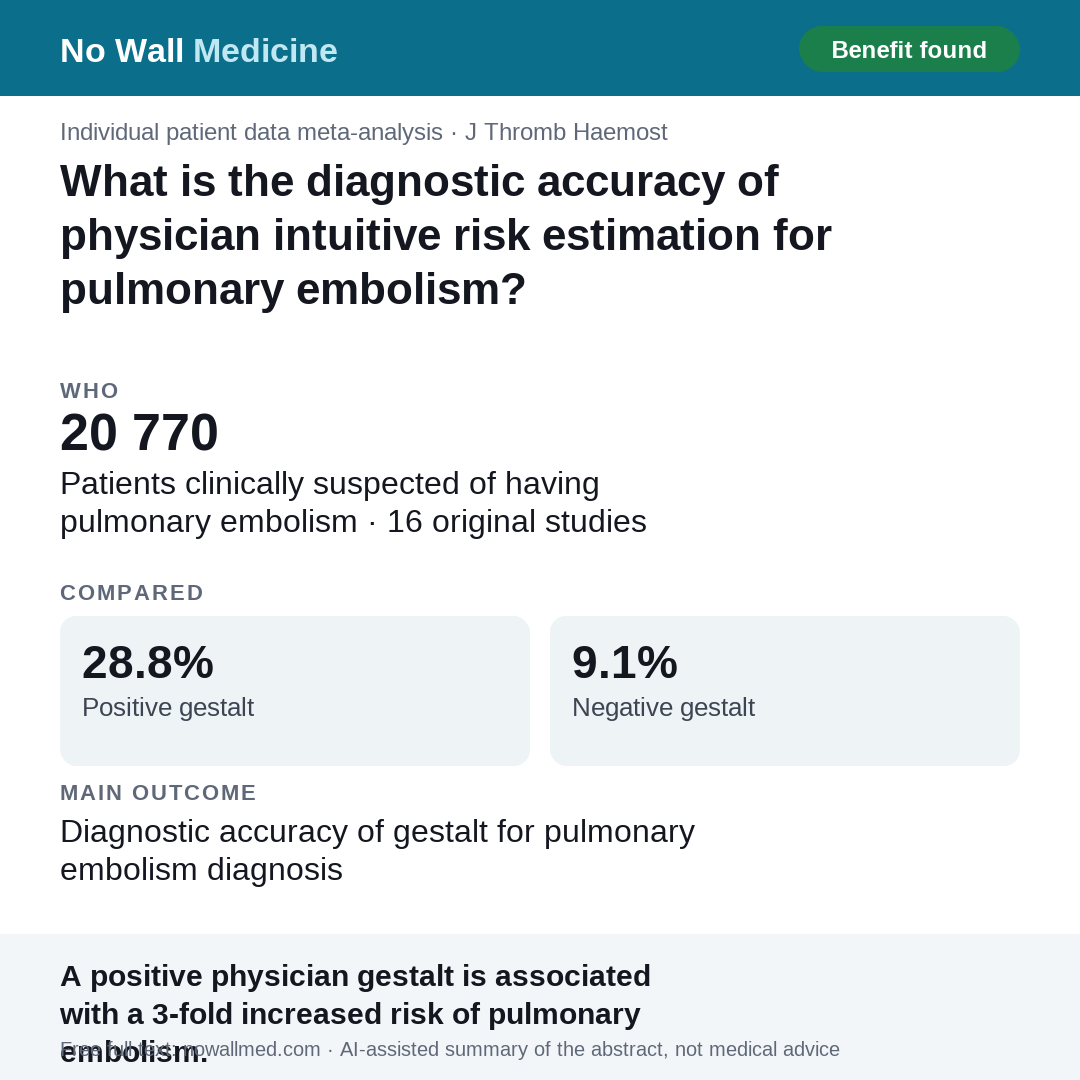
Clinical question: What is the diagnostic accuracy of physician intuitive risk estimation for pulmonary embolism?
Why it matters: It was unknown how accurate physicians' intuitive estimation, or gestalt, is for diagnosing pulmonary embolism and how this accuracy varies across different patient groups and settings.
Key points
- Researchers analyzed 20,770 patients suspected of having pulmonary embolism across 16 original studies.
- A positive intuitive estimation was associated with a risk ratio of 3.02, with 74% sensitivity and 61% specificity.
- The prevalence of pulmonary embolism was 28.8% in patients with a positive intuitive estimation compared to 9.1% in those without.
Headline and key points written with AI from the paper’s abstract, with every number checked against it. Read the paper before relying on them.
Was this summary helpful?
Subject terms
Cite this article
van Maanen R, Martens ESL, Takada T, Roy PM, de Wit K, Parpia S. Accuracy of physicians' intuitive risk estimation in the diagnostic management of pulmonary embolism: an individual patient data meta-analysis. J Thromb Haemost. 2023. doi:10.1016/j.jtha.2023.05.023
Spotted a mistake? Suggest a correction
Top studies every Monday
The week’s key trials and guidelines in your specialties, plus any topics you follow. By email, free.
Get the weekly digest