Scoring tools show moderate accuracy for ICU admission and mortality prediction
Accuracy of prognostic scoring tools for ICU triage and mortality among patients in low- and middle-income countries: a systematic review and meta-analysis
Systematic review and meta-analysisMixed results
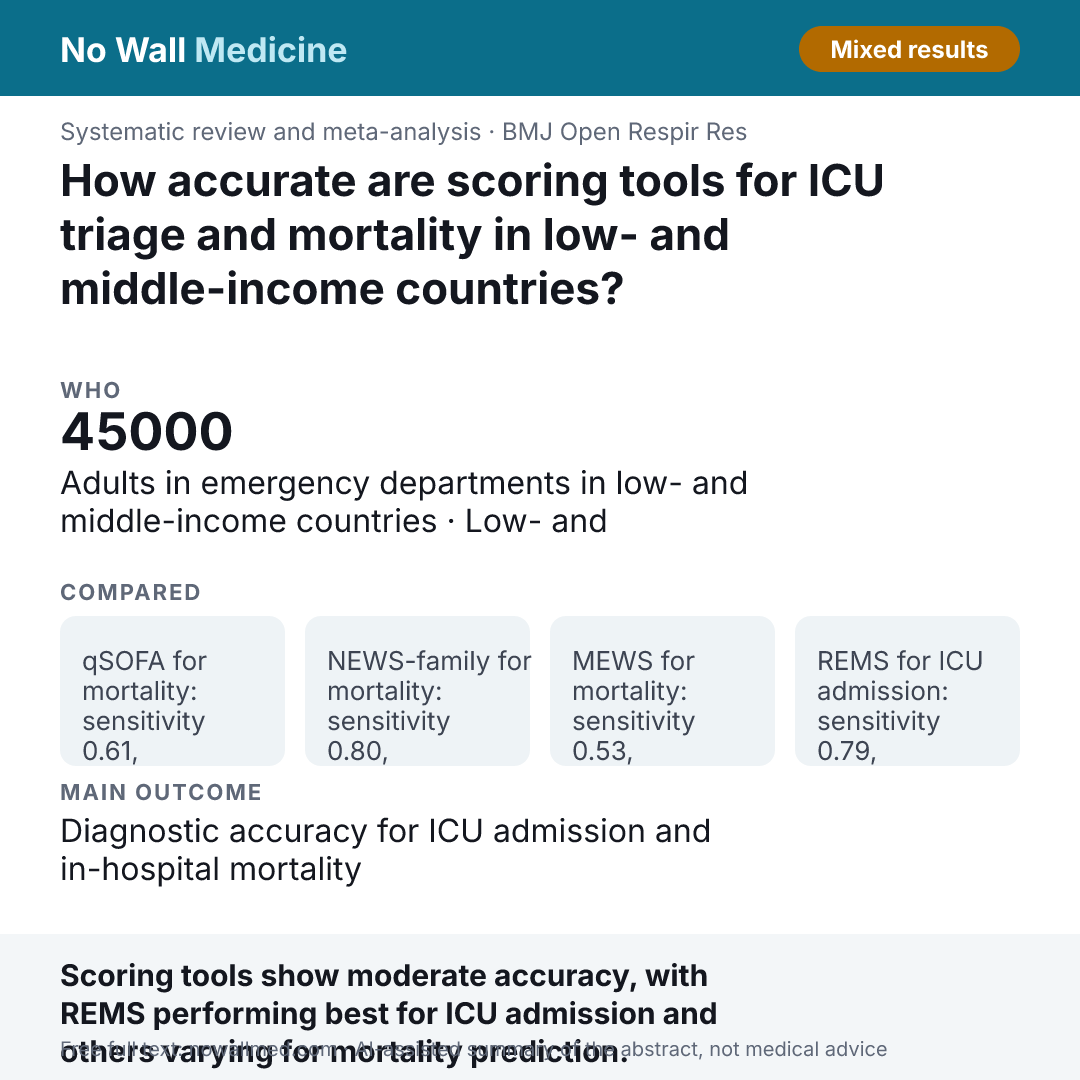
How accurate are scoring tools for ICU triage and mortality in low- and middle-income countries?
Who
45000
Adults in emergency departments in low- and middle-income countries · Low- and middle-income countries
Compared
qSOFA for mortality: sensitivity 0.61, specificity 0.73 (AUC=0.67)
NEWS-family for mortality: sensitivity 0.80, specificity 0.56 (AUC=0.68)
MEWS for mortality: sensitivity 0.53, specificity 0.83 (AUC=0.68)
REMS for ICU admission: sensitivity 0.79, specificity 0.85 (AUC=0.81)
Main outcome
Diagnostic accuracy for ICU admission and in-hospital mortality
Bottom line: Scoring tools show moderate accuracy, with REMS performing best for ICU admission and others varying for mortality prediction.
Limitation: Considerable heterogeneity was observed across studies.
BMJ Open Respir Res · 2026-07-24 · Save PNG
Clinical question: How accurate are scoring tools for ICU triage and mortality in low- and middle-income countries?
Key points
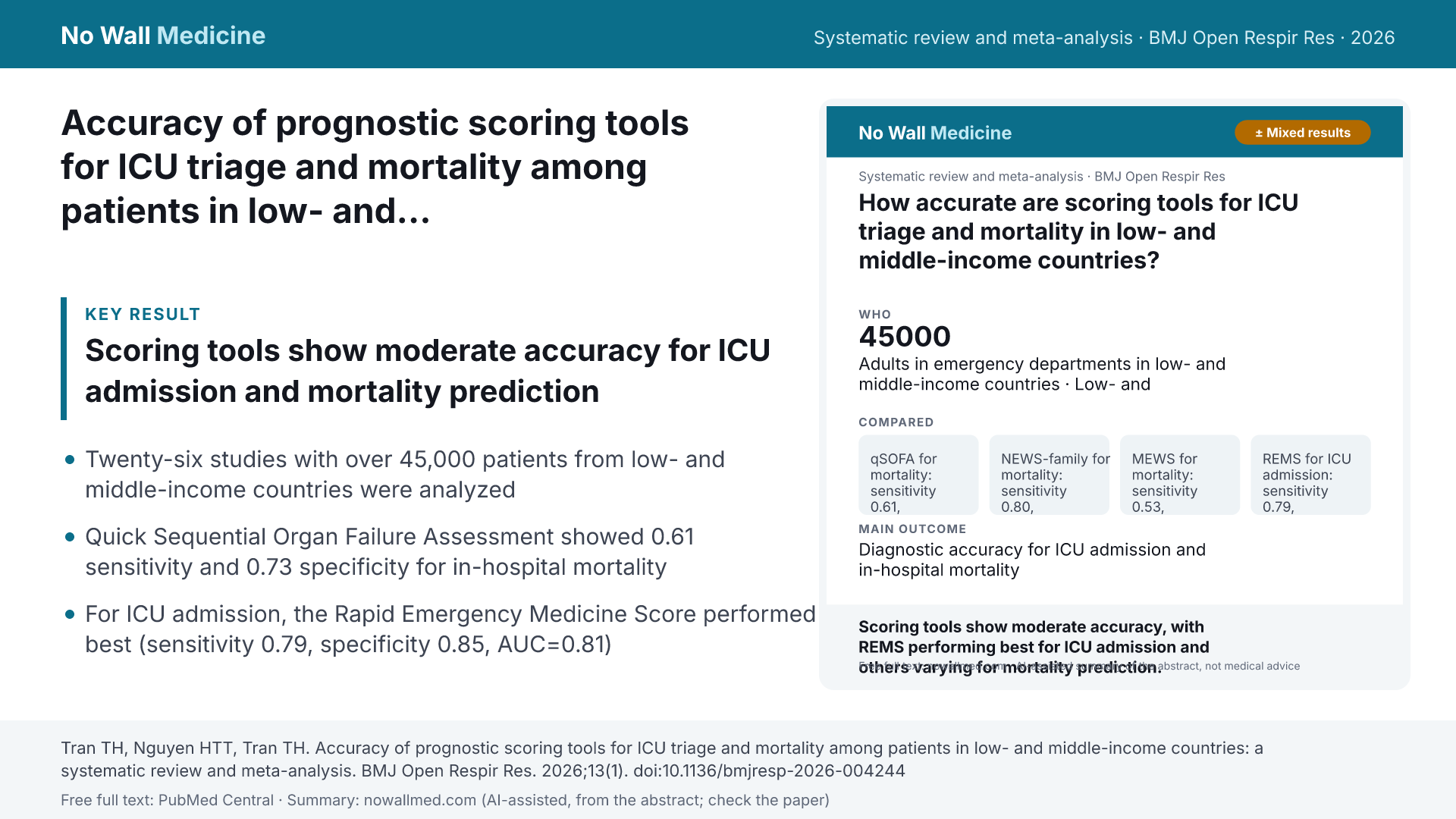
- Twenty-six studies with over 45,000 patients from low- and middle-income countries were analyzed.
- Quick Sequential Organ Failure Assessment showed 0.61 sensitivity and 0.73 specificity for in-hospital mortality.
- For ICU admission, the Rapid Emergency Medicine Score performed best (sensitivity 0.79, specificity 0.85, AUC=0.81).
Limitation the authors note: Considerable heterogeneity was observed across studies
Headline and key points written with AI from the paper’s abstract, with every number checked against it. Read the paper before relying on them.
Was this summary helpful?
Abstract
Background
Early warning and severity scores are widely used to support triage and predict clinical deterioration. Their diagnostic performance in low- and middle-income countries (LMICs) however remains uncertain due to differences in patient populations and healthcare resources compared with high-income settings. Objectives
This study aimed to evaluate and compare the diagnostic accuracy of commonly used scoring systems for predicting intensive care unit (ICU) admission and in-hospital mortality among adults presenting to emergency departments in LMICs. Methods
We conducted a systematic review and meta-analysis of PubMed, Science Direct, Web of Science and the Cochrane Library. Observational studies assessing the accuracy of early warning or severity scores for ICU admission or in-hospital mortality of patient admitted to the emergency department were included. Data were pooled using a bivariate random-effects model to estimate sensitivity, specificity and area under the curve (AUC). Study quality was appraised using QUADAS-2 (Quality Assessment of Diagnostic Accuracy Studies 2). Results
Twenty-six studies comprising over 45 000 patients from LMICs were analysed. For in-hospital mortality, quick Sequential Organ Failure Assessment (qSOFA) showed sensitivity of 0.61 and specificity of 0.73 (AUC=0.67); National Early Warning Score (NEWS)-family had higher sensitivity (0.80) but lower specificity (0.56, AUC=0.68); Modified Early Warning Score (MEWS) provided high specificity (0.83) but lower sensitivity (0.53, AUC=0.68). For ICU admission, NEWS demonstrated balanced performance (sensitivity 0.74, specificity 0.77, AUC=0.76), while Rapid Emergency Medicine Score (REMS) achieved the highest overall accuracy (sensitivity 0.79, specificity 0.85, AUC=0.81). Considerable heterogeneity was observed across studies. Conclusions
Early warning scores show moderate accuracy in predicting ICU admission and in-hospital mortality in LMIC emergency departments. qSOFA and MEWS may be most useful when high specificity is required, while NEWS and REMS provide more balanced performance, with REMS showing the best overall accuracy. No single score was optimal across settings, underscoring the need for local validation and adaptation in resource-limited environments.
Abstract reproduced under the article’s CC BY NC licence.
Subject terms
Headline, design, result, key points, caveat and citation as plain text.
Cite this article
Tran TH, Nguyen HTT, Tran TH. Accuracy of prognostic scoring tools for ICU triage and mortality among patients in low- and middle-income countries: a systematic review and meta-analysis. BMJ Open Respir Res. 2026;13(1). doi:10.1136/bmjresp-2026-004244
Spotted a mistake? Suggest a correction