Machine learning using medical imaging data predicts recurrence risk in non-small cell lung cancer
Accuracy of Radiomics-Based Machine Learning for Predicting Risk of Recurrence in Non-Small Cell Lung Cancer: Systematic Review and Meta-Analysis
Systematic review and meta-analysisBenefit found
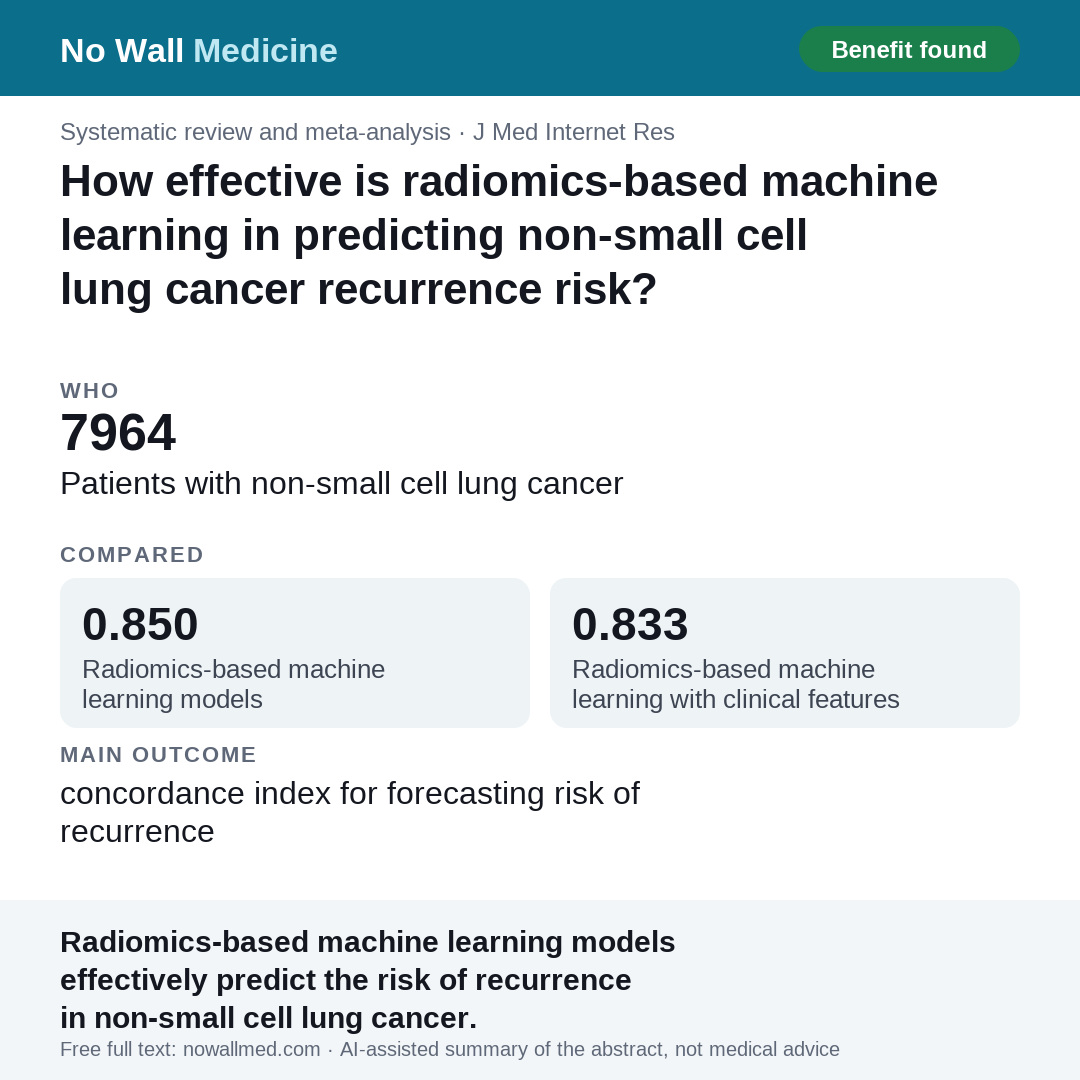
How effective is radiomics-based machine learning in predicting non-small cell lung cancer recurrence risk?
Who
7964
Patients with non-small cell lung cancer
Compared
0.850Radiomics-based machine learning models (95% CI 0.834-0.866, 95% prediction interval 0.623-1.004)
0.833Radiomics-based machine learning with clinical features (95% CI 0.822-0.854, 95% prediction interval 0.717-0.945)
Main outcome
concordance index for forecasting risk of recurrence
Result: c-index 0.850 (95% CI 0.834-0.866)
Bottom line: Radiomics-based machine learning models effectively predict the risk of recurrence in non-small cell lung cancer.
Limitation: Methodological limitations and an absence of standardization were revealed by the average Radiomics Quality Score.
J Med Internet Res · 2026-04-02Download image
Clinical question: How effective is radiomics-based machine learning in predicting non-small cell lung cancer recurrence risk?
Why it matters: Detecting the risk of recurrence in an early phase of non-small cell lung cancer remains a challenge.
Key points
- Researchers analyzed 30 studies involving 7964 patients with non-small cell lung cancer to evaluate machine learning models that use radiomics, which is the extraction of data from medical images.
- The models achieved a c-index, a measure of predictive accuracy, of 0.850 in the training set and 0.878 in the validation set.
- The pooled c-index was 0.876 for patients receiving stereotactic body radiation therapy and 0.825 for those receiving surgery combined with other adjuvant treatment regimens.
Limitation the authors note: The average Radiomics Quality Score was 27.4%, revealing methodological limitations and an absence of standardization.
Headline and key points written with AI from the paper’s abstract, with every number checked against it. Read the paper before relying on them.
Topics
Cite this article
Wu J, Zhang Y, Wang J, Chen C, Hu S, Chen W. Accuracy of Radiomics-Based Machine Learning for Predicting Risk of Recurrence in Non-Small Cell Lung Cancer: Systematic Review and Meta-Analysis. J Med Internet Res. 2026. doi:10.2196/84223
Spotted a mistake? Suggest a correction