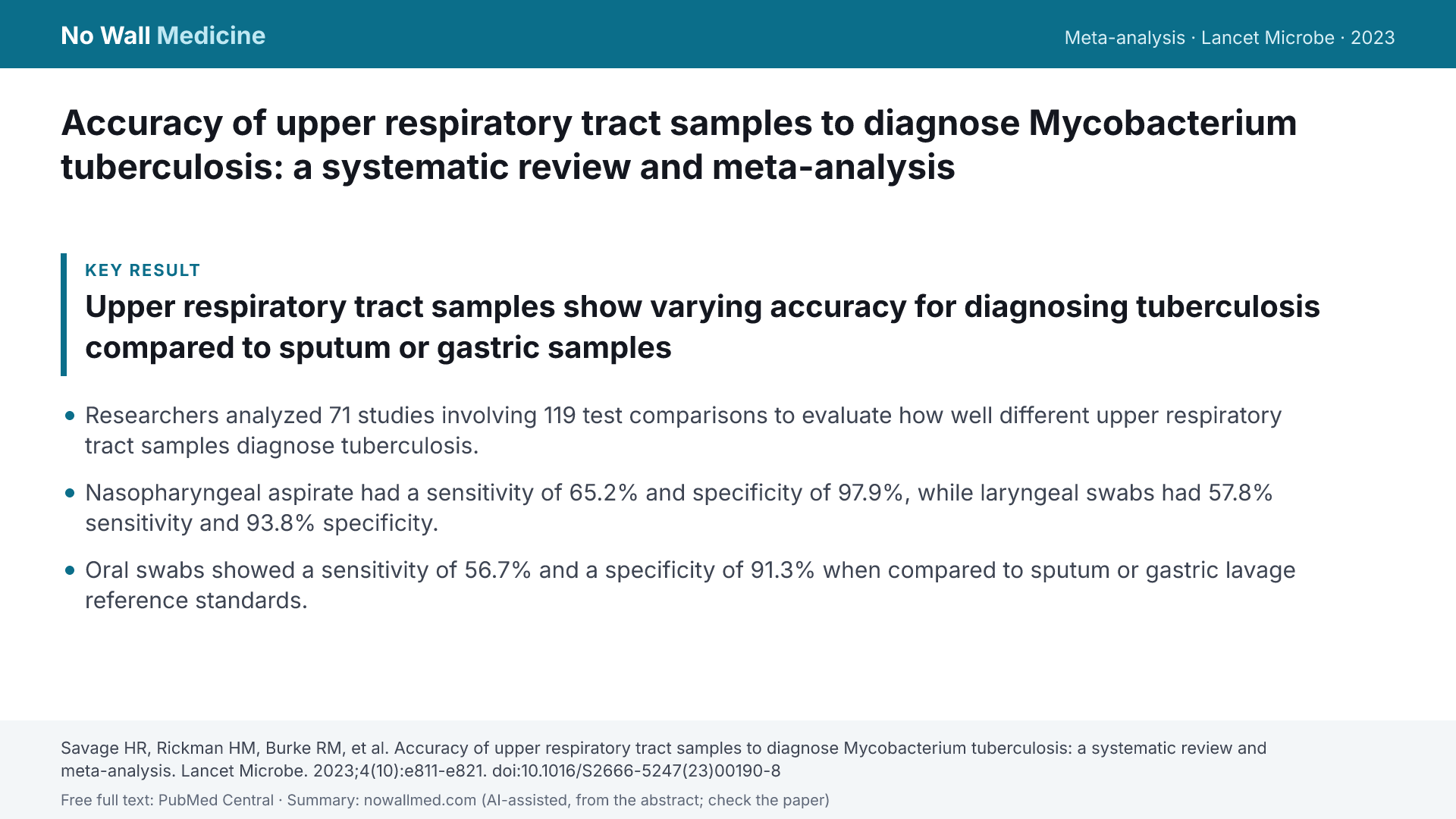
Upper respiratory tract samples show varying accuracy for diagnosing tuberculosis compared to sputum or gastric samples
Accuracy of upper respiratory tract samples to diagnose Mycobacterium tuberculosis: a systematic review and meta-analysis
Why it matters: Diagnosing pulmonary tuberculosis is difficult when patients, such as children or older people, cannot provide sputum samples.
Key points
- Researchers analyzed 71 studies involving 119 test comparisons to evaluate how well different upper respiratory tract samples diagnose tuberculosis.
- Nasopharyngeal aspirate had a sensitivity of 65.2% and specificity of 97.9%, while laryngeal swabs had 57.8% sensitivity and 93.8% specificity.
- Oral swabs showed a sensitivity of 56.7% and a specificity of 91.3% when compared to sputum or gastric lavage reference standards.
Limitation the authors note: Substantial heterogeneity in diagnostic accuracy was found, probably due to differences in reference and index standards.
Headline and key points written with AI from the paper’s abstract, with every number checked against it. Read the paper before relying on them.
Was this summary helpful?
Abstract
Background
Pulmonary tuberculosis due to Mycobacterium tuberculosis can be challenging to diagnose when sputum samples cannot be obtained, which is especially problematic in children and older people. We systematically appraised the performance characteristics and diagnostic accuracy of upper respiratory tract sampling for diagnosing active pulmonary tuberculosis. Methods
In this systematic review and meta-analysis, we searched MEDLINE, Cinahl, Web of Science, Global Health, and Global Health Archive databases for studies published between database inception and Dec 6, 2022 that reported on the accuracy of upper respiratory tract sampling for tuberculosis diagnosis compared with microbiological testing of sputum or gastric aspirate reference standard. We included studies that evaluated the accuracy of upper respiratory tract sampling (laryngeal swabs, nasopharyngeal aspirate, oral swabs, saliva, mouth wash, nasal swabs, plaque samples, and nasopharyngeal swabs) to be tested for microbiological diagnosis of tuberculous (by culture and nucleic acid amplification tests) compared with a reference standard using either sputum or gastric lavage for a microbiological test. We included cohort, case-control, cross-sectional, and randomised controlled studies that recruited participants from any community or clinical setting. We excluded post-mortem studies. We used a random-effects meta-analysis with a bivariate hierarchical model to estimate pooled sensitivity, specificity, and diagnostics odds ratio (DOR; odds of a positive test with disease relative to without), stratified by sampling method. We assessed bias using QUADAS-2 criteria. This study is registered with PROSPERO (CRD42021262392). Findings
We screened 10 159 titles for inclusion, reviewed 274 full texts, and included 71, comprising 119 test comparisons published between May 13, 1933, and Dec 19, 2022, in the systematic review (53 in the meta-analysis). For laryngeal swabs, pooled sensitivity was 57·8% (95% CI 50·5-65·0), specificity was 93·8% (88·4-96·8), and DOR was 20·7 (11·1-38·8). Nasopharyngeal aspirate sensitivity was 65·2% (52·0-76·4), specificity was 97·9% (96·0-99·0), and DOR was 91·0 (37·8-218·8). Oral swabs sensitivity was 56·7% (44·3-68·2), specificity was 91·3% (CI 81·0-96·3), and DOR was 13·8 (5·6-34·0). Substantial heterogeneity in diagnostic accuracy was found, probably due to differences in reference and index standards. Interpretation
Upper respiratory tract sampling holds promise to expand access to tuberculosis diagnosis. Exploring historical methods using modern microbiological techniques might further increase options for alternative sample types. Prospective studies are needed to optimise accuracy and utility of sampling methods in clinical practice. Funding
UK Medical Research Council, Wellcome, and UK Foreign, Commonwealth and Development Office.
Abstract reproduced under the article’s CC BY licence.
Subject terms
Headline, design, result, key points, caveat and citation as plain text.
Cite this article
Savage HR, Rickman HM, Burke RM, et al. Accuracy of upper respiratory tract samples to diagnose Mycobacterium tuberculosis: a systematic review and meta-analysis. Lancet Microbe. 2023;4(10):e811-e821. doi:10.1016/S2666-5247(23)00190-8
Spotted a mistake? Suggest a correction