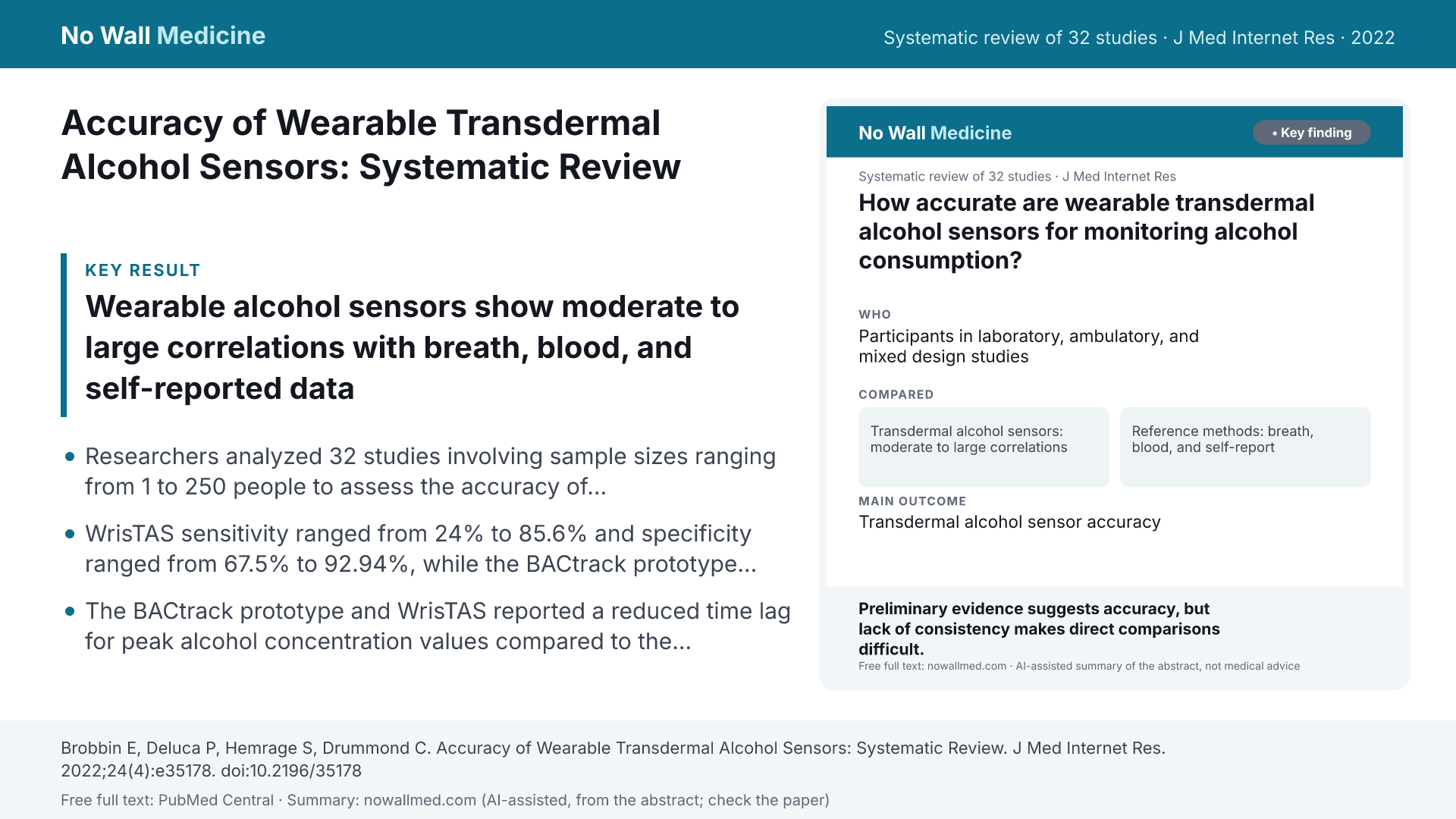
Wearable alcohol sensors show moderate to large correlations with breath, blood, and self-reported data
Accuracy of Wearable Transdermal Alcohol Sensors: Systematic Review
Systematic review of 32 studiesKey finding
How accurate are wearable transdermal alcohol sensors for monitoring alcohol consumption?
Who
Participants in laboratory, ambulatory, and mixed design studies
Compared
Transdermal alcohol sensors: moderate to large correlations
Reference methods: breath, blood, and self-report
Main outcome
Transdermal alcohol sensor accuracy
Bottom line: Preliminary evidence suggests accuracy, but lack of consistency makes direct comparisons difficult.
Limitation: Lack of consistency in study procedures and analyses of findings
J Med Internet Res · 2022-04-14 · Save PNG
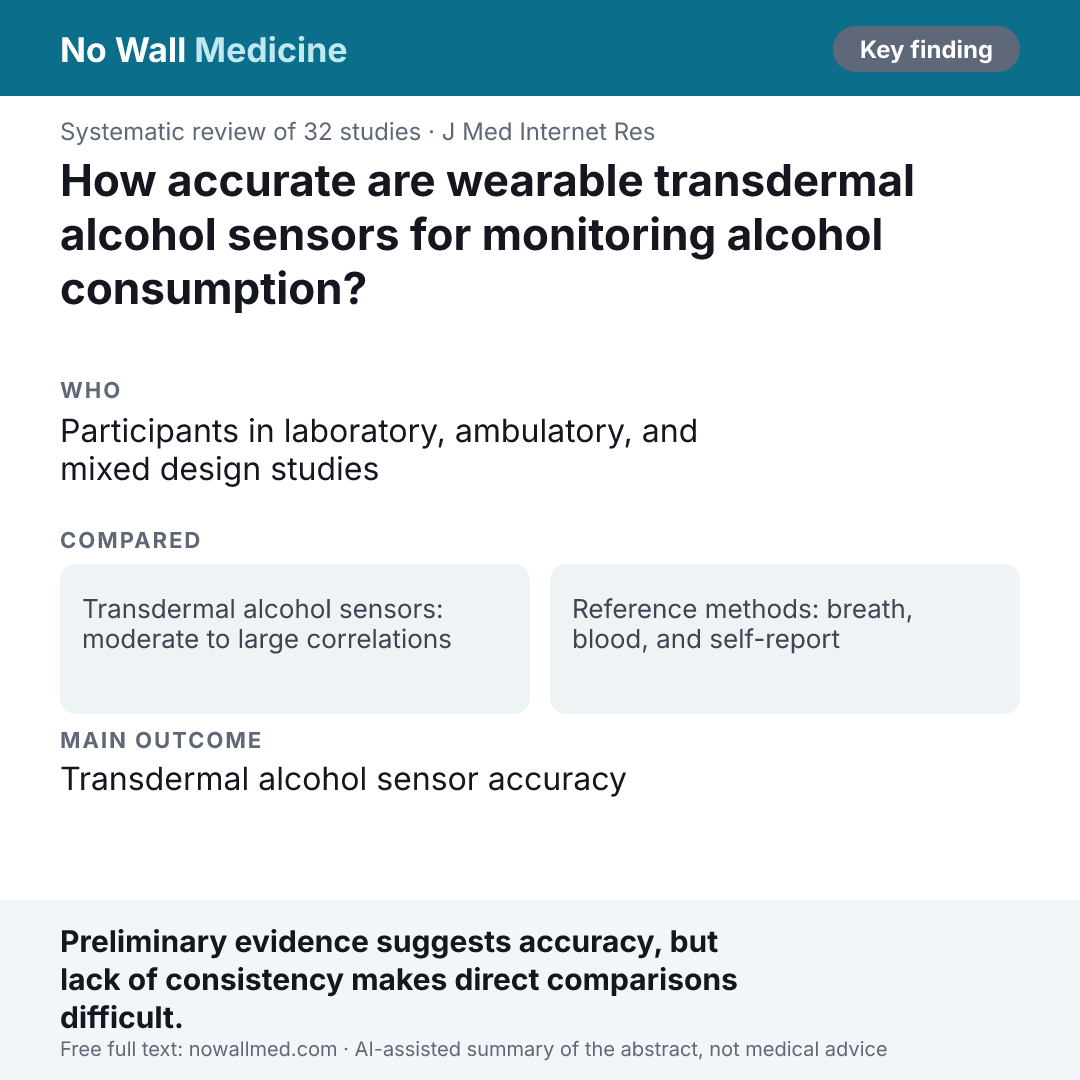
Clinical question: How accurate are wearable transdermal alcohol sensors for monitoring alcohol consumption?
Why it matters: The accuracy of wearable transdermal alcohol sensors for continuous monitoring remains uncertain due to inconsistent study procedures and a lack of research in clinical populations.
Key points
- Researchers analyzed 32 studies involving sample sizes ranging from 1 to 250 people to assess the accuracy of wearable skin-based alcohol sensors.
- WrisTAS sensitivity ranged from 24% to 85.6% and specificity ranged from 67.5% to 92.94%, while the BACtrack prototype had malfunctions reported at 16%-38%.
- The BACtrack prototype and WrisTAS reported a reduced time lag for peak alcohol concentration values compared to the SCRAM device.
Limitation the authors note: There is a lack of consistency in the studies regarding study procedures and analyses of findings, making direct comparisons difficult.
Headline and key points written with AI from the paper’s abstract, with every number checked against it. Read the paper before relying on them.
Was this summary helpful?
Subject terms
Headline, design, result, key points, caveat and citation as plain text.
Cite this article
Brobbin E, Deluca P, Hemrage S, Drummond C. Accuracy of Wearable Transdermal Alcohol Sensors: Systematic Review. J Med Internet Res. 2022;24(4):e35178. doi:10.2196/35178
Spotted a mistake? Suggest a correction