Acetaminophen did not increase days alive and free of organ support in sepsis patients
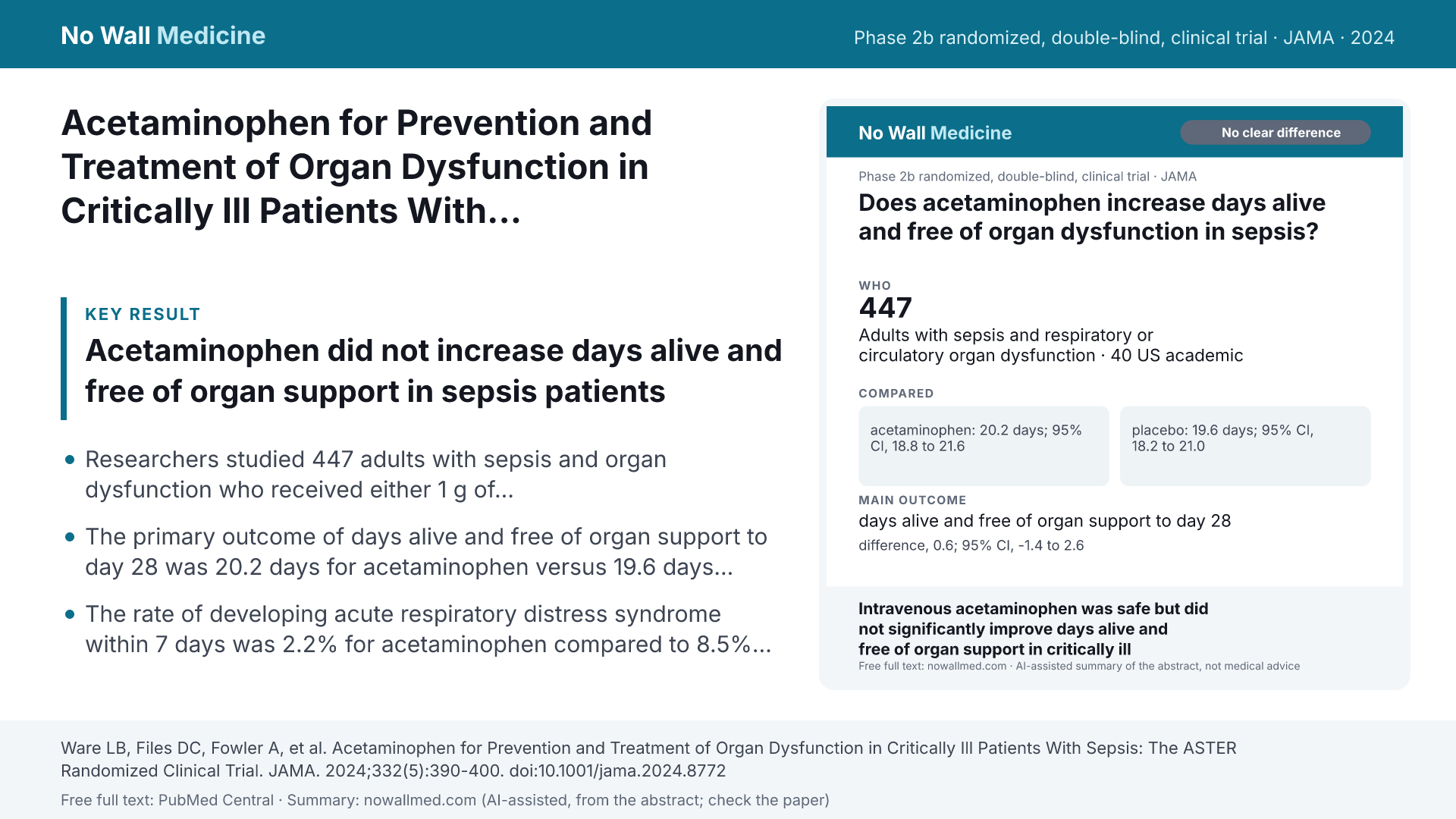
Acetaminophen for Prevention and Treatment of Organ Dysfunction in Critically Ill Patients With Sepsis: The ASTER Randomized Clinical Trial
Phase 2b randomized, double-blind, clinical trialNo clear difference
Does acetaminophen increase days alive and free of organ dysfunction in sepsis?
Who
447
Adults with sepsis and respiratory or circulatory organ dysfunction · 40 US academic hospitals
Compared
acetaminophen: 20.2 days; 95% CI, 18.8 to 21.6
placebo: 19.6 days; 95% CI, 18.2 to 21.0
Main outcome
days alive and free of organ support to day 28
Result: difference, 0.6; 95% CI, -1.4 to 2.6
Bottom line: Intravenous acetaminophen was safe but did not significantly improve days alive and free of organ support in critically ill sepsis patients.
JAMA · 2024-05-19 · Save PNG
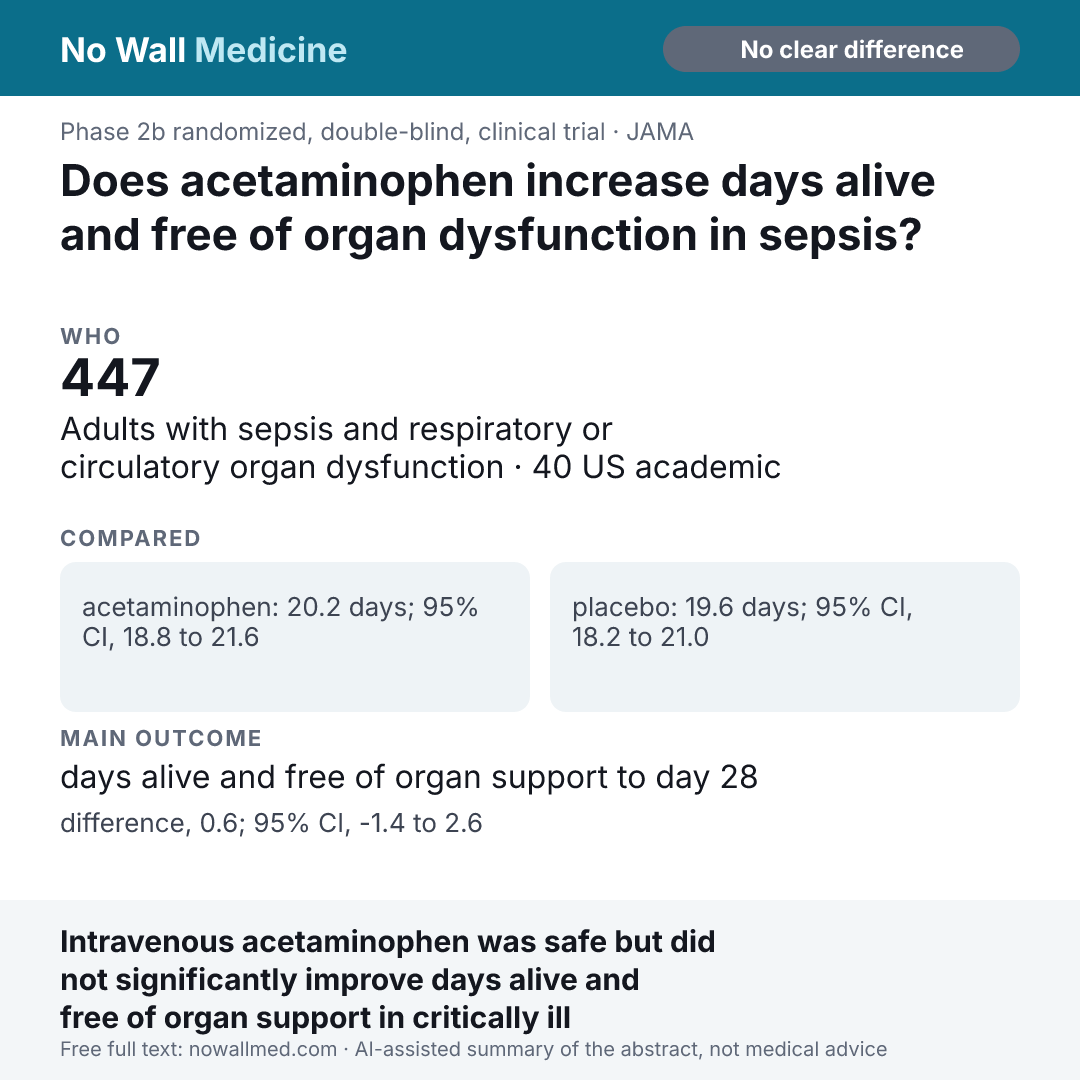
Clinical question: Does acetaminophen increase days alive and free of organ dysfunction in sepsis?
Key points
- Researchers studied 447 adults with sepsis and organ dysfunction who received either 1 g of intravenous acetaminophen every 6 hours or a placebo for 5 days.
- The primary outcome of days alive and free of organ support to day 28 was 20.2 days for acetaminophen versus 19.6 days for placebo.
- The rate of developing acute respiratory distress syndrome within 7 days was 2.2% for acetaminophen compared to 8.5% for placebo.
Headline and key points written with AI from the paper’s abstract, with every number checked against it. Read the paper before relying on them.
Was this summary helpful?
Subject terms
Headline, design, result, key points, caveat and citation as plain text.
Cite this article
Ware LB, Files DC, Fowler A, et al. Acetaminophen for Prevention and Treatment of Organ Dysfunction in Critically Ill Patients With Sepsis: The ASTER Randomized Clinical Trial. JAMA. 2024;332(5):390-400. doi:10.1001/jama.2024.8772
Spotted a mistake? Suggest a correction