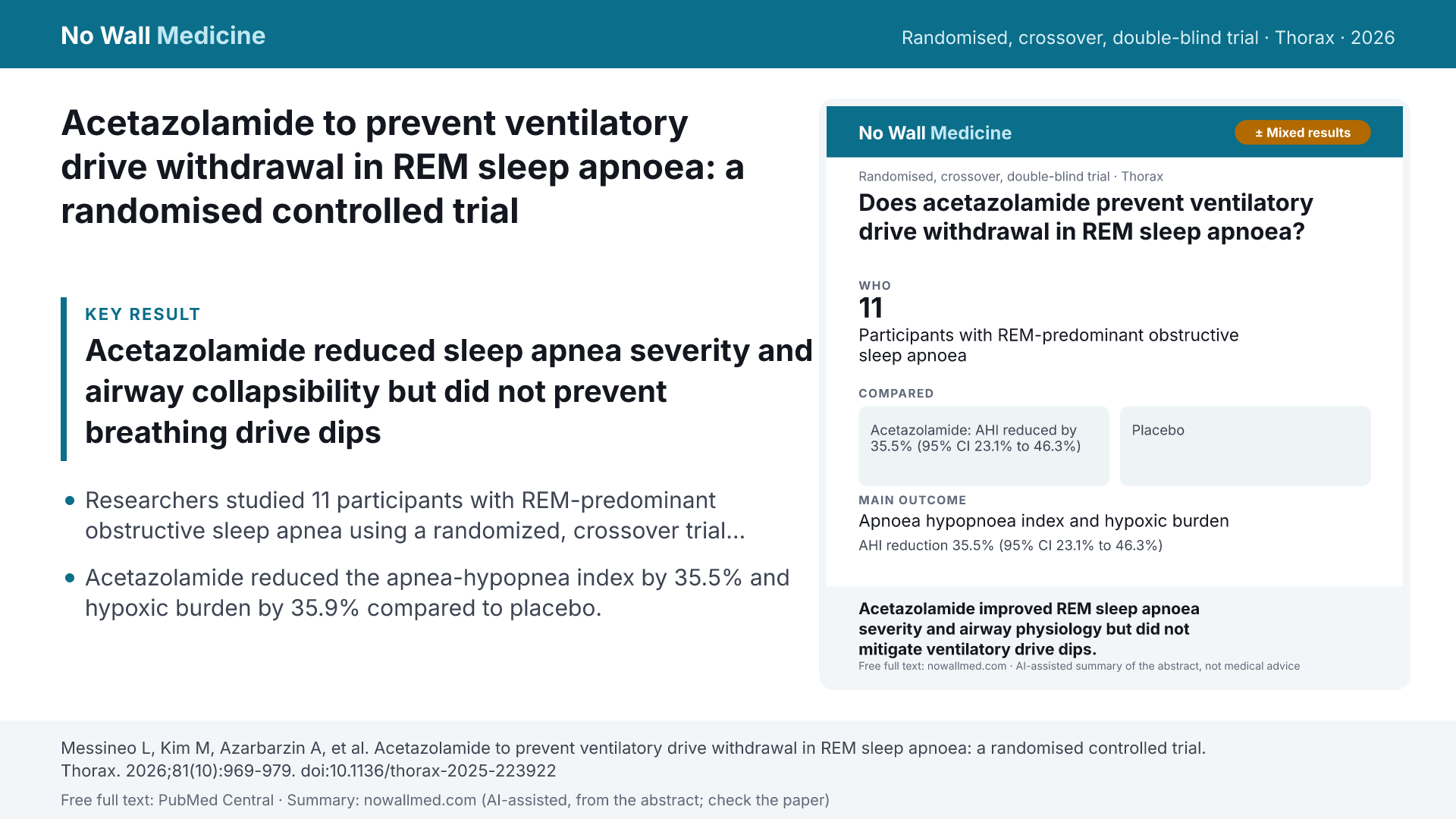
Acetazolamide reduced sleep apnea severity and airway collapsibility but did not prevent breathing drive dips
Acetazolamide to prevent ventilatory drive withdrawal in REM sleep apnoea: a randomised controlled trial
Randomised, crossover, double-blind trialMixed results
Does acetazolamide prevent ventilatory drive withdrawal in REM sleep apnoea?
Who
11
Participants with REM-predominant obstructive sleep apnoea
Compared
Acetazolamide: AHI reduced by 35.5% (95% CI 23.1% to 46.3%)
Placebo
Main outcome
Apnoea hypopnoea index and hypoxic burden
Result: AHI reduction 35.5% (95% CI 23.1% to 46.3%)
Bottom line: Acetazolamide improved REM sleep apnoea severity and airway physiology but did not mitigate ventilatory drive dips.
Thorax · 2026-09-15Download image
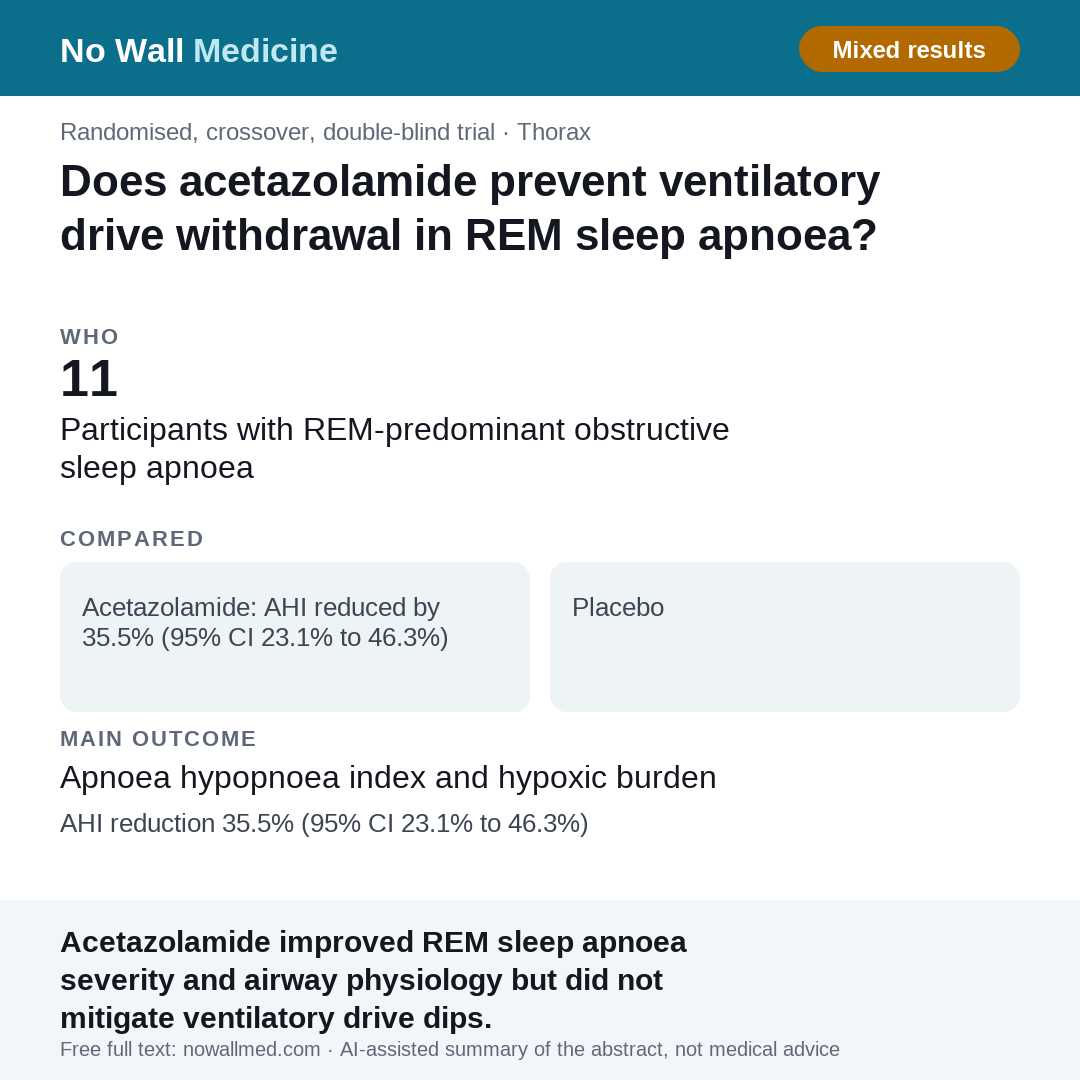
Clinical question: Does acetazolamide prevent ventilatory drive withdrawal in REM sleep apnoea?
Key points
- Researchers studied 11 participants with REM-predominant obstructive sleep apnea using a randomized, crossover trial of acetazolamide or a placebo.
- Acetazolamide reduced the apnea-hypopnea index by 35.5% and hypoxic burden by 35.9% compared to placebo.
- The medication increased muscle responsiveness and ventilation but did not mitigate dips in the ventilatory drive during REM sleep.
Headline and key points written with AI from the paper’s abstract, with every number checked against it. Read the paper before relying on them.
Was this summary helpful?
Subject terms
Headline, design, result, key points, caveat and citation as plain text.
Cite this article
Messineo L, Kim M, Azarbarzin A, et al. Acetazolamide to prevent ventilatory drive withdrawal in REM sleep apnoea: a randomised controlled trial. Thorax. 2026;81(10):969-979. doi:10.1136/thorax-2025-223922
Spotted a mistake? Suggest a correction